
The list of problems with the Question 4 campaign is long, and this postmortem examines the major issues in depth one by one.
Part 1 (released on October 17, 2025) analyzes the decision to run a policy out of touch with public opinion as indicated by polling, against the recommendations of the Dewey Square Group strategists hired by the campaign and the Massachusetts ACLU.
Part 2, initially released in installments as Part 2.1, Part 2.2, and Part 2.3 (on October 21, October 31, and November 6, 2025), analyzes the campaign’s costly handling of a polarizing psychedelics activist and underground practitioner.
Part 3 (released on November 8, 2025), analyzes the campaign’s decision to divert resources to a new nonprofit, co-founded by a close associate of Yes on 4’s campaign director, while polling behind.
Part 4 (released on November 17, 2025), analyzes the campaign’s decision to portray itself as led by a local female veteran who had suffered PTSD while the official campaign director was a non-veteran, white male, with no history of serious mental illness, operating from 3000 miles away in California and patient advocates were excluded from the strategy team.
Part 5 (released on December 7, 2025), analyzes how the campaign’s messaging exaggerated the risks of its proposal and capitulated to misleading ballot language—in contradiction to the campaign’s own polling and research.
Part 6 (released on December 26, 2025), analyzes a variety of the campaign’s shortcomings in the context of an organizational structure that discouraged accountability.
Part 7 (released on December 28, 2025), analyzes how the campaign possibly put its grassroots staff and nonprofit affiliates in legal jeopardy in the absence of conservative adherence to campaign finance law.
Part 8 (released on December 30, 2025), concludes the postmortem with an acknowledgement of unanswered questions, a description of what happened to ballot committee organizers after election day, and where the psychedelic healing movement should go from here.
WHY THE CAMPAIGN FELL SHORT
3. The Campaign Diverted Resources to a New Nonprofit While Polling Behind
While internal research showed the ballot measure polling behind and voters having difficulty “wrapping their head around” certain provisions, the campaign diverted substantial resources to creating Open Circle Alliance (OCA), a new 501(c)(3) nonprofit, while simultaneously underfunding critical voter persuasion—as demonstrated by the last-minute cancellation of approximately $800,000 to $1,000,000 in television advertising. Despite functionally receiving over $130,000 in contributions–over 86% of which constituted compensation for just two staff members, including Stefanie Jones, a longtime friend of Yes on 4 campaign director Jared Moffat—Open Circle Alliance shuttered shortly after the election without achieving federal tax-exempt status and having hosted only a tiny handful of events.
Executive Summary
Resource and Polling Shortcomings
The campaign cancelled over $800,000 in TV advertising in its final nine weeks.
Funds were insufficient to both persuade swing voters and mobilize the base.
Three of four polls before June 2024 showed the measure trailing, with voter resistance centered on the home cultivation provision.
Open Circle Alliance: A Costly Miscalculation
Yes on 4 campaign director Jared Moffat launched a brand-new 501(c)(3) nonprofit, Open Circle Alliance, less than seven months before election day.
Its three co-founders had no prior nonprofit founding experience and had no independent board.
All three had deep pre-existing campaign ties; co-founder Emily Oneschuk simultaneously served as the nonprofit’s treasurer and the campaign’s grassroots director.
Oneschuk’s substantial diversion to co-founding Open Circle Alliance contributed to the ballot question committee’s outreach team being understaffed.
Moffat actively fundraised for Open Circle Alliance in early 2024, effort that could have been directed toward the underfunded ballot question committee.
Coordination Disguised as Independence
Open Circle Alliance officers attended weekly campaign all-hands meetings organized by the ballot question committee.
Its events promoted the ballot measure and actively recruited campaign volunteers.
Open Circle Alliance’s email list was seeded with ballot question committee contacts transferred without volunteer consent.
Factsheets denied campaign ties while being written in close collaboration with ballot question committee staff.
In the final days before the election, Open Circle Alliance officers used the ballot question committee’s own phone-banking systems to contact voters.
No contributions between the ballot question committee and Open Circle Alliance were ever disclosed.
Open Circle Alliance as a Policy Influence Vehicle
Open Circle Alliance positioned itself as the primary gateway for community members seeking appointed positions on Massachusetts psychedelics regulatory bodies.
Co-founder Rebecca Slater maintained contact with the legislative director responsible for the HERO Act’s psychedelics working group, despite lacking relevant clinical, research, or policy expertise.
State Representative Mike Connolly sought Slater’s input on legislation and considered naming Open Circle Alliance in legislative text.
Co-founder Stefanie Jones’s policy recommendations would have increased the authority of individuals like herself while reducing the influence of racial equity experts and licensed healthcare workers.
Post-election, Open Circle Alliance pivoted toward promoting external partners’ initiatives—including MAPS and the Coalition for Psychedelic Safety and Education—in alignment with a national psychedelics philanthropy roadmap that named Open Circle Alliance as Massachusetts’s sole representative in a proposed national policy coalition.
Just three days after Open Circle Alliance’s post-election “Looking Forward” event, Yes on 4 chief strategist Tocci incorporated Open Circle Alliance officers into a private lobbying email thread alongside registered lobbyists and senior ballot question committee staff—sharing non-public intelligence regarding bill tracking.
Structural and Financial Failures
Over $120,000 flowed through Heroic Hearts Project—a veterans nonprofit—to Open Circle Alliance’s two non-veteran co-founders.
The organization reported only $5,487 in expenses in state filings despite functionally spending far more.
Open Circle Alliance never achieved federal tax-exempt status.
The organization held only two independently organized public events during the campaign.
It shut down in March 2026 after under two years and over $130,000 in funding, having delivered minimal public-facing output.
Spokesperson Exploitation
Oneschuk, the campaign’s most visible public figure and Open Circle Alliance’s sole veteran co-founder, publicly acknowledged ongoing mental health struggles and privately sought to resign multiple times.
Oneschuk’s physician explicitly urged her to stop using psilocybin, directly undermining the campaign’s narrative of her as a model of psychedelic healing.
Campaign leadership, particularly Moffat, was made aware of concerns about Oneschuk’s health and continued involvement but declined to act substantively.
3.1 An Uphill Battle
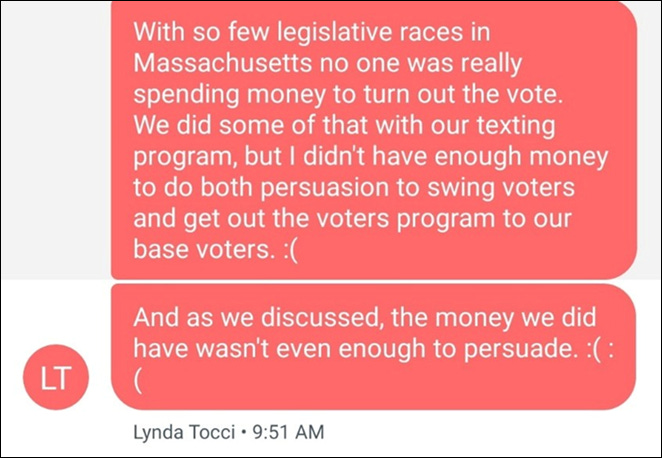
The Question 4 campaign struggled with resource management, as reflected most clearly in the ballot question committee’s cancelling of over $800,000 of previously reserved television advertising slots in the final nine weeks of the election (Lucid News reported a figure of over $500,000 in cancellations but—to my understanding from speaking with individuals familiar with details of Yes on 4’s advertising decisions—the true figure was at least over $800,000 and plausibly just over, or just under, $1,000,000). A month after the ballot measure had been defeated, Dewey Square Group principal and Yes on 4 chief strategist Lynda Tocci opined in an internal group chat that the campaign had been under-resourced, texting: “I didn’t have enough money to do both persuasion to swing voters and get out the voters program to our base voters. :( And as we discussed, the money we did have wasn’t even enough to persuade. :( :(.”
During the election, strategic leadership (including Tocci) stressed the importance of careful utilization of scarce resources to Jamie Morey and me. For example, New Approach deputy policy director and Yes on 4 campaign director Jared Moffat claimed to Morey in a June 2024 email exchange—which regarded Morey’s plans for outreach events in accordance with her community engagement director role—that he “[didn’t] know what the overall events/outreach budget [would] be” for the ballot question committee and that, while there was “flexibility” in budgeting, the campaign needed to be “judicious” with spending. In the same email thread, he floated a “$20k-$25k budget” for an “overall events/outreach budget,” excluding the cost of related ballot question committee staff time. However, to my understanding, the ballot question committee ultimately allocated considerably less than $10,000 to public community outreach events, excluding staff costs. This constraint was markedly demonstrated by Moffat’s rejection of a proposal for an approximately $1,800 summer event at a popular venue in the Boston suburbs as too expensive. Morey, who had a professional background in market research, wanted to engage suburban voters—an important demographic that ended up decisively rejecting Question 4—but she was hamstrung by a lack of organizational support from the campaign.
Of course, close scrutiny of spending decisions was warranted—the cost savings from avoiding the $1,800 event were less than 1% of the over $800,000 shortfall that kept Yes on 4’s advertisements off the air. Efficient budgeting was especially important given the campaign’s precarious polling position—prior to June 2024, the final version of the ballot measure had polled behind in three of the four representative surveys held:
The initial September 2023 internal poll of the ballot measure with home cultivation, showing 42% total support and 53% total opposition.
The second September 2023 internal poll of the ballot measure with home cultivation (this poll included “expanded explanations of the proposed reforms”), showing 55% total support and 40% total opposition.
An October 2023 independent poll of the ballot measure (after the decision to include home cultivation was finalized) showing 41% total support and 46% total opposition.
A May 2024 independent poll of the ballot measure showing 40% total support and 41% total opposition.
As far back as September 2023, Moffat had publicly acknowledged the political vulnerability of the campaign due to the initiative’s provisions for growing psychedelics at home. In an interview with Marijuana Moment, Moffat had said survey research showed voters struggled in “wrapping their head around” the inclusion of home cultivation, and he had even said a “good shot” at victory for the ballot measure was conditional on the campaign “[doing] our job in explaining what the ballot initiative is all about and what it does and we’re clear in our communication.” These comments suggested strategic leadership thought winning depended on a substantial public education effort to increase the electorate’s comfort with expansive decriminalization. But instead of concentrating on developing the ballot question committee’s internal capacity for the purpose—or partnering substantially for public education exclusively with organizations with proven track records like Heroic Hearts Project (HPP) and Students for Sensible Drug Policy (SSDP)—the campaign diverted resources to a new public education nonprofit: Open Circle Alliance, formally incorporated less than seven months before election day.
3.2 An Experimental Inauguration
As claimed to me by Jared Moffat on a February 21, 2024, phone call and an in-person meeting on March 23, 2024, the idea for a new public education nonprofit was his. He said his intention was to establish a replicable political strategy, in which a ballot measure campaign and an independent, but complementary, 501(c)(3) nonprofit would co-launch in support of psychedelics policy in a specific state—in this case, Massachusetts. According to Moffat, the model would address three critical concerns:
Public education related to psychedelics, necessary to generate strong support for impactful, evidence-based policy, including the ballot measure.
Steering psychedelics policymaking, responsive to grassroots supporters, after a (presumed) election day triumph by the ballot measure and subsequent dissolution of the campaign.
Unifying key stakeholders, particularly grassroots supporters, to promote a healthy psychedelics-oriented local community and to facilitate effective political and educational mobilization.
Moffat’s theory was that by the nonprofit prioritizing community-building and public education rather than electioneering—in line with the restrictions of its 501(c)(3) status—and the campaign prioritizing electoral success, the twin goals of laying the groundwork for long-term reform and running an effective, short-term political operation could be achieved better by two independent organizations (the nonprofit and the campaign) than by one (the campaign) overextending itself. He told me that his original goal was for Bay Staters for Natural Medicine to be the complementary nonprofit in Massachusetts, but—as a consequence of Bay Staters for Natural Medicine’s emergent hostility after receiving a $35,000 donation from the campaign—he had pivoted to spinning up a new organization whole cloth, in collaboration with major donors and New Approach, to fill the role. Moreover, he pitched me on working for the nonprofit instead of for the campaign—emphasizing the nonprofit’s potential to continue indefinitely—but I chose to work for the ballot question committee because I thought that was where I could contribute the most as an advocate.
The explanations Moffat provided me in February and March 2024 about the new nonprofit—which was named Open Circle Alliance a few weeks later—were partially corroborated later by Open Circle Alliance co-founder Stefanie Jones. When asked about the origin of the nonprofit during a recorded panel discussion in December 2024, Jones explained that her fellow panelist, Moffat—whom Jones had described earlier in the conversation as one of her “longtime friends and colleagues”—had convinced her to assist the Massachusetts Question 4 campaign in 2023, eventually leading to the creation of Open Circle Alliance. This assistance began at the campaign’s inception: at Moffat’s invitation, Jones was one of just 16 signers of a mandatory initial filing for the ballot measure. While the signatures of 10 registered Massachusetts voters were legally required for the document, more were submitted in case any were disqualified during the certification process. Jones—whose verbatim remarks are provided below—went on to speak at length about what happened after she contributed to the filing:
I honestly thought that maybe that would be the end of it, and I would be, like, watching from the wings, and helping, you know, as I could, um, in Massachusetts as it advanced and, and became like a actual ballot question. Um, but come early 2024, Jared [Moffat] and I had another conversation. And we were just, you know, talking about the progress, how it was going. And we were talking a little bit about the community in Massachusetts and, um, what that landscape looked like. And Jared [Moffat] was mentioning some of the groups that were on the ground, um, uh, that he was working with at the time. And, you know, very strong groups like with, like, a long history of working in Massachusetts but, like, also kind of like, isolated, like they worked with specific aspects of the psychedelic community and there was not much overlap. There was not much, like, unity between, like, overlapping but disparate groups.
And again, given my background with Drug Policy Alliance and, um, particularly putting together the Reform Conference, which the whole goal is to bring together all of these disparate people who might be working on marijuana policy, might be working on harm reduction, and might be working on criminal justice reform, but you have to like, sort of, unite people around this, like, broader idea and this, you know, have a way to build support, right?
And so that was the kind of way the conversation, like, went with Jared [Moffat], where I was like, uh, you know, we were just identifying the fact that there were these strong, uh, components of psychedelic support within Massachusetts, but a little bit isolated and a little bit, like, um, diffuse. And so I felt like there was a need and an opportunity there to bring this community together, like especially from the different aspects. And, like, I, I kind of felt uniquely in some ways suited to do that because, you know, I’ve seen this, you know, like, from the medical, from the therapeutic, from the ritual, or from the, like, you know, sacred, um, practice, kind of, and then my own background, which is, like, recreational and personal use, and like.
So just seeing all of those things, um, it really felt, like, something valuable that I could bring to, to the environment was, like, how can we bring all of these different areas of the psychedelic community together? And, more importantly, how can we make sure that they stay connected to broader drug policy, to, like, other movements for, like, health, healing, and justice?
And so that was really the motivation for the founding of what became Open Circle Alliance. Um, Jared [Moffat] put me in touch with two other amazing women. Uh, I have to say I was reluctant, but he, I was put in touch with two other amazing women in Massachusetts with different backgrounds, a little bit more connected to the healing, um, practices, a little bit more connected to the veterans community. And together we formed, uh, Open Circle Alliance.
And so the objective really was to, like, to help bring the psychedelics community in Massachusetts together. And that was objective number one. Objective number two, which is near and dear to my heart, is, was all about education. And so that is about, like, psychedelics itself, but especially in this moment of the ballot question coming around, it’s like to also educate about the ballot question. Like, and again, this is really speaks to my background in a drug policy organization, like, you, you know, not only have to, like, teach people what are drugs, what are their effects, you know, how do you stay safe, all this, but you have to also teach them, like, all of this basic policy education, right? Like, how do you evaluate, like, what is a stronger, uh, option and what is a weaker option, or what you prefer in your community?
So doing that, kind of like, basic education is also really important. And it felt really important, too, because of the question that we put together, like, had multiple components, right? Like, it was, it was not a simple piece of legislation. Um, so it was really important that the folks in Massachusetts understand each of those pieces, and, um, that way they’re more informed voters, and were more likely to get to yes, and not get, like, hung up on any one of those, those things.
And so, um, I, maybe I’ll say a little bit more about it later, but, like, that was primarily the role. And I would say, like, you know, I’m always jazzed by these things, but definitely the idea of the ballot question coming this year in 2024 was, like, a little bit of a inciting incident to, like, push, you know, push, uh, into formation when it, you know, we might have paused or we might’ve thought a little bit more. We were like, ‘Wow, this thing is coming, it’s a huge opportunity, like, you know, kind of like [panel moderator interjects: “Let’s meet it”], yeah, let’s, let’s get in there, let’s do it.’
So we jumped in and, um, founded Open Circle Alliance. And in our eight months of life, like, I’m, I’m very proud of what we accomplished in terms of, like, helping develop and bring together the community, and putting on some amazing events, and beginning that process of, like, education for folks here in, in the state.
In Jones’s explanation—told in sight of, and uncorrected by, Moffat on the panel—Open Circle Alliance’s establishment in early 2024 was a direct product of the ballot measure campaign and Moffat’s intervention. According to Jones, Moffat informed her of the initiative and persuaded her to provide her signature as a registered Massachusetts voter for a key filing in summer 2023—Jones’s later characterization of the ballot question as “the question that we put together” (emphasis in italics mine) suggests she may have consulted on the policy details as well. Jones further shared that in a “conversation” about “how it [(the ballot question effort)] was going” at the beginning of the subsequent year, Moffat raised a concern to her about divisions in “the community”—simultaneous with the escalating deterioration of the campaign’s relationship with Bay Staters for Natural Medicine. As an aside, Jones’s recollection of “very strong groups” comprising “the psychedelics community in Massachusetts,” which Moffat “was working with at the time,” undercut Moffat’s retrospective justification of the campaign’s $35,000 contribution to Bay Staters for Natural Medicine (namely, that Bay Staters for Natural Medicine was “the only grassroots organization operating around psychedelics in MA at the time”).
Jones claimed that, after Moffat’s and her discourse “[identified] the fact” of “strong components of psychedelic support” that were “a little bit isolated” and “diffuse,” she “felt uniquely in some ways suited” to “bring[ing] this community together.” And Jones went on to say that, after her conversation with Moffat: “Jared [Moffat] put me in touch with two other amazing women. Uh, I have to say I was reluctant, but he, I was put in touch with two other amazing women in Massachusetts with different backgrounds […] and together we formed, uh, Open Circle Alliance.” Jones’s repetition of the detail that she was “put in touch with” her co-founders by Moffat and her expressing that she “[had] to say I was reluctant,” corroborated Moffat’s claim to me that he had a driving role in Open Circle Alliance’s creation.
Jones’s statements about the purpose of the nonprofit once established also aligned with Moffat’s account. Jones disclosed two founding objectives for Open Circle Alliance—“to help bring the psychedelics community in Massachusetts together[, which was] objective number one” and “objective number two, which [was] near and dear to [her] heart, [was], was all about education”—and she explicitly tied both of them to the campaign. Jones “felt like there was a need and an opportunity there to bring [the local psychedelics] community together” in a conversation with Moffat about the ballot question effort, in which Moffat informed Jones of disunity among “the groups that were on the ground, um, uh, that he was working with at the time” (emphasis in italics mine). This meant “objective number one”—“to help bring the psychedelics community in Massachusetts together”—was helping to unify specifically “the groups” that Moffat had been “working with” for the campaign. With regards to “objective number two”—educating the public—Jones elaborated that “it felt really important” because of the complexity of the ballot question and that the education provided by Open Circle Alliance meant voters “were more likely to get to yes [(answer “yes” to the ballot question/vote in favor of the initiative)].” In addition, Jones made clear the nonprofit’s focus on the initiative was not incidental, stating “the idea of the ballot question coming this year in 2024 was, like, a little bit of a inciting incident to, like, push, you know, push, uh, into formation when it, you know, we might have paused or we might’ve thought a little bit more.” Moreover, in describing the motivation of her and others for launching Open Circle Alliance, Jones said “[they] were like, ‘Wow, this thing [(the ballot question)] is coming, it’s a huge opportunity, […] let’s get in there, let’s do it.’” In Jones’s telling, Open Circle Alliance was intentionally formed when it was, in close collaboration with high-ranking campaign officials—New Approach deputy policy director, and eventual Yes on 4 campaign director, Moffat and grassroots campaign director Emily Oneschuk (one of the “two other amazing women” introduced to Jones by Moffat)—to meet the “huge opportunity” of the ballot measure.
While Jones did not discuss financing or New Approach in her answer for the panel discussion, a few months later, in March 2025, she explicitly acknowledged that “the idea and funding for a community org [(what became Open Circle Alliance)] originated in collaboration with New Approach” in an email to multiple grassroots advocates. Where Jones’s account most prominently diverged from Moffat’s was in elevating Jones’s role—Moffat had not told me that Jones had played a role in generating the idea for the new organization. Rather, Moffat had characterized the complementary nonprofit strategy as his brainchild and a solution to a problem he had identified in other states: insufficient political and social infrastructure to steward ongoing drug policy reform after successful ballot measures. The examples of the problem Moffat had shared with me were particularly relevant to the Question 4 campaign—he had cited the experiences of Colorado and Oregon in the wake of their successful, New Approach-backed psychedelics ballot measures in 2022 and 2020, respectively.
Notably, Moffat’s earliest mention of Jones to me framed her as a potential ballot question committee hire rather than as an upcoming nonprofit co-founder. In response to me telling Moffat over the phone that Oneschuk had given me the impression the ballot question committee had hired a second “campaign director” to handle the nuts and bolts of the operation, Moffat texted a follow-up: “Long story short we have not hired a new campaign director. Emily [Oneschuk] was probably thinking of Stefanie [Jones] but she hasn’t been hired and would not be overseeing the whole campaign.”
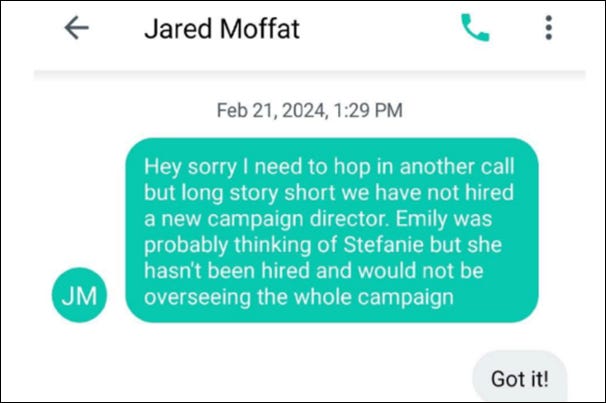
Moffat’s choice of words in characterizing Jones’s role were she to be hired—“not overseeing the whole campaign” (emphasis in italics mine)—and his assumption that Jones could be mistaken for “a new campaign director,” indicated Jones was being considered for a leadership (oversight) role for the “campaign” specifically, not for an independent corporate entity.
Nevertheless, Moffat’s and Jones’s stories unambiguously agreed that two director-level campaign staff members—Moffat, whose time was formally disclosed as an in-kind contribution to the ballot question committee from New Approach, and Oneschuk, who was on the ballot question committee’s payroll—had actively participated in creating a new nonprofit while the ballot measure effort was well underway. What Moffat and Jones did not highlight was that this detour from focusing on the ballot question committee began amidst the campaign’s proposal having received only marginal support in representative surveys.
My initial positive reaction to Moffat’s proposal in February 2024 was in the context of my ignorance of the relevant polling data—and the warnings from the campaign’s Dewey Square Group consultants and others—indicating the ballot question was in very serious jeopardy of failing. In light of the true circumstances of the campaign, diverting resources from the ballot question committee to an unproven, at least theoretically independent nonprofit—even one supportive of the campaign’s mission—was extremely risky at best.
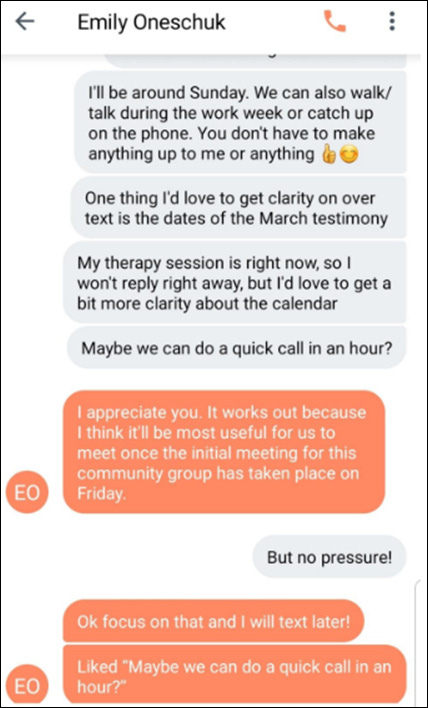
And this inherent risk was amplified by the rushed, ad hoc nature of Open Circle Alliance’s formation. The individuals slated to be the nonprofit’s three founding officers—Jones, Oneschuk, and Rebecca Slater—held their first in-person meeting on March 15, 2024, referred to by Oneschuk in a text message to me as “the initial meeting for this community group.”
While Oneschuk had known Slater since 2022, stemming from their mutual participation in the Boston Psychedelic Research Group (BPRG)—a local psychedelics advocacy group—the two had not been personally close (Oneschuk did not describe Slater as a “friend” when discussing the formation of the nonprofit with me in early March 2024), nor had they ever been work colleagues. And Oneschuk had been introduced to Jones for the first time in 2024—via Moffat—specifically to facilitate Jones’s heightening involvement in Massachusetts psychedelics policy. Furthermore, neither Jones, Oneschuk, nor Slater had been involved in founding a nonprofit before or possessed an advanced degree.
Of the three women, Jones had the most relevant professional experience. She had held multiple director-level roles for 501(c)(3) nonprofits over the course of her 19-year career related to drug policy. For the nonprofit Drug Policy Alliance (DPA)—one of the largest drug policy reform organizations in the United States—Jones had served as Director of Audience Development for over four years and Interim Managing Director, Communications for nearly two years. Concluding as recently as September 2023, Jones had served for nine months as Director of Outreach for the nonprofit Fireside Project—an organization dedicated to providing supportive resources to individuals using psychedelics to increase safety. But these leadership positions were all for established organizations and were not equivalent to launching an ambitious, multi-officer, corporate entity such as Open Circle Alliance.
As for Oneschuk and Slater, they had little to no professional experience in drug policy reform, let alone nonprofit management, prior to the ballot measure campaign. Slater had spent most of the last two decades working for Lockheed Martin—one of the world’s largest military weapons manufacturers and a publicly-traded for-profit—exclusively in operations roles. She had also, starting in 2022, become an advocate for veterans’ access to psychedelic therapy, possibly including—in addition to volunteer work—part-time employment as an independent contractor for one or more of the following organizations: the Boston Psychedelic Research Group, Heroic Hearts Project, and New Approach. Although not a veteran herself, Slater had co-founded a community support group for veterans and their families affiliated with the Boston Psychedelic Research Group, which was eventually attended by Oneschuk due to her interest in psychedelic therapy. In the first half of 2023, Slater had personally invited Moffat of New Approach to pitch the upcoming ballot measure campaign to the support group, and Slater had subsequently encouraged the campaign to recruit Oneschuk—directly contributing to Oneschuk’s hiring.
In addition, by fall 2023 at the latest, Slater had begun serving as a campaign organizer herself, albeit not one employed by the ballot question committee. While attending the third annual “Soulquinox” conference organized by the Psychedelic Society of Vermont in September 2023, Slater had characterized herself to attendees in informal conversations as a campaign surrogate. Moreover, she had subsequently unilaterally added the emails of attendees with whom she had become acquainted to a campaign email distribution list, which she had disclosed to the individuals in question after the fact in a group message. In that email from Slater—with the subject line: “Soulquinox: Follow-Up: 2024 Ballot Initiative”—she had again characterized herself as a campaign surrogate, encouraging recipients to “[help] us gather signatures for our petition” and to “reach out to us [(Slater and Moffat)]” to get involved (emphasis in italics mine):
I am writing in follow-up to our discussions on the 2024 MA Ballot Initiative for Plant Medicine. So that you are included in campaign news and event invitations, I have shared your emails with Jared Moffat, one of the campaign organizers with New Approach. If at any time you wish to be removed from this distribution, please let him know (cc me, so I can follow up as well) […] If you are interested in helping us gather signatures for our petition, email Jared at he’ll get you started with a packet and some training. […]
The first in-person coalition kickoff will be 10/12 from 7-8:30 at the Marriott in Newton, MA, 2345 Commonwealth Ave, Newton, MA 024. You should be receiving an invitation from Jared (if you haven’t already). If you cannot make it, there will be future coalition meetings in-person & via Zoom
Please pass information on to those in your network who might benefit and have them reach out to us if they would also like to get involved.
Thank you again for reaching out to me at the event!
With gratitude,
Rebecca Slater
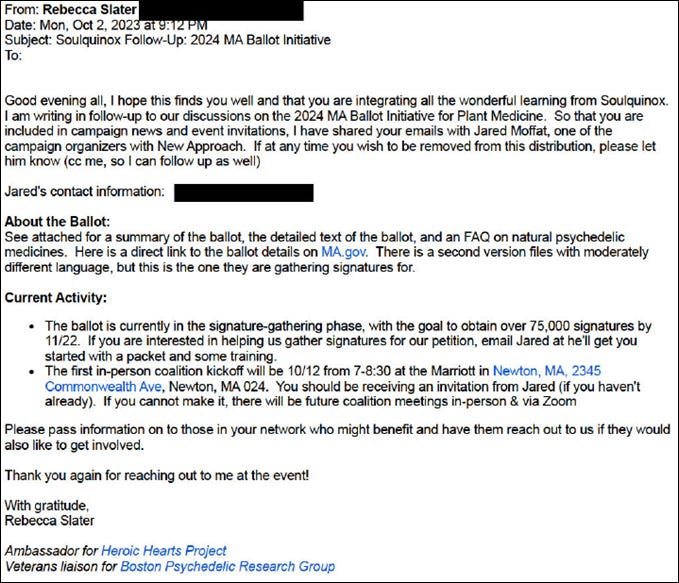
By issuing an invitation to help gather the tens of thousands of signatures necessary for the initiative to get on the ballot and to join “the first in-person coalition kickoff” in support of the ballot question—and advertising herself as an active facilitator of this involvement—in the email, Slater was explicitly organizing on behalf of the ballot question committee. However, neither this organizing—nor any other advocacy work of Slater’s, to my knowledge—constituted drug policy experience anywhere close to that of Jones’s, let alone demonstrated Slater could launch a successful nonprofit at breakneck speed.
Oneschuk was considerably younger, and had significantly less work history, than Slater. Oneschuk’s professional life predominantly consisted of her military service, and the ballot question committee was the first employer to hire her for a full-time role since she left the United States Navy (USN or the Navy). Immediately after graduating from college in 2017, Oneschuk had served in the Navy for more than four years, primarily in explosive ordnance disposal. During this time, she had held junior officer leadership positions, including as a platoon commander and—for a three-month stint—an operations director for a refugee camp in Spain. After being honorably discharged from the military in 2022 as a conscientious objector, Oneschuk had paused her professional life to return home to Massachusetts and focus on improving her health, leading her to use psychedelic therapy to treat her diagnosed PTSD. Not only was Oneschuk’s Navy leadership not especially applicable to the unique demands of co-founding a new nonprofit, but—having only recently entered her first major non-military work role—she was still acclimating to the civilian professional environment in general.
Increasing the potential for mismanagement, the deficits in relevant experience among the three founding officers were not mitigated by the oversight of qualified board members. According to the organization’s public filings, Open Circle Alliance never had an independent board—the nonprofit’s board of directors always consisted exclusively of its own officers.
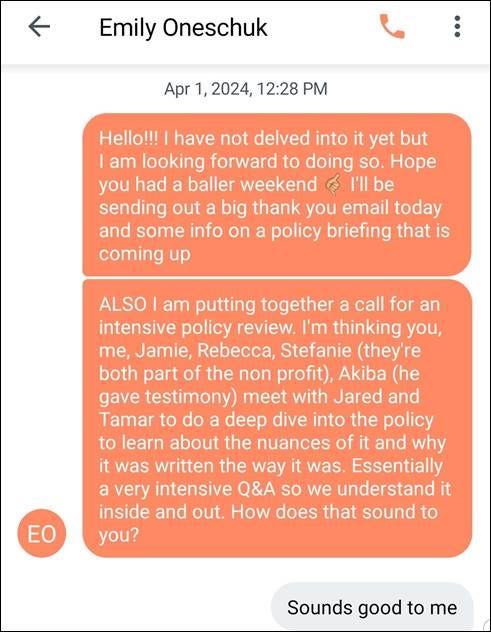
The absence of independent board supervision was consistent with the organization’s overall lack of foundational clarity; its public-facing mission remained unsettled until the eve of its legal formation. As told to me contemporaneously by Oneschuk—with whom I was in close contact at the time—key components of the nonprofit’s identity were finalized only a few weeks before its incorporation as a public charity on April 19, 2024. Illustrating the point, when Oneschuk texted me on April 1, 2024, about a proposed policy review, she referred to the nascent organization as simply “the non profit” because its name had not been chosen. Even the brand identity was still a matter of discussion at the time.
Weighing in, I urged Oneschuk to advocate for a social justice and therapeutic use-focused group—a civil rights organization dedicated to advocating for medical patients using psychedelics—and I floated “Legalize Healing” as a bumper-sticker-ready name and slogan. After behind-the-scenes discussions that did not include me—the details of which I am not privy to—the nonprofit ultimately went in a very different direction. The name “Open Circle Alliance,” according to Oneschuk, stemmed from the organization’s aspiration at launch to be a facilitator organization rather than a standard-bearing one within the local psychedelics community.
Reflecting the foundation roles of the ballot measure campaign and Moffat in the nonprofit’s origin, on April 10, 2024—less than two weeks before Open Circle Alliance was officially incorporated—I emailed a detailed suggestion for the new nonprofit to Oneschuk, at her ballot question committee email address, and to Moffat, at his New Approach email address. Since the nonprofit’s name had not yet been shared with me, I floated “a scientific advisory board or boards” for “the new nonprofit” as a way to “engage scientists like [redacted] without forcing them to become public advocates” and as a tool to “reward and incentivize experts embracing legalization [of psychedelics]”—benefiting the ballot measure campaign.
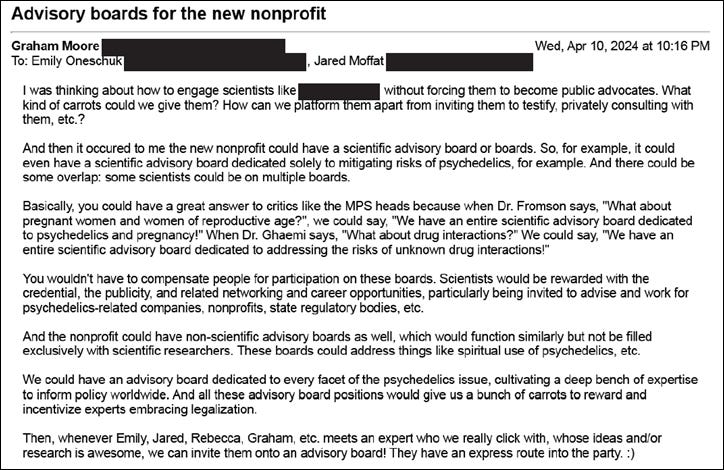
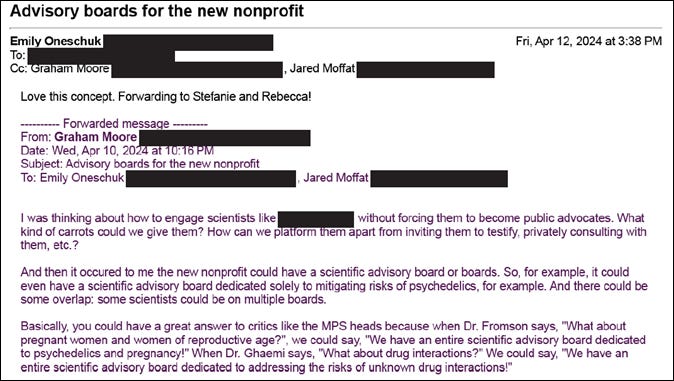
I concluded my email by invoking a presumptive collaborative relationship of Moffat with Open Circle Alliance: “Then, whenever Emily [Oneschuk], Jared [Moffat], Rebecca [Slater], Graham [Moore], etc. meets an expert who we really click with, whose ideas and/or research is awesome, we can invite them onto an advisory board! They have an express route into the party. :)” Oneschuk enthusiastically replied to my suggestion over email two days later, writing from her ballot question committee email address: “Love this concept. Forwarding to Stefanie [Jones] and Rebecca [Slater]!” Her message was addressed primarily to an Open Circle Alliance email address for “staff” and carbon copied me and Moffat (using Moffat’s New Approach email address). Despite the initial positive reception to the idea, however, Open Circle Alliance never implemented an advisory board.
3.3 An Unofficial Extension
The three founding officers—and sole board members—of Open Circle Alliance, were all closely affiliated with the Question 4 campaign. As previously described: Stefanie Jones was one of just 16 signatories of a requisite campaign filing and counted campaign official Jared Moffat as one of her “longtime friends and colleagues,” Emily Oneschuk was a prominent campaign official employed by the ballot question committee, and Rebecca Slater had served as a campaign surrogate and organizer, and actively facilitated Oneschuk’s hiring by the campaign, in 2023.
Furthermore, months after Oneschuk became a publicly-identified campaign official, Slater testified alongside Oneschuk and local police officer Sarko Gergerian—a campaign surrogate and signatory of the campaign filing Jones participated in—on panels for two state legislative hearings in support of psychedelics-related legislation. The first of these hearings occurred on January 23, 2024, and regarded An Act Honoring, Empowering, and Recognizing Our Servicemembers and Veterans (better known as the HERO Act)—which would establish research on psychedelic therapy for veterans. Although the panel addressing the HERO Act was at least nominally organized on behalf of the Boston Psychedelic Research Group (BPRG), a campaign consultant—Dewey Square Group associate Aayush Bajpai—later framed Oneschuk’s and Slater’s activity as an extension of the ballot question committee’s “[support]” for the legislation, writing in an August 2024 email to Oneschuk, Slater, and Yes on 4 community outreach director Jamie Morey:
We’ve gotten the word that there will be a signing ceremony for the HERO act this Thursday at 1pm. We’ve been asked not to spread the word about it yet as they are sorting out details, but since MA for Mental Health [(the ballot question committee)] has supported the bill before, shout out Emily [Oneschuk] and Rebecca [Slater], I wanted to let you all know to see if you’d be interested in attending.
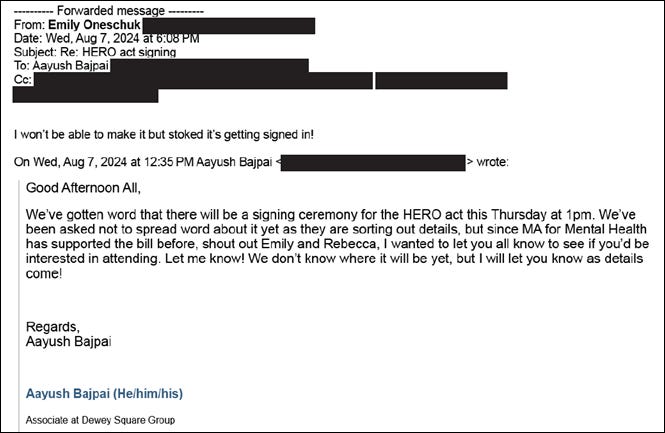
Even though Bajpai had addressed the email to Oneschuk, Slater, and Morey—presumably in recognition of their shared emotional investment in veterans issues and support for the HERO Act—he only credited Oneschuk and Slater—who had participated on the “Boston Psychedelic Research Group” panel, unlike Morey—in relation to the ballot question committee “[having] supported the bill before.” Moreover, neither Slater nor Oneschuk objected to the “shout out,” and Oneschuk replied to say she “[wouldn’t] be able to make [the bill signing].”
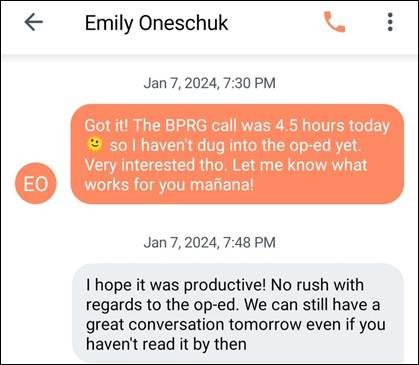
And Bajpai’s characterization of Oneschuk’s and Slater’s advocacy for the HERO Act as coordinated with the campaign appeared to be corroborated by the content and contemporaneous context of the panel’s testimony. The panel was comprised exclusively of Gergerian, Oneschuk, and Slater—all individuals linked to the campaign—and debuted in the wake of a closed-door, “4.5[-]hour[]” virtual meeting the campaign held with the Boston Psychedelic Research Group on January 7, 2024, as documented in a text message to me from Oneschuk.
As a panelist at the January 2024 hearing, Oneschuk introduced herself as “currently the grassroots campaign director for Massachusetts for Mental Health Options [(the ballot question committee)].” Unlike her co-panelist Gergerian—who included a pointed clarification at the start of his testimony, “please note that these opinions are my own”—Oneschuk did not specify whether she was speaking as a campaign representative or in a personal capacity, effectively inviting the presumption that she was testifying in her official role as grassroots campaign director. Slater, too, did not specify in her testimony whether she was speaking in a professional or personal capacity—especially notable considering her employment by a government contractor (Lockheed Martin). While Slater did not mention her “defense contractor” employer by name, she did share that she “lead a veteran support community within the Boston Psychedelic Research Group” and was “a Heroic Hearts [Project] ambassador,” inviting the presumption she was speaking on behalf of the two named, psychedelics-focused organizations. Conspicuously for a panel organized under the heading of the Boston Psychedelic Research Group, Slater was the only one of the three panelists to bring up the organization. Neither Oneschuk nor Gergerian mentioned the Boston Psychedelic Research Group even once in their testimonies, and Oneschuk’s remarks mostly consisted of her recounting her personal experience with psychedelic therapy. Furthermore, campaign talking points were woven throughout the testimonies of all three panelists, as exemplified by Slater’s self-introduction:
My name is Rebecca Slater. I have worked as a defense contractor for over 20 years. Additionally, I support and advocate for therapy, for psychedelic therapy for veterans. There is a stat that nearly 22 veterans commit suicide every day. Take into account the story we heard today and the peripheral effects of substance abuse disorder, and it’s why here nearly double. For this reason, I lead a veteran support community within the Boston Psychedelic Research Group, which is an educational nonprofit community that includes some of the top researchers from MGH, from Johns Hopkins, and others that are dedicated to bringing these therapies safely into our medical and mental health systems. I’m also a Heroic Hearts ambassador, which is a nonprofit dedicated saving veterans lives by taking them out of this country to South America to do ayahuasca.
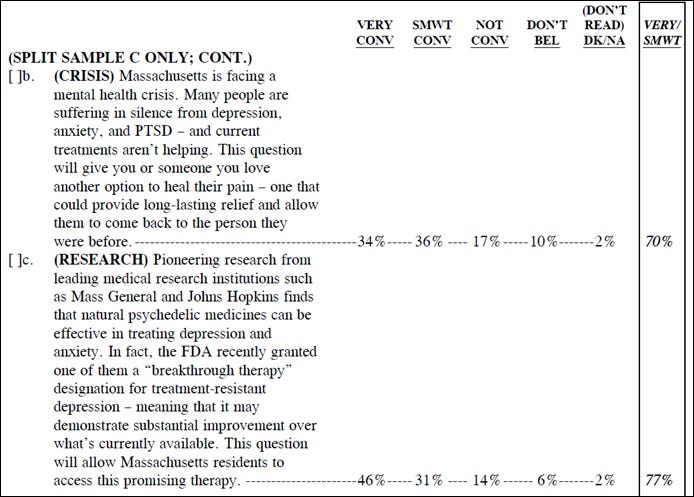
In the first six sentences of her remarks, Slater echoed two of the three most persuasive arguments for the ballot question from the campaign’s June 2023 feasibility survey (“END OF LIFE,” “RESEARCH,” and “PTSD”), specifically the “RESEARCH” and “PTSD” arguments most relevant to the HERO Act’s focus on researching psychedelic therapy for veterans:
“(PTSD) Massachusetts veterans are facing a PTSD crisis. More than 6 thousand veterans commit suicide each year, and countless more struggle with the trauma from their service. Many veterans suffering from PTSD have found healing and help with natural psychedelic medicines where other treatments have failed. This question allows people with PTSD who have already tried therapy and pills without success a chance to recover and truly heal.”
“(RESEARCH) Pioneering research from leading medical research institutions such as Mass General and Johns Hopkins finds that natural psychedelic medicines can be effective in treating depression and anxiety. In fact, the FDA recently granted one of them a “breakthrough therapy” designation for treatment-resistant depression – meaning that it may demonstrate substantial improvement over what’s currently available. This question will allow Massachusetts residents to access this promising therapy.”
Slater led with an alternative formulation—“nearly 22 veterans commit suicide every day”—of the campaign’s citation of the veteran suicide rate—“more than 6 thousand veterans commit suicide each year”—then invoked the survey’s referenced “pioneering research from leading medical research institutions such as Mass General and Johns Hopkins” by mentioning, as a direct response to the veteran suicide crisis (“for this reason”), her involvement with “the Boston Psychedelic Research Group, which is an educational nonprofit community that includes some of the top researchers from MGH, from Johns Hopkins, and others that are dedicated to bringing these therapies safely into our medical and mental health systems.” From there, Slater segued to highlighting that numerous veterans already perceive benefit from psychedelic therapy—as described in the survey as, “many veterans suffering from PTSD have found healing and help with natural psychedelic medicines where other treatments have failed”—by bringing up Heroic Hearts Project’s mission of, in her words, “saving veterans lives by taking them out of this country to South America to do ayahuasca.” Moreover, in touting the touted the therapeutic value of DMT-containing “ayahuasca,” Slater advertised a psychedelic substance, DMT, that—while included in the ballot question—was explicitly excluded from the scope of the HERO Act, which constrained its psychedelics research to concerning “psychedelic therapy” as defined as “the use of psilocybin, ketamine, or 3,4 methylenedioxymethamphetamine [(MDMA)], under the direction of a health care provider, to treat mental health disorders.”
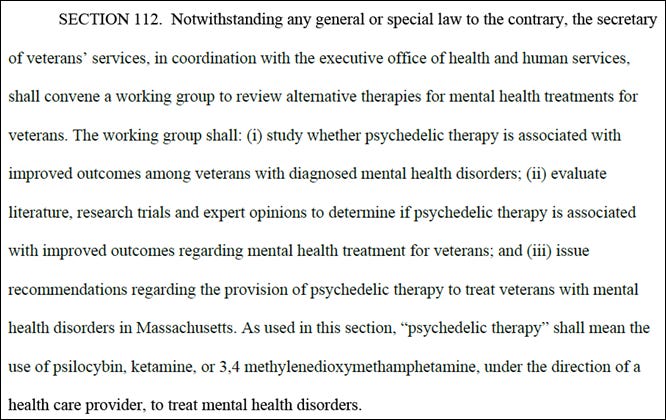
This emphasis on the legal availability of psychedelic therapy abroad was one of the granular throughlines of all three panelists’ testimonies, although Slater was the only panelist to mention a psychedelic substance by name other than psilocybin and MDMA. After the hearing, a single joint statement attributed to Gergerian, Oneschuk, and Slater provided an unambiguously united message.
This quotation had the distinction of being one of twelve “statements of support” quoted in a press release from the office of Massachusetts Governor Maura Healey celebrating the HERO Act, issued the same day the panelists gave testimony. The inclusion in the press release was presumably engineered by Yes on 4 chief strategist Lynda Tocci, who knew the governor from working as one of her senior advisors. Even though psychedelics research was only a minor component of the HERO Act, the statement carried the ballot question committee’s emphasis on psychedelics for veterans and copied certain language (“pioneering research from leading medical research institutions such as Mass General and Johns Hopkins”) nearly verbatim from the aforementioned, high-polling “RESEARCH” argument from the campaign’s feasibility survey. Attributed to “Sarko Gergerian from Winthrop Police Department, Rebecca Slater from Boston Psychedelic Research Group, Emily Oneschuk [(notably without mentioning affiliation)],” the endorsement read:
We wholeheartedly support the Governor’s HERO’s Act as a crucial expansion of veterans’ benefits, their inclusivity, and necessary modernization of services. We are especially enthusiastic about the creation of a working group to study the benefits of psychedelic medicine to treat PTSD making good on the promise of cutting-edge research from leading medical institutions like Mass General Hospital and Johns Hopkins.
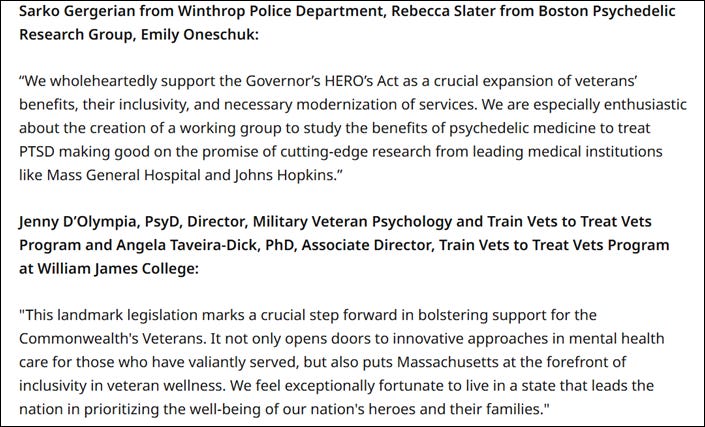
Of the twelve “statements of support” incorporated into the press release, the quotation from the three panelists stood out for multiple reasons, including that it was both the only joint statement and the only statement not overtly made on behalf of a single organization. In addition, it was one of only two statements that referenced psychedelics—both of which, the evidence suggests, were coordinated by Yes on 4 leadership.
The other psychedelics-referencing statement was from an Oregon-based psilocybin advocate, Sam Chapman, who was identified in the press release as “Executive Director, Healing Advocacy Fund.” Chapman’s endorsement was notable as the sole quotation in the press release from an individual based outside Massachusetts, even though Chapman had not testified at the hearing nor had any background operating in New England. Pertinent to the ballot question committee, however, Chapman had been the campaign manager of the successful, New Approach-backed ballot measure campaign that legalized psilocybin in Oregon, and he had since taken a leading role in the implementation of Oregon’s psilocybin program as the executive director of the 501(c)(3) nonprofit The Healing Advocacy Fund. Relatedly, Chapman had also co-presented—alongside New Approach executive director Graham Boyd—to the Boston Psychedelics Research Group in November 2022 at a forum regarding “the future of state access to [sic] in Oregon and beyond,” attended virtually by Slater. At this event, Boyd had floated the possibility of a New Approach-backed ballot measure in Massachusetts, which Chapman had signaled interest in. In response to Slater asking if Boyd knew anyone in Massachusetts “already working on” a ballot measure effort, Boyd had replied in the negative and then asked Chapman if he had spoken to anyone in-state about a campaign—Chapman had answered, “Not yet. Key word: ‘yet.’”
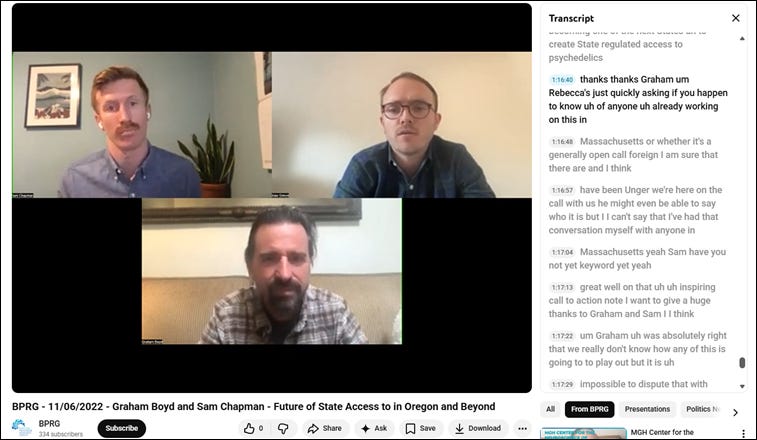
And—considering Chapman’s close affiliation with New Approach—Chapman had almost certainly had his anticipated conversation with a Massachusetts campaign organizer by the time he was quoted in Governor Healey’s January 2024 press release, giving a statement that echoed that of Gergerian, Oneschuk, and Slater. Chapman’s quotation framed “the study of psychedelic medicine” as a means to delivering “Massachusetts veterans […] access to the care they need when they return home”:
The HERO Act supports the study of psychedelic medicine as a new tool for mental health care for those struggling with PTSD, including our veterans. Massachusetts veterans answered the call to serve their state and country, and they deserve to have access to the care they need when they return home.
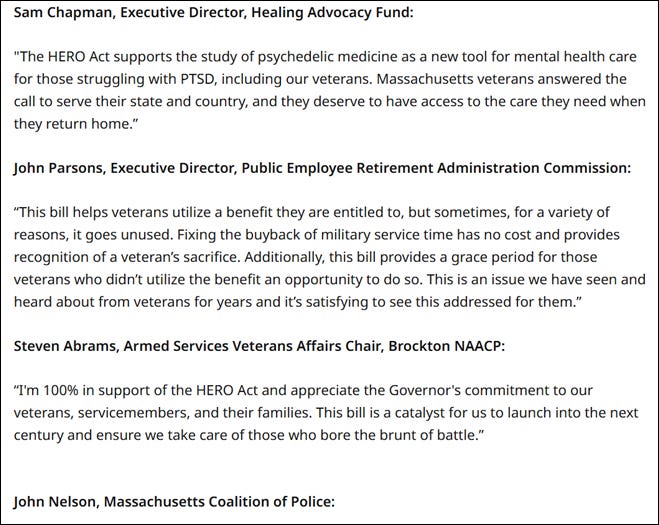
Both the statement from Chapman and the statement from Gergerian, Oneschuk, and Slater used praise for the HERO Act to subtly characterize the therapeutic value of psychedelics as established—bolstering the case for the Massachusetts ballot measure—without calling for immediate access to psychedelic therapy outright. The quotations referred to psychedelics as “psychedelic medicine” (“medicine,” by definition, is therapeutic) and Gergerian’s, Oneschuk’s, and Slater’s quotation described the mission of the HERO Act’s research working group as “to study the benefits of psychedelic medicine to treat PTSD” (emphasis in italics mine), endorsing the normative assumption that there were, in fact, benefits of treating PTSD with psychedelics.
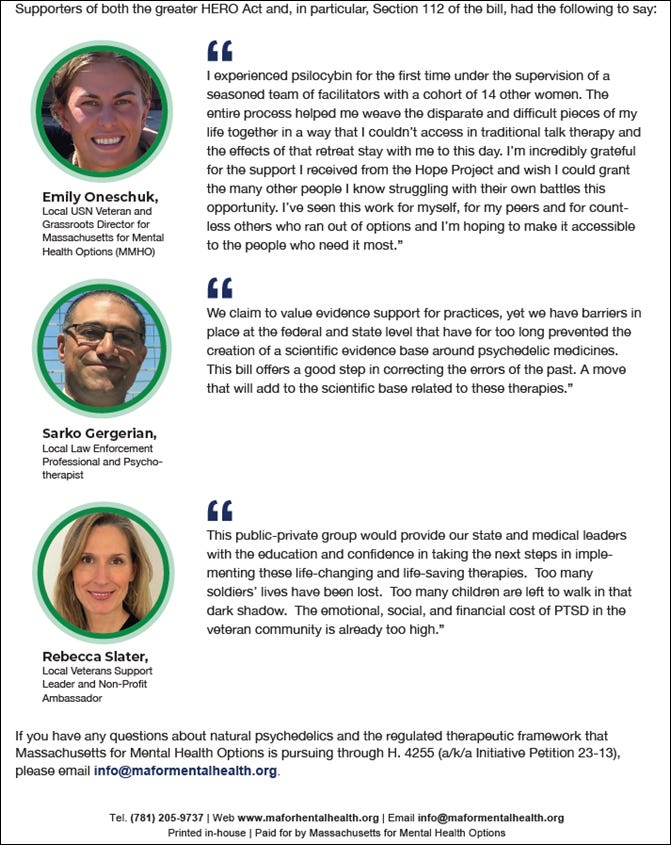
Although the campaign affiliation of Oneschuk was excluded from the press release—perhaps to avoid the impression that the governor had taken a position on the ballot question—the testimonies of Gergerian, Oneschuk, and Slater regarding the HERO Act were soon overtly utilized by the ballot question committee by being incorporated into campaign literature. Starting in mid-March and continuing through July 2024, the three panelists—along with excerpts from their remarks at the hearing—were featured together in a “Psychedelic Healing for Veterans Fact Sheet,” officially produced and distributed by the campaign. As one of the campaign consultants tasked with disseminating the document, Bajpai may have been inspired to “shout out” Oneschuk and Slater in part because of his familiarity with the factsheet their testimony had populated.
For the second panel that Slater participated on alongside Oneschuk and Gergerian prior to Open Circle Alliance’s incorporation, she overtly spoke on behalf of the campaign. This panel was a ballot question committee-organized proponent panel for a high-profile procedural hearing on the ballot question legislation, held on March 26, 2024. Notably, this panel included a fourth member, Chapman, who testified virtually from Oregon. The direct affiliation of the campaign with Chapman, especially combined with the aforementioned details of Chapman’s history, strongly suggested he had been similarly selected—presumably like Oneschuk, Gergerian, and Slater—for inclusion in Governor Healey’s press release by campaign organizers. But, as Chapman was an established public figure in the psychedelics policy field, well-known to be affiliated with New Approach and eminently qualified—through his experience with Oregon’s novel psilocybin program—to speak in support of the Oregon-style psychedelic therapy framework in the ballot question, his participation on the proponent panel—unlike Slater’s—was not an elevation of a hitherto obscure figure.
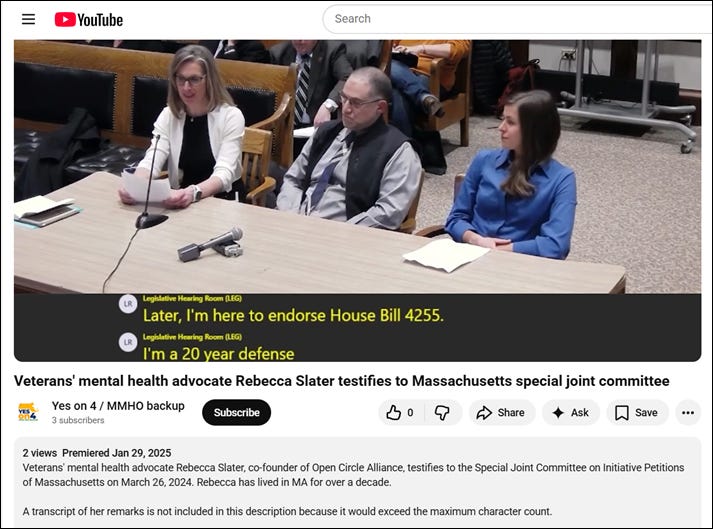
While Gergerian and Oneschuk had already been quoted in public reporting as a campaign surrogate (Gergerian) and as a campaign official (Oneschuk) as far back as 2023, Slater had virtually no media presence. Consequently, the March 2024 hearing—which was predictably covered by major media outlets, including The Boston Globe and NBC Boston—uniquely marked Slater’s public debut as a formally-embraced, high-profile surrogate for the ballot question committee. Her opening remarks as a panelist were: “All right, good afternoon. My name’s Rebecca Slater, and I’m here to endorse House Bill 4255 [(the ballot question legislation)].” Demonstrating ongoing comfort with Slater as a campaign surrogate, her proponent testimony was subsequently incorporated into the ballot question committee’s promotional messaging:
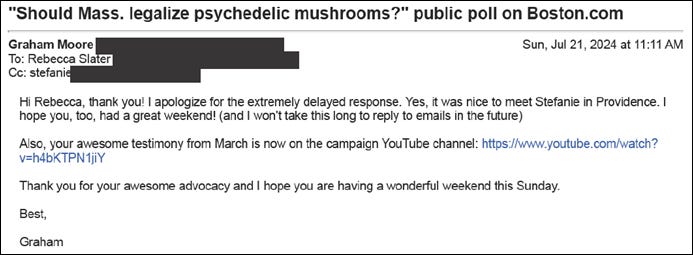
In July 2024, with her knowledge and implied consent (I emailed Slater and Jones notice to their Open Circle Alliance email addresses), a full recording of Slater’s spoken endorsement was made available on the ballot question committee’s official YouTube channel.
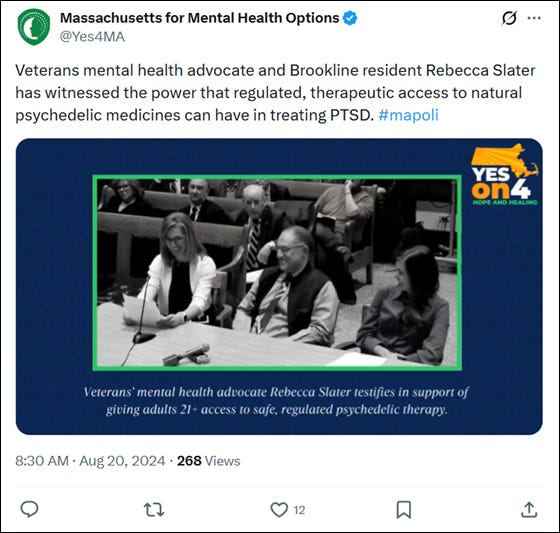
In August 2024, a clip of her testimony was centrally featured in one of the ballot question committee’s official social media posts, shared on Instagram, Facebook, and X.
Yet less than a month after the March hearing, on April 19, 2024, Open Circle Alliance was legally formed as a 501(c)(3) nonprofit, independent of the ballot question committee, even as its independence was undercut by:
The entirety of its officers and board of directors (Jones, Oneschuk, and Slater) having explicitly endorsed the ballot question legislation and actively assisted the ballot question committee—in Oneschuk’s case, in an overt and ongoing professional capacity as grassroots campaign director.
Its clerk and director, Jones, being a “longtime friend[] and colleague[]” of ballot question committee leader Moffat.
Its mission having substantive overlap with that of the ballot question committee.
All three of these factors were reflected in a text message exchange with Moffat just two weeks after Open Circle Alliance was incorporated. In response to me floating a proposal specifically for “the campaign” (“incorporating a public education/harm reduction component to the campaign, done in partnership with experts, including some arguably conservatives ones maybe”), Moffat replied, “Yes yes yes Stefanie jones is thinking a lot about this.” In doing so, Moffat—a ballot question committee leader—had explicitly cited the strategic thinking of Jones, the clerk and director of the ostensibly independent Open Circle Alliance, to address a proposal I had made for the ballot question campaign. Moffat went on to share that, “There’s a pilot program in the works in CA and I’d love to see something take off in MA too,” presumably referring to a nonprofit initiative since there was no active psychedelics ballot measure effort in California at the time. After I responded, “I’d love to learn more about that,” Moffat emphasized: “It’s a good strategy To work on public education 💯[(100%)].”
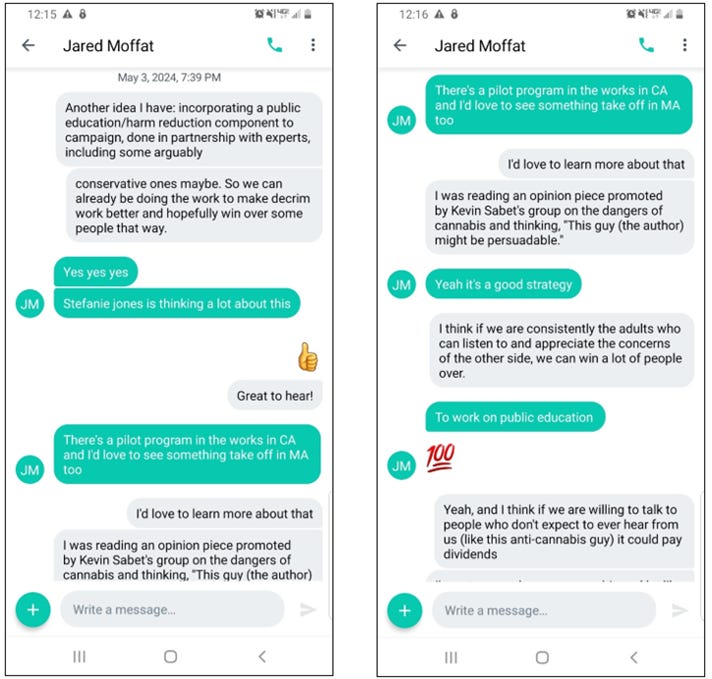
He made no delineation between campaign and non-campaign “public education” in the conversation, and, in the context of my explicit and exclusive focus on “the campaign,” he conflated the two with his invocation of Jones and the unspecified public education pilot program in California. This blurring of lines was a predictable consequence of Open Circle Alliance’s formation and structure.
Per Open Circle Alliance’s publicly-available articles of organization, its purpose was to “convene stakeholders for education, community building and advocacy activities related to psychedelics.”
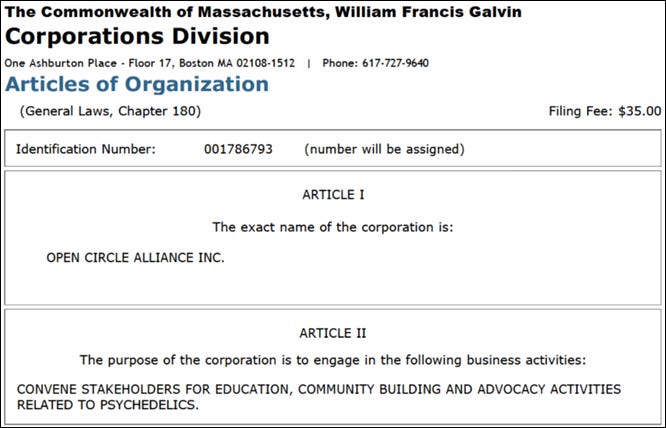
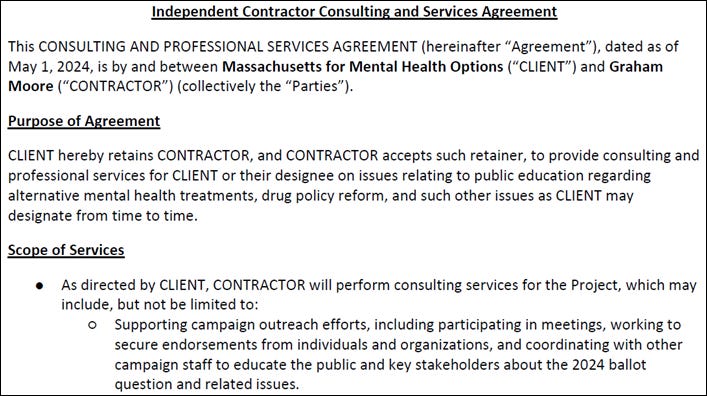
This language was strikingly similar to that of Jamie Morey’s and my contracts with the ballot question committee. Both our contracts—using identical language—stipulated that we were retained “to provide consulting and professional services for CLIENT or their designee on issues relating to public education regarding alternative mental health treatments, drug policy reform, and such other issues as CLIENT may designate from time to time” and agreed to “perform consulting services for the Project, which may include, but not be limited to […] coordinating with other campaign staff to educate the public and key stakeholders about the 2024 ballot question.” As our titles—“community engagement director” and “educational outreach director,” respectively—clearly indicated, “conven[ing] stakeholders for education, community building and advocacy activities related to psychedelics” was well within Morey’s and my purviews as campaign officials.
Structurally tying the nonprofit to the ballot question committee even further, Open Circle Alliance was incorporated with Slater serving as president, Jones serving as clerk, and Oneschuk—a paid ballot question committee staffer—serving as the treasurer and the resident agent. According to the laws governing Massachusetts nonprofits and Open Circle Alliance’s publicly-available bylaws, this meant Oneschuk was given “charge and custody of and [responsibility] for all funds and securities of the [nonprofit]” as treasurer and, as resident agent, was made the nonprofit’s designated point of contact for legal correspondence, intended to be present at a fixed physical address during normal business hours.

Not only were the demands of full-time, public-facing campaign organizing (specifically regular travel and irregular hours)—which Oneschuk’s grassroots campaign director role theoretically obligated her to perform—logistically incompatible with the responsibilities inherent to being a resident agent for an independent nonprofit, but Oneschuk’s control of Open Circle Alliance’s finances—while simultaneously drawing a paycheck from the ballot question committee—constituted an especially pronounced conflict of interest as well. Insomuch as the direction of Open Circle Alliance could be steered by budgetary restrictions, the officer with the most explicit allegiance to the ballot question committee (Oneschuk) was assigned de facto veto authority over the nonprofit’s activities under its own bylaws. Although Oneschuk was replaced as resident agent on August 7, 2024, by a professional service—essentially a physical, auto-forwarding mailbox, provided by the firm Northwest Registered Agent—Oneschuk remained Open Circle Alliance’s treasurer until she resigned from the position on July 24, 2025, far beyond the end of the campaign.
Making this conflict of interest even more substantial—to my knowledge, from contemporaneous conversations with Oneschuk—Oneschuk considered payments she received from the ballot question committee to be compensation for her work for the ballot question committee as well as for her work for Open Circle Alliance. In other words, Oneschuk thought the ballot question committee was paying her to be Open Circle Alliance’s treasurer. Such an arrangement was contractually accommodated because—in common with Morey’s and my professional agreements—Oneschuk’s contract with the ballot question committee stipulated she was “to provide consulting and professional services for CLIENT or their designee” (emphasis in italics mine), empowering the ballot question committee to task Oneschuk with serving another entity (the client’s “designee”), such as Open Circle Alliance, at will.
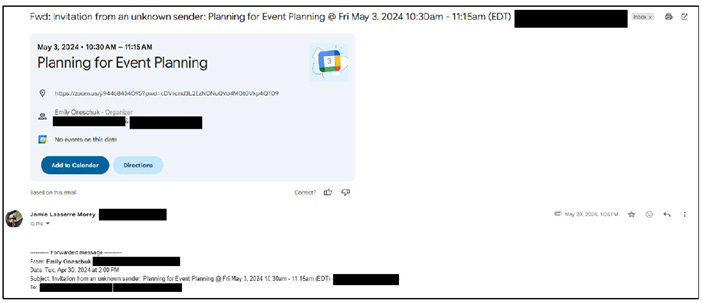
An early demonstration of Oneschuk’s dual role was her using her Open Circle Alliance email address on April 30, 2024, less than two weeks after Open Circle Alliance had been incorporated, to schedule a meeting with Moffat and Morey to discuss campaign event planning (the meeting was titled, “Planning for Event Planning”).
And Oneschuk’s lengthy tenure as both grassroots campaign director for the ballot question committee and treasurer for Open Circle Alliance was just one of multiple ways Open Circle Alliance functioned as an extension of the campaign, even while publicly claiming in its own educational literature to be “not associated with the Yes on 4 campaign and [striving] to present clear and neutral information.”
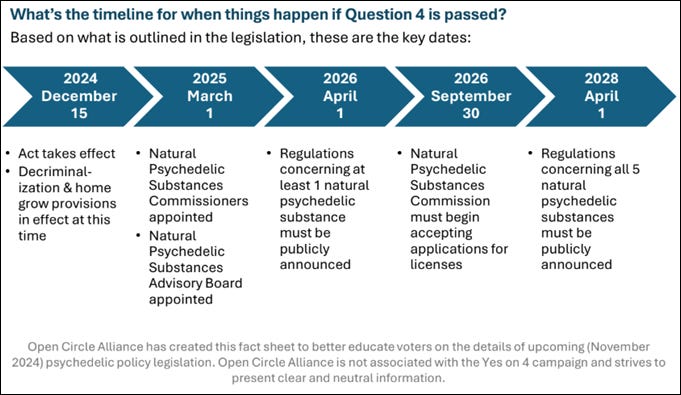
As reflected in emails from the officers of Open Circle Alliance, the nonprofit held six events from its inception through election day in 2024. All but one—a private, non-publicly-advertised “town hall” on October 30—effectively functioned as promotional events for the ballot measure campaign.
Open Circle Alliance’s inaugural event was a private, non-publicly-advertised soft launch “gathering,” held at a brewery in Cambridge, Massachusetts on May 11. Even though Oneschuk was nonprofit’s treasurer and Slater was nonprofit’s president, the mass-distributed announcement email for the event came solely from Oneschuk’s Open Circle Alliance email address—rather than from Slater’s nonprofit email address or from a general, non-personal organizational email address—and was signed, “Emily [Oneschuk], Rebecca [Slater] & Stefanie [Jones],” putting Oneschuk’s name first and excluding titles distinguishing the three co-founders’ roles. In introducing the organization, the email stated:
We’re starting a new organization to bring together people and organizations across Massachusetts working in the psychedelic ecosystem. We want to connect and empower people passionate about the potential for psychedelic healing and growth, and who are interested in building toward the best possible outcome for the state.
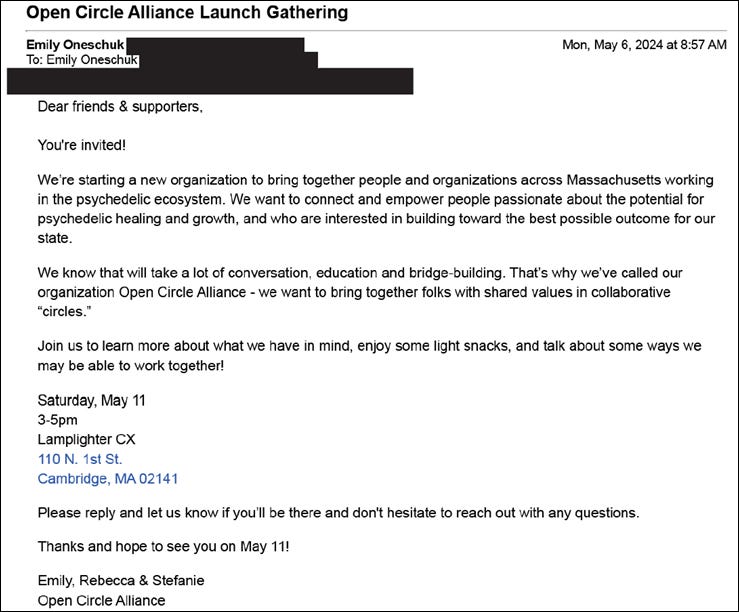
Considering Oneschuk’s well-publicized grassroots campaign director role for the ballot measure campaign and her prominence as the sender and first signer of the email, “the best possible outcome for the state” could reasonably be interpreted as referring, at least in part, to an election day-triumph of the ballot question. At the launch event itself, which Morey and I attended, Oneschuk touted the value of the ballot measure, and disclosed her professional position for the campaign, in her remarks as a headliner. This clarified to attendees that “the best possible outcome for the state,” from the perspective of Open Circle Alliance’s leadership, included campaign victory. In a post-event bulk email from Open Circle Alliance—this time sent from Slater using her Open Circle Alliance email address and featuring Slater as the first of three signers, albeit still without the inclusion of titles—the restatement of Open Circle Alliance’s mission left even less ambiguity than the announcement message about whether the nonprofit was invested in the election outcome:
Open Circle Alliance is a non-profit striving to connect Massachusetts psychedelics communities, build a supportive community network, provide psychedelic education, and advocate for the best possible psychedelic policies for Massachusetts.
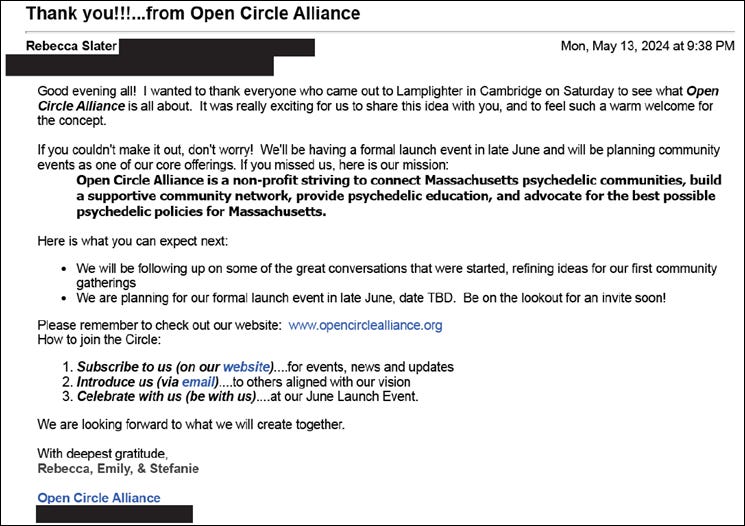
Given all three co-founders had explicitly endorsed the ballot question legislation in the recent past, as well as the advertising of Oneschuk’s campaign role to attendees at the soft launch party, “advocat[ing] for the best possible psychedelic policies” clearly aligned with the intention of the ballot question committee.
The next event that Open Circle Alliance held was its “formal launch event,” open to the public and held at a bookstore in Boston, Massachusetts, on June 27. The announcement email blast reiterated that Open Circle Alliance’s “goals” included “advocat[ing] for the best possible psychedelic policies for Massachusetts” and advertised that attendees would “learn […] the latest in Massachusetts psychedelic policy and advocacy.”
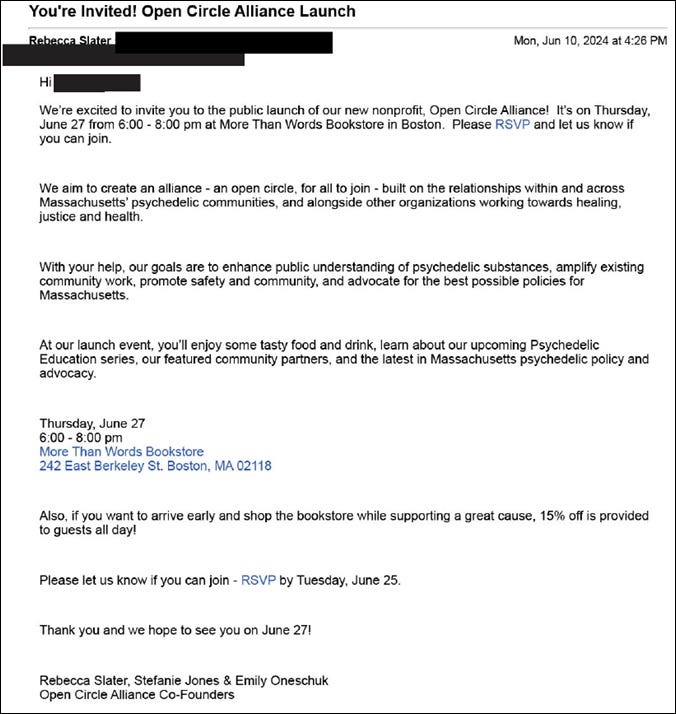
As in the last email from the nonprofit, the sender was Slater and featured Slater as the first of three co-founder signers, still without distinguishing titles. At the event, attended by Morey and me as well as Dewey Square Group consultants working for the ballot question committee, Oneschuk once again spoke as a headliner. She identified herself as grassroots campaign director for the ballot measure campaign, as well as an Open Circle Alliance co-founder, and provided an update on the status of the ballot question effort, encouraging attendees to assist the campaign as volunteers. The other featured speakers were Oneschuk’s fellow nonprofit officers (Jones and Slater) and two high-profile ballot measure campaign surrogates: the aforementioned Gergerian and Jenny Chen Robertson—a local, formally trained facilitator of psychedelic therapy—both of whom had spoken as proponents of the ballot question legislation at the March 26 hearing and as campaign-selected speakers for the ballot question committee’s press conference directly before the hearing. Every email the nonprofit sent to its distribution list regarding the event included a photograph prominently featuring Oneschuk—already recognizable as the face of the ballot question committee in media coverage.
And the centrality of the ballot measure campaign to even Open Circle Alliance’s public-facing identity was further documented by coverage of the event by Psychedelic Spotlight—one of the only two journalistic articles (the other being a Marijuana Moment article that quoted Slater in relation to the HERO Act passing into law) to mention Open Circle Alliance in 2024. Despite being Open Circle Alliance’s treasurer rather than its president, Oneschuk was the only Open Circle Alliance co-founder—none of whom were identified by title—quoted in the article, and the piece described Open Circle Alliance’s “vision and mission” as:
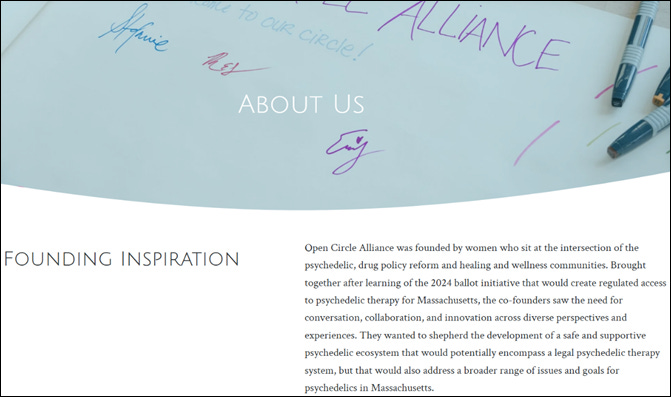
Open Circle Alliance is a nonprofit organization whose founding members came together after learning of the 2024 ballot initiative that would create regulated access to psychedelic therapy for Massachusetts. The co-founders saw the need for conversation, collaboration, and innovation across diverse perspectives and experiences. They wanted to shepherd the development of a safe and supportive psychedelic ecosystem that would potentially encompass a legal psychedelic therapy system, but that would also address a broader range of issues and goals for psychedelics in Massachusetts.
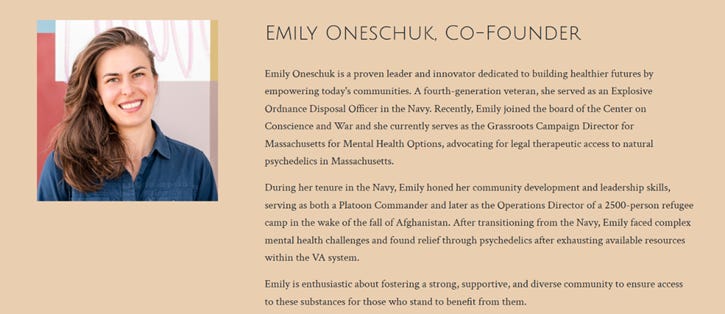
This characterization of the nonprofit as formed in direct response to the “2024 ballot initiative that would create regulated access to psychedelic therapy for Massachusetts”—lifted practically verbatim from the self-description that Open Circle Alliance provided on its own website, beneath a photograph displaying Emily Oneschuk’s signature—positioned the nonprofit as intrinsically linked to the ballot question effort.
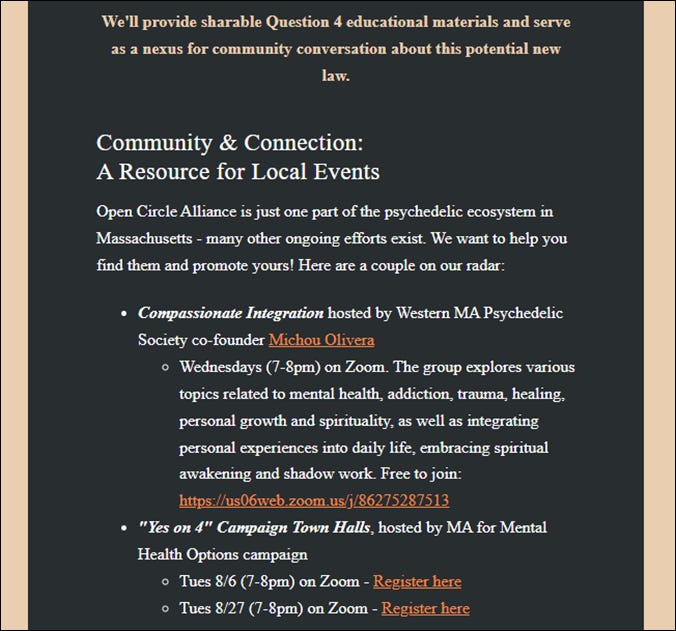
In a subsequent Open Circle Alliance email newsletter, sent to the nonprofit’s distribution list on August 1 from “The Open Circle Team” and unsigned (in a departure from the nonprofit’s previous, more personal style of communication), the organization claimed that the psychedelics ballot measure proposal Question 4 “[was] on many of your minds” and said that Open Circle Alliance would “provide sharable Question 4 educational materials and serve as a nexus for community conversation about this potential new law”:
The upcoming initiative, now known as Question 4, that will ask Massachusetts voters whether or not to create a regulated system for psychedelic therapy is on many of your minds. While the campaign has good resources [(“resources” in the newsletter linked to the ballot measure campaign’s website)], we will provide our own breakdown of the legislation. We’ll provide sharable Question 4 educational materials and serve as a nexus for community conversation about this potential new law.
Directly below the statement that Open Circle Alliance would “serve as a nexus” for conversations regarding Question 4, the dispatch advertised three “local events,” including attendance and registration links: a weekly psychedelic community meeting—hosted by leading Question 4 campaign volunteer Michou Olivera, familiar to Oneschuk and other ballot question committee staff—and two official Question 4 campaign events (“campaign town halls”), organized by the ballot question committee, for August 6 and August 27. The email did not disclose that Olivera was affiliated with the campaign nor that Oneschuk (presumably a member of “The Open Circle Team”) was also employed by the ballot question committee whose events Open Circle Alliance was promoting.
Somewhat conversely, in the same newsletter, Open Circle Alliance also shared the results of a poll of attendees at its June event that showed relatively little interest in programming within the “category” of “political advocacy” (i.e. regarding a ballot measure). Attendees had expressed their “[Open Circle Alliance] programming interest” within various “categor[ies],” by placing stickers on poster board—each placed sticker being a single “programming interest response” for that category. After Open Circle Alliance tallied these stickers and assigned each category a “programming interest response count”—equivalent to the number of stickers placed per focus area—this was how the categories ranked in order from greatest to least programming interest response counts:
“community social groups” (count: 17)
“networking with psychedelic professionals” (count: 14)
“community integration groups” (count: 11)
“psychedelic education – continuing ed” (count: 11)
“policy advocacy” (count: 10)
“psychedelic education – newcomers” (count: 8)
“other” (count: 4)
In Open Circle Alliance’s methodology, these categories comprised different “focus area[s]” as well. This is how the focus areas ranked in order from greatest to least programming interest response counts, as displayed in the bar graph Open Circle Alliance included in the newsletter:
“Community” (count: 42), comprised of three categories:
o “community social groups”
o “networking with psychedelic professionals”
o “community integration groups”
“Education” (count: 19), comprised of two categories:
o “psychedelic education – continued ed”
o “psychedelic education – newcomers”
“Advocacy” (count: 10), comprised of a single category:
o “policy advocacy”
“other” (count: 4), comprised of a single category:
o “other”
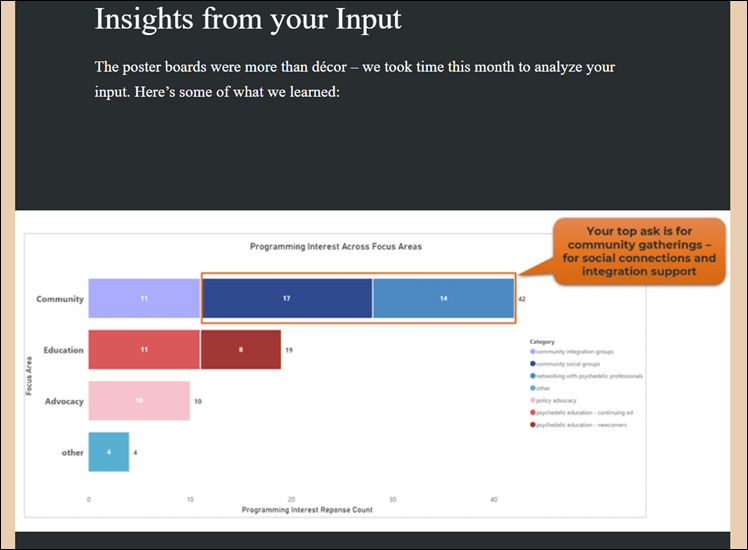
In the August 1 communique, Open Circle Alliance recognized that—according to the poll—“Your [(Open Circle Alliance community members’)] top ask is for community gatherings – for social connections and integration support.” Yet a little over a week later, in an August 9 mass email announcing the nonprofit’s third event, “The Open Circle Team” suggested that “community gatherings” and “education on the upcoming ballot question” were similarly popular, justifying the focus on Question 4 in the upcoming program:
As we mentioned in our August newsletter [(the newsletter with the bar graph)], your feedback told us that you want both community gatherings and more education on the upcoming ballot question (Question 4). We’re going to do both!
Join us as we share the Open Circle Alliance factsheet on Question 4 (regulated psychedelic therapeutic services in MA), foster community connections, and enjoy late summer sunset vibes.
While it was technically true that the feedback had indicated desire for “both community gatherings and more education on the upcoming ballot question,” that same feedback had also indicated Open Circle Alliance’s community members significantly preferred professional networking-focused and non-political educational programming more than events explicitly concerned with Question 4. Notably absent from the August 9 email were any mention of “networking,” “professionals,” “integration” or educational material unrelated to the ballot measure, despite “networking with psychedelic professionals,” “community integration groups,” and “psychedelic education – continuing ed” all having drawn more support as categories for future programming than “policy advocacy” in Open Circle Alliance’s June poll. By organizing an event more aligned with the objectives of the ballot question committee—the employer of Open Circle Alliance’s treasurer—than the expressed preferences of its own attendees, Open Circle Alliance operated more like an arm of the ballot measure campaign than an independent public charity.
The event in question, dubbed a “late summer social” by the nonprofit, was held at a park in Cambridge, Massachusetts, on August 22. Unlike for the two Open Circle Alliance launch parties, Oneschuk—who was attending a psychedelic therapy retreat in Brazil at the time—did not attend the gathering. Nevertheless, Open Circle Alliance still foregrounded the ballot measure by debuting educational literature on Question 4 at the event as advertised, with Slater presenting on, and distributing printed copies of, three factsheets. Every factsheet was prominently labeled “psychedelic policy education produced by Open Circle Alliance” and contained the following disclaimer:
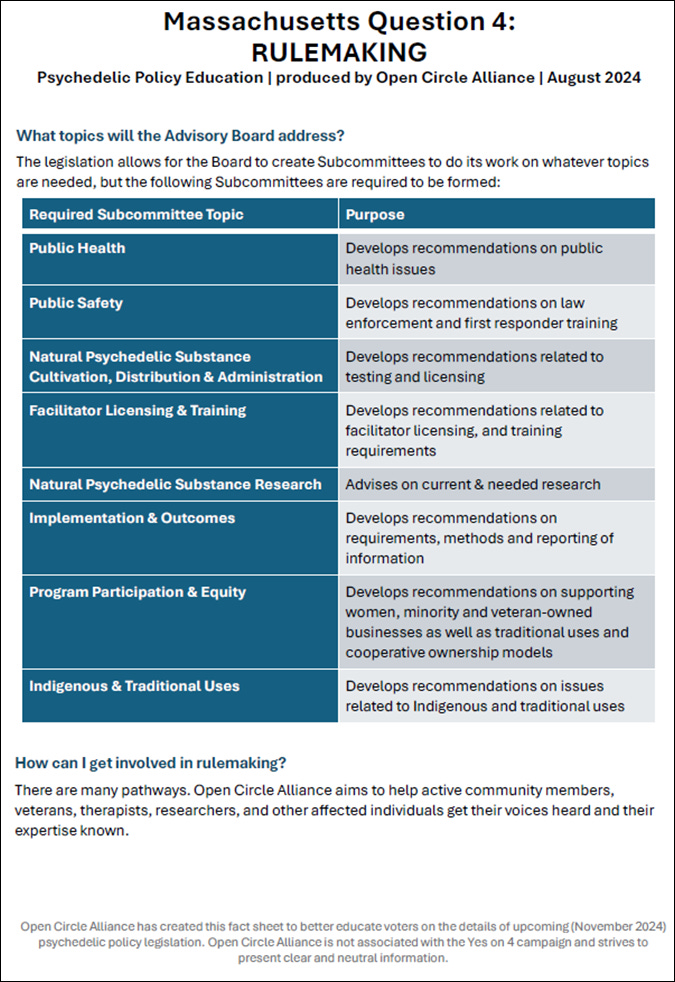
The statement that “Open Circle Alliance [was] not associated with the Yes on 4 campaign” was contradicted by the nonprofit’s own official website at the time—which spotlighted Oneschuk on the “About Us” page as a co-founder who “currently serves as the Grassroots Campaign Director for Massachusetts for Mental Health Options [(the ballot question committee)]”—in addition to being factually inaccurate.
Moreover, the claim of independence was undermined by Slater’s ongoing presence in the campaign’s official promotional messaging, produced and disseminated by the ballot question committee. As previously mentioned:
Slater and an excerpt of her testimony endorsing the HERO Act had been featured in the campaign’s official “Psychedelic Healing for Veterans Fact Sheet” since March 2024.
Slater’s testimony endorsing the ballot question legislation had been featured on the campaign’s official YouTube channel since July 2024.
Slater and an excerpt of her testimony endorsing the ballot question legislation were featured in a campaign social media post on Instagram, Facebook, and X in August 2024.
Strikingly, the ballot question committee also gave Slater the only quotation—explicitly utilizing her as the voice of the Yes on 4 campaign—in its official August 2024 press release celebrating the signing into law of the HERO Act, which would establish a working group to study psychedelic therapy for veterans. For Slater’s quotation, the press release repurposed the joint statement—originally attributed to Oneschuk, Gergerian, and Slater—included in Governor Maura Healey’s January 2024 press release regarding the HERO Act. The quotational part of the joint statement was copied verbatim, even retaining the original typos: misspelling the HERO Act as the “HERO’s Act” and missing a comma between “PTSD” and “making good.” The original attributions to Oneschuk and Gergerian, on the other hand, were stripped away, leaving Slater—with the newly appended titles of “Veterans Community Facilitator within Boston Psychedelic Research Group and co-founder of the Open Circle Alliance”—as the sole identified author. Although the modification gave the quotation the veneer of originality, it still clearly echoed the campaign’s language and—as it was now featured in a ballot question committee press release displayed on the campaign’s official website—no longer maintained a pretense of separation from the ballot measure effort. The identical text utilized in both the governor’s January 2024 announcement and the ballot question committee’s August 2024 press release reads as follows:
We wholeheartedly support the Governor’s HERO’s Act as a crucial expansion of veterans’ benefits, their inclusivity, and necessary modernization of services. We are especially enthusiastic about the creation of a working group to study the benefits of psychedelic medicine to treat PTSD making good on the promise of cutting-edge research from leading medical institutions like Mass General Hospital and Johns Hopkins.


The ballot question committee press release was not coy in tying the HERO Act to the ballot measure. The words attributed to Slater were immediately followed by two paragraphs that elaborated on the therapeutic potential of the “psychedelic medicines” in Question 4:
The current options for treating mental health issues are limited and often aren’t helpful to veterans with PTSD and patients confronting end-of-life anxiety. Veterans are facing a PTSD crisis. More than 6,000 veterans die by suicide each year and countless more struggle with the trauma from their service. Current laws and medical practice allow dying patients to access medications for physical pain but offer little to address the mental suffering that is part of an end-of-life diagnosis.
Question 4 would allow adults 21 years and older to access natural psychedelic substances whose tremendous therapeutic potential in mental health has been attested to by leading medical research institutions such as Mass General and Johns Hopkins. In fact, the FDA recently called psilocybin a “breakthrough therapy” for treatment-resistant depression – meaning that it may demonstrate a substantial improvement over what’s currently available. Many veterans suffering from PTSD have found healing and help with natural psychedelic medicines where other treatments have failed. Retail sales will not be permitted through this ballot question.
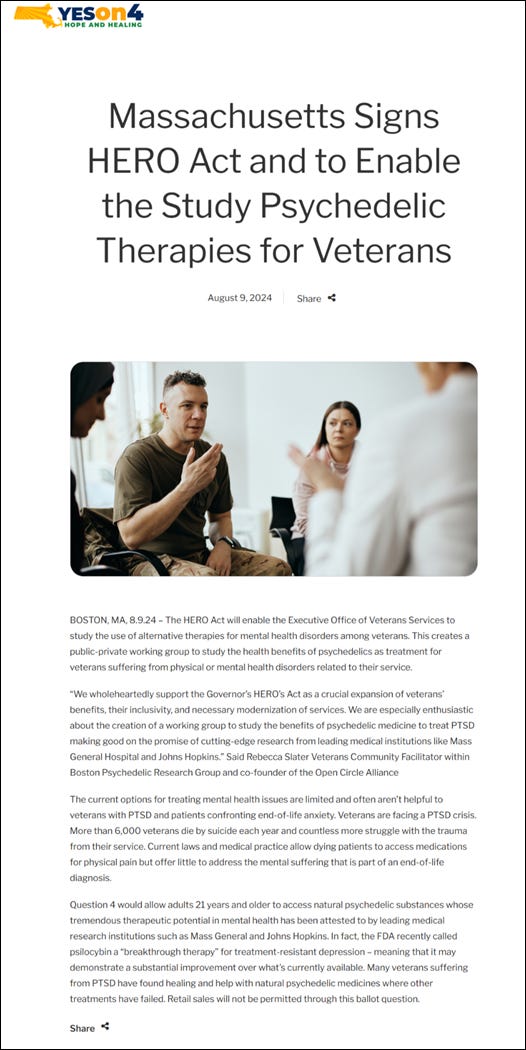
Given that the Boston Psychedelic Research Group and Open Circle Alliance were mentioned by name as the organizations of the press release’s only quoted individual—who spoke for a “we”—the statement implied that both the Boston Psychedelic Research Group and Open Circle Alliance, not just Slater, were members of the campaign’s coalition.
The association between Open Circle Alliance and the ballot question committee was further cemented by Slater becoming a central fixture of one of the campaign’s most widely disseminated pieces of messaging: the “Grasstops One Pager.” Beginning in August 2024, the “one pager”—which was actually two pages, despite its name—became one of the core informational materials that the ballot question committee shared with prospective supporters as standard practice.
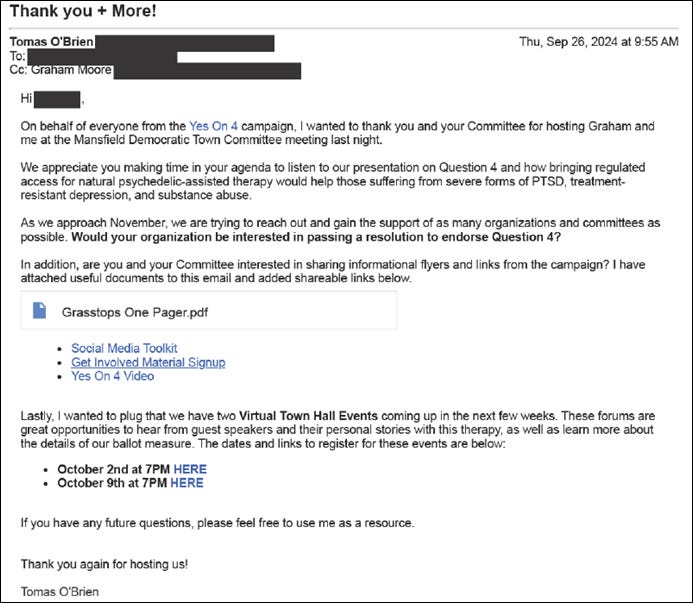
Underlining its ubiquity, the document was translated into other languages for distribution to certain demographics—even into two different Mandarin versions: one written in simplified Chinese characters (the most widely used characters worldwide) and one written in traditional Chinese characters (characters used primarily in Taiwan and Hong Kong). In all versions, the “Yes on 4” branding in English—with the same “hope and healing” tagline used on the campaign’s yard signs and in its television advertisements—was clearly displayed in the header, leaving no doubt as to the document’s political origin.
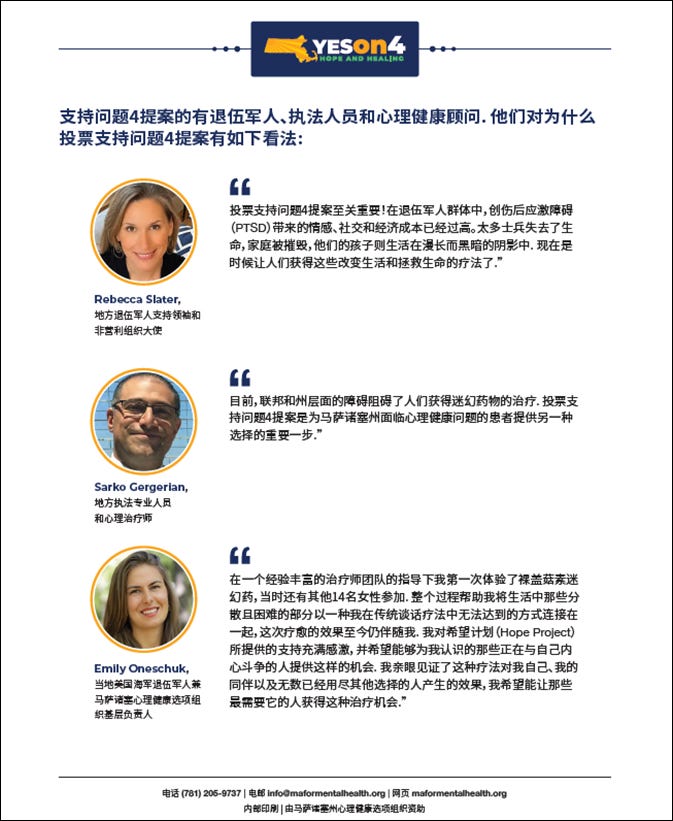
Almost directly below this branding, at the top of the second page, was Slater’s photograph—alongside a statement, attributed to Slater, explicitly declaring voting yes on Question 4 was “crucial” and “now is the time” to legalize psychedelic therapy. Oneschuk, in addition to Gergerian, was featured in the “Grasstops One Pager” in the same format as Slater. Despite the contemporaneous presence of two Open Circle Alliance co-founders and officers in this overt campaign material, which continued to be actively distributed through late October 2024, Open Circle Alliance still simultaneously purported to “strive[] to present clear and neutral information” in its factsheets.
Also misleadingly, the descriptor, “psychedelic policy education produced by Open Circle Alliance,” which was included in the header on each page of the nonprofit’s factsheets, implied the documents had been drafted solely by Open Circle Alliance. In reality, individuals formally working on behalf of the ballot question committee—even apart from Oneschuk—had directly assisted in writing them, as told to Morey by Slater. The factsheets’ true provenance was obscured by the Open Circle Alliance website hosting the documents in a view-only format, which required readers who wished to download the factsheets to “Print to PDF”—sanitizing the documents’ metadata and erasing the digital paper trail of their creation—rather than download the source files.
The ostensibly “neutral” factsheets, drafted in close collaboration with the ballot question committee, were subsequently spotlighted by Open Circle Alliance not just at the nonprofit’s August 22 “summer social” but in two follow-up emails to Open Circle Alliance’s distribution list on August 29 and September 14, as well. As with earlier communication, these emails—both sent from “The Open Circle Team” inclusive of Oneschuk—were not responsive to the expressed preferences of Open Circle Alliance attendees specifically for “networking with psychedelic professionals,” “community integration groups,” and “psychedelic education – continuing ed” in Open Circle Alliance’s programming.
The August 29 email—with the subject line, “Keeping the Energy and Education going”—expressed gratitude for those who had attended the August 22 gathering but did not announce or preview any future Open Circle Alliance events. Rather, most of the body of the email promoted the Question 4 factsheets—which were not yet available on the nonprofit’s website. In characterizing the factsheets in the communique, Open Circle Alliance implied an electoral motive behind them, stating “these sheets [were] designed for this community, who are already familiar with psychedelics” with the “hope they clarify the policy details and make it easier for you [(a member of the community ‘already familiar with psychedelics’)] to discuss them with those less familiar with the topic [(i.e. those outside the community of Open Circle Alliance’s distribution list)].” Especially for individuals unfamiliar with psychedelics in Massachusetts at the time, understanding “the policy details” of Question 4 was most pertinent to influencing voting behavior. To promote public understanding of psychedelics with a more incidental effect on the ballot measure campaign, Open Circle Alliance could have produced factsheets delving into psychedelic research or the various legal contexts in which psychedelics are used worldwide—both of these alternatives would have been more in line with what Open Circle Alliance attendees indicated they wanted in the June 22 poll than what Open Circle Alliance actually put forward.
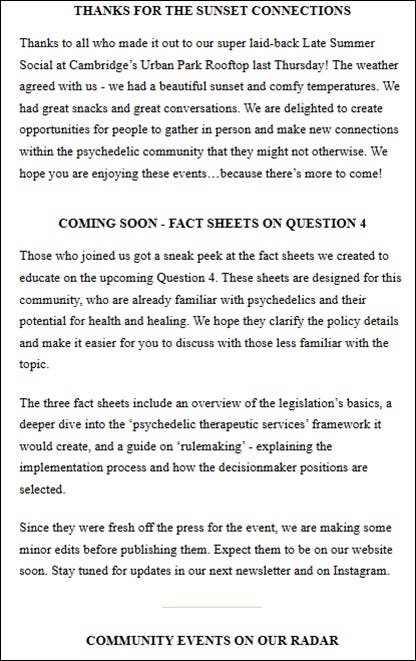
Tying the dispatch to electoral politics more explicitly, the “Community Events on Our Radar” section of the email spotlighted two upcoming “Yes on 4 campaign” events organized by the ballot question committee.
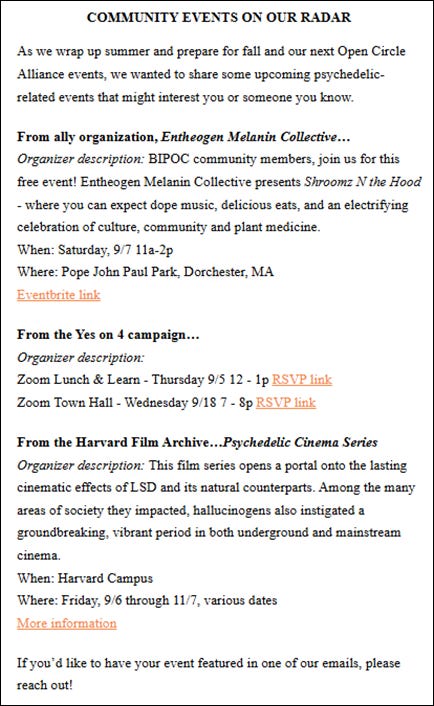
As for the September 14 email—which had the subject line: “Check out our Question 4 fact sheets”—it was transparently dedicated to boosting the Question 4 factsheets. Under the heading, “LEARN ABOUT QUESTION 4 AND SHARE,” the message announced that the educational materials regarding the ballot measure had just become available on the Open Circle Alliance website at “the critical time” and strongly urged readers to “help your friends, family, and community learn [about Question 4]” and “share [the factsheets] widely”:
Now is the critical time to get informed about this potentially game-changing piece of psychedelic policy legislation. Make sure your questions are answered and help your friends, family, and community learn too! Please check out the fact sheets we’ve created and share widely.
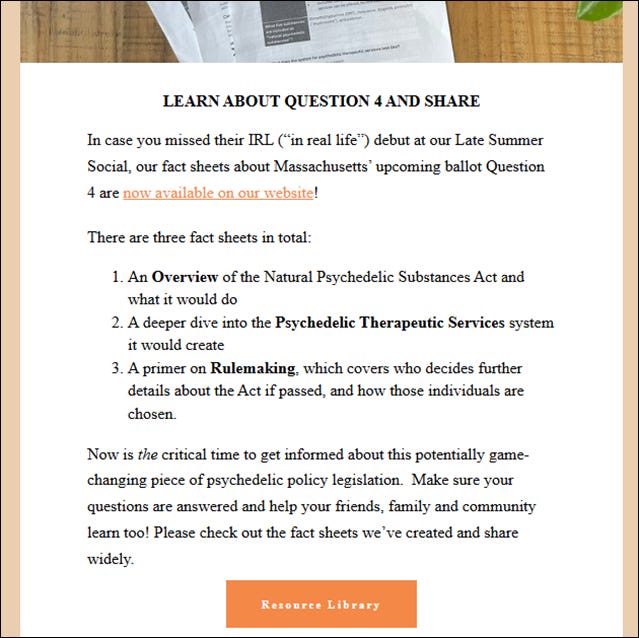
Although a short statement that “education is the cornerstone of our programming [and] we [(Open Circle Alliance)] plan to create more fact sheets on psychedelic topics down the line” was included at end of the message, there was again—as in the August 29 email—no announcement or preview of any future Open Circle Alliance events. And, despite the claimed “plan to create more fact sheets,” Open Circle Alliance did not produce any additional factsheets—or add any additional material to its resource library whatsoever—before shutting down. Furthermore, the final two public events Open Circle Alliance held prior to election day 2024 were overtly co-organized with the ballot question committee.
The first of these events was announced in an Open Circle Alliance email to its distribution list on October 2. From “The Open Circle Team,” the email opened with, “Join Open Circle Alliance and the Yes on 4 campaign on Sunday, October 6 for a special night of discussion, free mushroom sliders (!), and a screening of Music for Mushrooms.” In describing features of the “discussion” portion of the event, the message highlighted one could “learn more about Question 4,” and the end of the message included what was, in practice, an exhortation to vote in favor of the ballot measure:
We also want to give you an early head’s up… Election season is upon us, and this year is particularly exciting with Question 4 on the ballot. So first, get out and go vote on Tuesday, November 5 (or before)!
Considering the call, spelled in bold letters, to “get out and go vote” was within an email advertising a literal “Yes on 4 campaign” event co-hosted with Open Circle Alliance, there could be little doubt in a reasonable reader’s mind that “The Open Circle Team” was signaling a clear preference for a yes vote on Question 4.
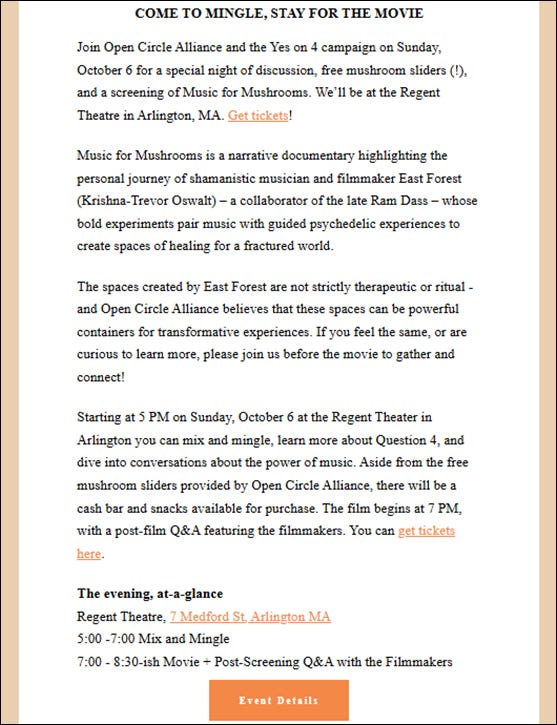
The only other Open Circle Alliance event the email disclosed was one scheduled for November 8, after the election would be concluded, vaguely described as “to discuss Massachusetts’ psychedelics future”—not clearly meeting the desire for programming unrelated to “policy advocacy.”
After the October 6 discussion and film screening proceeded smoothly as advertised, Open Circle Alliance sent an email to its distribution list on October 18 that announced a second film screening with accompanying discussion—openly co-hosted by the ballot question committee and Open Circle Alliance as well—to be held on November 3. As in the announcement for the October 6 event, this message also promoted Open Circle Alliance’s post-election gathering—now rescheduled to October 9 and simply described as “a gathering to collectively envision Massachusetts’ psychedelic future”—and exhorted readers to vote, presumably in favor of Question 4, stating:
With just 19 days until the election, we’ll soon learn if Massachusetts will become the third state to create legal, regulated access to psychedelic therapeutic services (Remember to vote if you haven’t already!)
The dispatch also shared information about two non-Open Circle Alliance events, one of which was an October 19 campaign event titled, “Yes on 4 at Bow Market,” on the posting on Open Circle Alliance’s website but titled, “Hope and Healing through Plant Medicine,” in Open Circle Alliance’s bulk email, obfuscating its explicitly political nature. One of the host organizations of “Yes on 4 at Bow Market” was Parents for Plant Medicine—a grassroots advocacy group founded and openly led by Morey that, unlike Open Circle Alliance, had made no claim of being an organization “not associated with the Yes on 4 campaign” while having a senior member (Morey) employed by the ballot question committee.
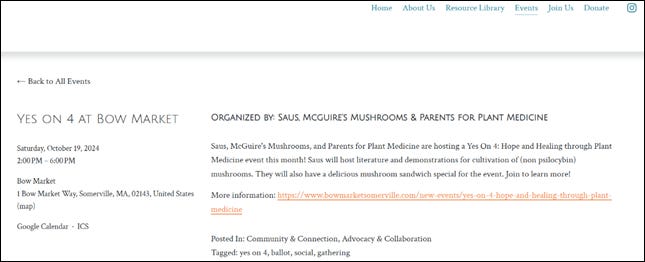
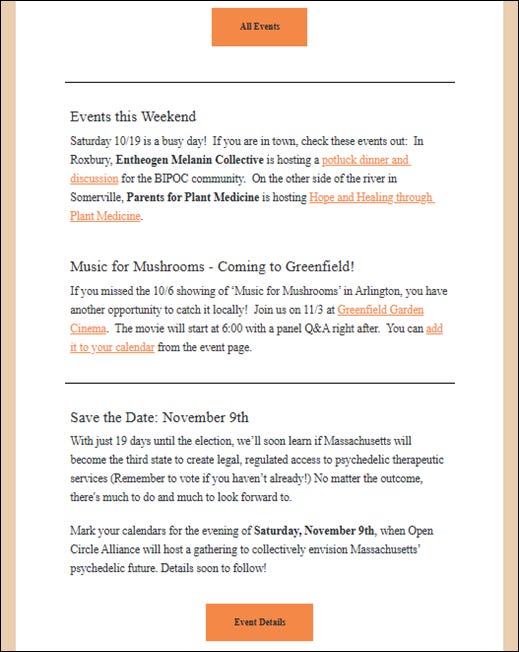
Open Circle Alliance sent three more emails to its distribution list prior to the end of the 2024 election. On October 25, Open Circle Alliance shared further details of its “post-election gathering,” to be held in Boston, Massachusetts, on November 9—which doubled as a reminder of what was at stake with regards to Question 4. The message’s opening paragraph read:
Change is inevitable, but our community is constant. Join us for a post-election evening of camaraderie, connection, food and drink. By then, we’ll know if Massachusetts has become the third state to create legal, regulated access to psychedelic therapeutic services. But no matter the outcome (!), Open Circle Alliance has plans for 2025 to share, and we want you to be a part of them.
Three days later, on October 28, Open Circle Alliance sent a dispatch almost entirely devoted to promoting the Question 4 campaign, with the subject line: “If you believe in psychedelics for healing - this is your moment.” In the lengthy message, the nonprofit advertised just two upcoming, organized activities, including its November 9 post-election gathering, which were not directly in support of the ballot measure—and these were mentioned only briefly in the message’s second half. The bulk of the email consisted of, in this order:
Explicitly encouraging readers to attend a ballot question committee-organized campaign rally the next day (on October 29), including an RSVP link (embedded link underlined): “This is the moment to demonstrate strength in numbers. Please consider attending, and RSVP if you can make it. Lunch will be provided following the event.”
Encouraging readers to sign and circulate a sign-on letter endorsing Question 4 (embedded links underlined):
If you’re a medical or mental health professional who believes that Question 4 articulates a responsible framework for creating regulated access to psychedelic therapeutic services, you can add your name to a sign-on letter showing your support. (If you need more information, please check out Open Circle’s fact sheets on the initiative, or the Yes on 4 campaign website.) If you are a supporter and can’t make it to the event tomorrow, this is a fantastic way to have your voice and expertise represented.
Even if you’re not a health professional, you can help by sharing this link with any that you know who may want to sign.
Encouraging readers to participate in additional ballot question committee-organized campaign events (embedded link underlined):
There is A LOT going on with the Yes on 4 campaign this last full week before the vote. If you’d like to be more involved, check out their events page for more information.
Urging readers to attend the November 3 discussion and film screening, to be held in Greenfield, Massachusetts—which was openly co-organized by the ballot question committee, Parents for Plant Medicine, and Open Circle Alliance, as clearly posted on Open Circle Alliance’s website.
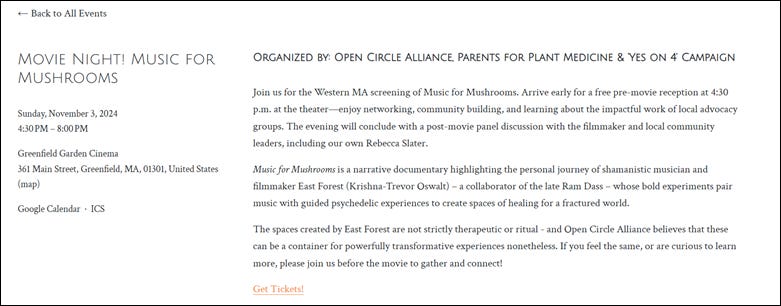
In the body of the email, however, the campaign’s role was conspicuously left unmentioned—amidst six other affiliate organizations being named—in the event description (embedded link underlined):
Join us for a special evening featuring a screening of Music for Mushrooms. Arrive early for a free pre-movie reception at 4:30 p.m. at the theater—enjoy networking, community building, and learning about the impactful work of local advocacy groups. The evening will conclude with a post-movie panel discussion with the filmmaker and local community leaders, including Open Circle’s own Rebecca Slater. Representatives from partner organizations include Parents for Plant Medicine, Open Circle Alliance, the Veteran Alliance for Psychedelic Access, Heroic Hearts Project, Students for Sensible Drug Policy, Western Mass Psychedelic Society and more. Get Tickets.
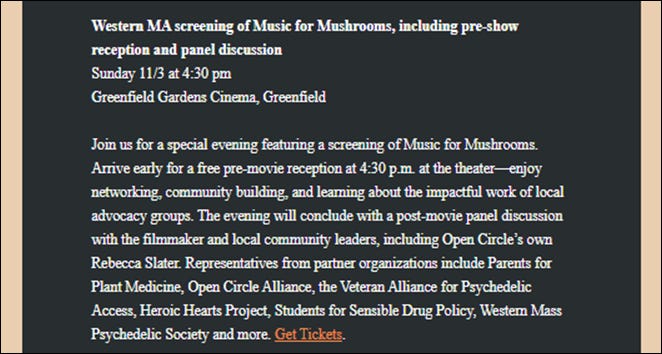
Finally, on November 1, Open Circle Alliance sent a message that highlighted the election while ostensibly being focused on the nonprofit’s intended post-election direction. At the start of the email, with the subject line, “A Sneak Peek into our Post-Election World,” was a large photograph of the state-issued Massachusetts voter guide on “2024 Ballot Questions.” Directly below this image, the introductory two paragraphs frontloaded references to the significance of Question 4, reminding readers “a major election” was “five days out” and characterizing Massachusetts as being “poised on the cusp of becoming the third state in the nation to create regulated access to psychedelic therapeutic services”:
Let’s set aside the fact that we’re five days out (!) from a major election. Let’s forget for a moment that Massachusetts is poised on the cusp of becoming the third state in the nation to create regulated access to psychedelic therapeutic services.
Have you thought about what Massachusetts’ post-election landscape might look like? Keep reading to learn more about what’s on our minds.
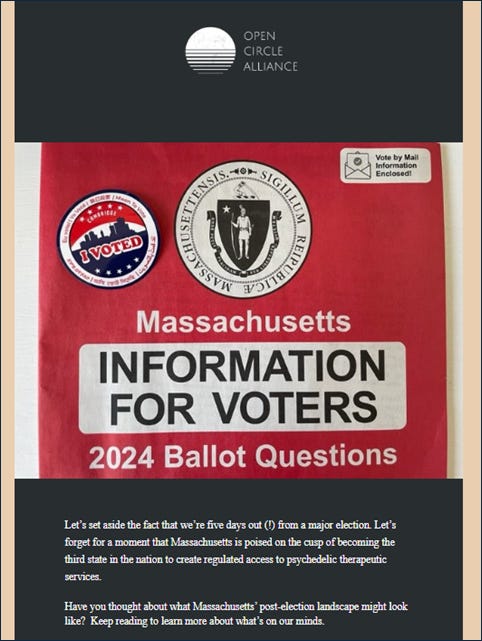
The email went on to promote a “Psychedelic Crisis and Intervention Training” that Open Circle Alliance claimed to be disseminating in collaboration with the Multidisciplinary Association for Psychedelic Studies (most commonly known by its acronym, MAPS) and First Responders & Experts for Entheogens Gaia (most commonly known as FREE Gaia, sometimes written as “F.R.E.E. GAIA”). Both these partner organizations were closely affiliated with the Question 4 campaign. FREE Gaia was led by its founder Gergerian, the nominal author of the official proponent statement for Question 4—ghostwritten by the ballot question committee—found in the pictured voter guide. MAPS had recently donated $550,000 to the ballot question committee. Open Circle Alliance incorporated a call to vote into the promotion of the training, stating (embedded link underlined):
From now until Election Day, this training is free to residents of Massachusetts. So in the coming days, please vote (!!), share this training with first responders you may know, and explore it yourself.
The email also included another advertisement of Open Circle Alliance’s post-election event on November 9, which the message introduced—beneath the header, “Join Us on November 9”—with a sentence elevating the election’s significance again, “If putting the election out of mind was tough for you, you’re not alone!” In an implicit acknowledgement of the non-advocacy-focused activity Open Circle Alliance had neglected since its inception, the email announced that Open Circle Alliance would “discuss our first steps toward supporting community affinity needs (veterans, in this case)” (emphasis in italics mine) at the post-election gathering. Considering Open Circle Alliance had been co-founded by the organizer of a veterans community support group affiliated with the Boston Psychedelic Research Group (Slater) and a veteran (Oneschuk), this was a startling reveal.
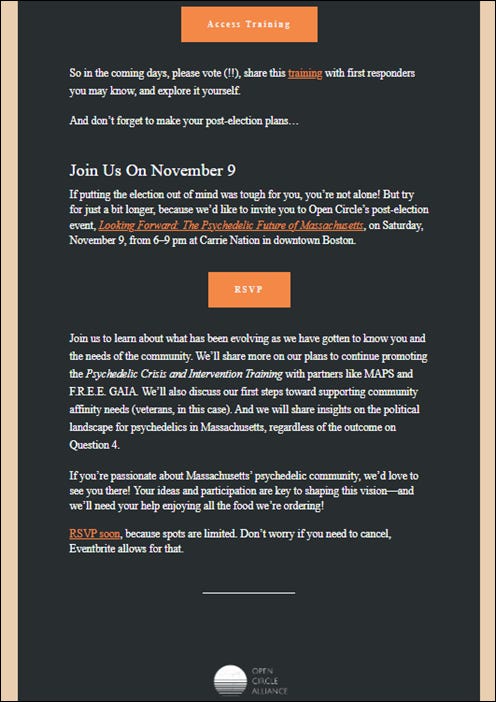
More shockingly, behind the scenes, Slater had claimed in an October 27 email to five prominent psychedelics supporters, whose support for Open Circle Alliance she was soliciting, that she was unsure if Open Circle Alliance “could commit to offering veteran-focused programming in 2025,” writing:
I’d love to commit to offering veteran-focused programming in 2025, so if leading any aspect of this work interests you, please let me know within the week. We could then announce it at our 11/9 event..
Despite Slater having introduced herself to lawmakers and the public in her high-profile March testimony as a “a dedicated advocate for mental health and veterans”—and her subsequent spotlighting of her “advocacy work with the Heroic Hearts Project, the Boston Psychedelic Research Group, and [] her creation of a welcoming and safe online space for veterans and those who serve them” in her profile on Open Circle Alliance’s “About Us” webpage—the nonprofit she had co-founded with a veteran had operationally treated “veteran-focused programming” as an afterthought, contingent on additional resources. By contrast, the predominant throughline of Open Circle Alliance’s actual 2024 programming was support for the ballot measure, even reflected in Slater’s sign-off in her October 27 email: “I will get a meeting on the calendar after the election. In the meantime, get out the vote!”
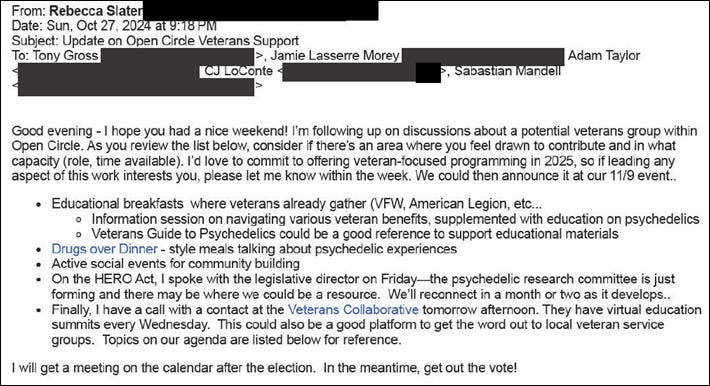
Emblematically, Open Circle Alliance’s last event prior to the end of the 2024 election was openly and officially a Yes on 4 campaign event: on November 3, the discussion and film screening in Greenfield, Massachusetts, was conducted as planned, co-hosted by the ballot question committee, Parents for Plant Medicine, and Open Circle Alliance. Of the six events Open Circle Alliance had held so far since its April incorporation, two had featured Yes on 4 grassroots campaign director Oneschuk as a speaker and headliner, one had been largely dedicated to distributing educational literature (developed in collaboration with the ballot question committee behind the scenes) about Question 4, and two (including the November 3 event) had been overt Yes on 4 campaign events co-organized by the ballot question committee.
The only event Open Circle Alliance held prior to election day that did not fit the pattern of Open Circle Alliance events functioning as de facto or de jure ballot measure campaign events was also its least advertised. According to an email sent to ballot question committee organizers by Open Circle Alliance co-founder Jones, using her Open Circle Alliance email, the event was “a Zoom Town Hall / Q&A for Plant Medicine Guides on 10/30 from 7-8pm […] [that] [was] not open to the public or nor is it publicly advertised.” Even this virtual town hall, however, included attorney Tamar Todd—a legal director of New Approach and an author of Question 4—as one of its three featured speakers, further reflecting a close affiliation with the organizers behind the ballot measure.
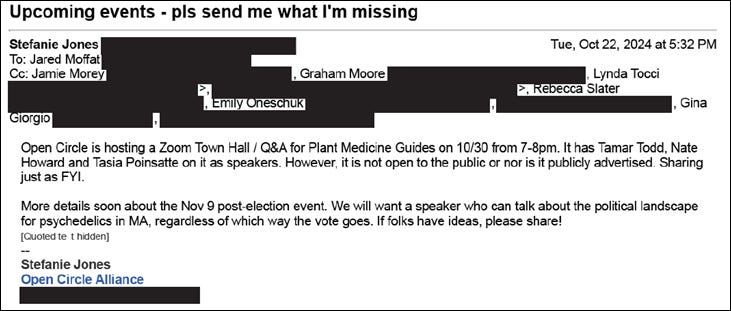
Todd’s participation continued a consistent practice of ballot question committee representation at Open Circle Alliance events. With the sole exception of the November 3, 2024, discussion and film screening in Greenfield, Massachusetts, every Open Circle Alliance event in 2024 was attended by at least one individual, apart from Oneschuk, who formally worked on behalf of the ballot question committee:
At the May 11, 2024, “launch gathering”:
o Jamie Morey—ballot question committee community outreach director.
o Graham Moore (me)—ballot question committee educational outreach director.
At the June 27, 2024, “public launch event”:
o Aayush Bajpai—Dewey Square Group consultant tasked to the campaign.
o Tomás O’Brien—Dewey Square Group consultant tasked to the campaign.
o Zachary (Zach) Last—Dewey Square Group consultant and registered lobbyist tasked to the campaign.
o Jamie Morey—ballot question committee community outreach director.
o Graham Moore (me)—ballot question committee educational outreach director.
At the August 22, 2024, “Late Summer Social”:
o Graham Moore (me)—ballot question committee educational outreach director.
At the October 6, 2024, film screening and discussion co-hosted by the ballot question committee:
o Jamie Morey—ballot question committee community outreach director.
o Tomás O’Brien—Dewey Square Group consultant tasked to the campaign (he tabled for the campaign at the event).
At the October 30, 2024, “Zoom Town Hall / Q&A for Plant Medicine Guides”:
o Tamar Todd—New Approach attorney, legal director, and author of Question 4, tasked to the campaign.
At the November 3, 2024, film screening and discussion co-hosted by the ballot question committee:
o N/A (none)
At Open Circle Alliance’s November 9, 2024, “Looking Forward” event, at which the nonprofit revealed its public-facing vision for 2025:
o Lynda Tocci—Dewey Square Group principal, registered lobbyist, and chief strategist for the ballot question committee.
The ubiquitous presence of de jure campaign organizers at the events of Open Circle Alliance contributed to the nonprofit functioning as an extension of the ballot question committee—blurring the lines between the two entities in the eyes of attendees. Face to face conversations with campaign officials like Oneschuk or Morey spoke more loudly than a one-sentence statement of neutrality on a factsheet.
And, in addition to organizing and promoting events for Open Circle Alliance that implicitly or explicitly advocated for Question 4, Jones and Slater supported the ballot measure effort in other ways after Open Circle Alliance was incorporated, as well. These included:
Jones and Slater participating, as core attendees, in standing, weekly campaign all-hands meetings—beginning at the end of May, and continuing through the entirety of June, in 2024—for the purpose of “shar[ing] updates and be[ing] coordinated around outreach/coalition building,” as described by Moffat in a related email thread. The invites to these meetings were sent to Jones’s and Slater’s Open Circle Alliance email addresses. Jones and Slater temporarily stopped attending campaign all-hands meetings in July 2024 and resumed attendance in October 2024.
Slater participating as a featured speaker in a private “Yes on 4: Psychedelic Medicine Breakfast” campaign fundraiser, openly co-hosted by the ballot question committee on September 17, 2024.
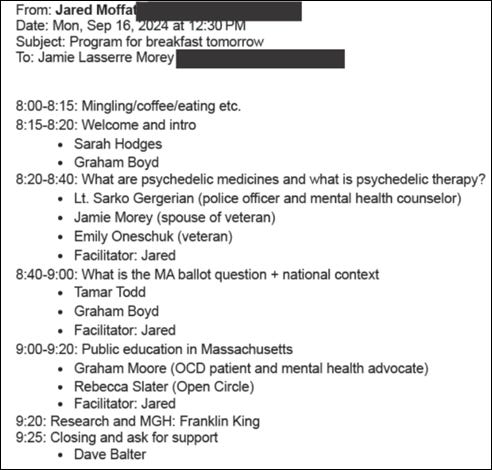
Slater—using her Open Circle Alliance email address—informing the ballot question committee about upcoming informational forums hosted by the League of Women Voters on Massachusetts ballot questions, including Question 4, on October 3, 2024. The next day, Slater clarified in an email from her Open Circle Alliance email address that she would not be attending a particular forum because of a scheduling conflict but added: “I wish I was, because it definitely feels like the guy who wrote the analysis of it doesn’t Overly opposed, but definitely doesn’t appear to support. Ethan Horowitz, I think his name.” Ethan Horowitz—the executive director of the Center for State Policy Analysis at Tufts University—was, indeed, the presenter offering analysis on Question 4 and other ballot questions for the event. Slater’s statement that she “wish[ed]” she was going to the forum featuring Horowitz “because” Horowitz “definitely doesn’t appear to support” the psychedelics ballot measure implied that, had Slater attended, she would have advocated on behalf of Question 4.
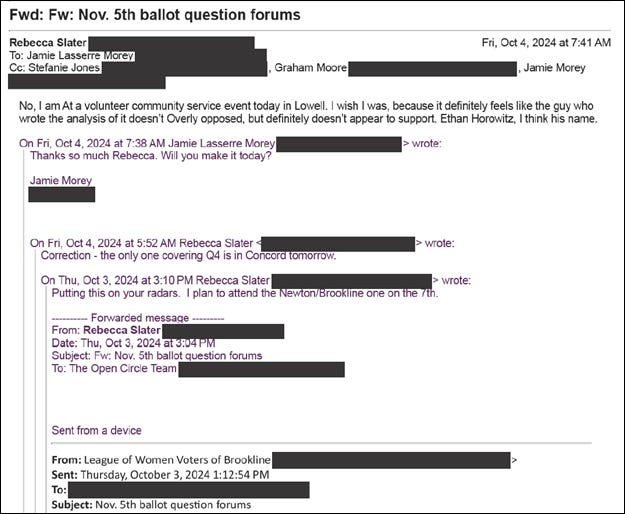
Jones prepping Oneschuk for Oneschuk’s televised campaign debate on October 15, 2024—as known to, and approved by, Yes on 4 campaign director Moffat (who participated in an email thread on debate prep with Jones and me). In her email correspondence with me and Moffat regarding the debate, Jones exclusively used her Open Circle Alliance email address.
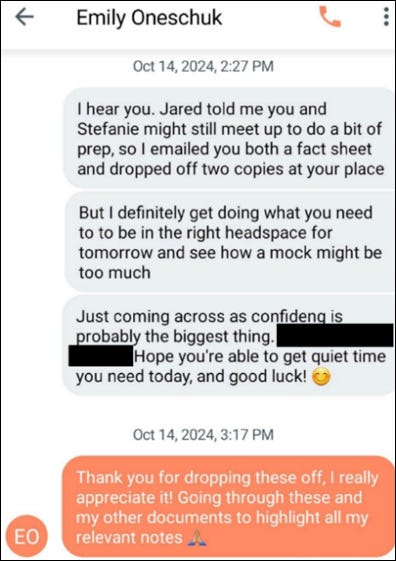
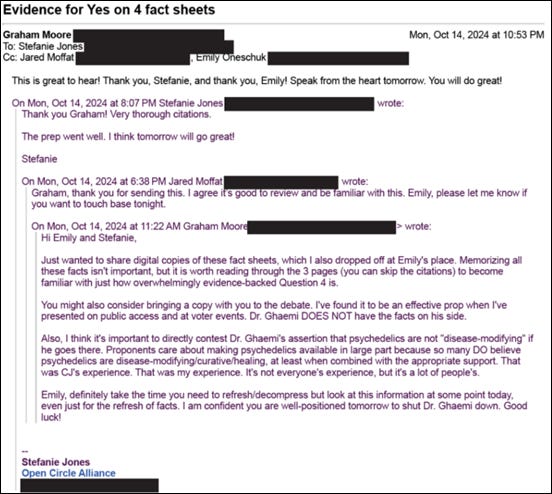
As previously referenced, Jones and Slater resuming attendance at campaign all-hands meetings—which were dedicated to coordinating electoral advocacy, as reflected in meeting agendas—beginning on October 22, 2024 (the displayed invite for the October 22 meeting was issued on October 21). The invites to these meetings were sent to Slater’s and Jones’s Open Circle Alliance email addresses.
Jones attending a ballot question committee-organized campaign rally on October 29, 2024.
In the final week of the election, both Jones and Slater directly contacting voters, urging them to vote yes on Question 4, using the ballot question committee’s auto-dialer and texting software. The emails from the campaign to Jones and Slater regarding auto-dialer and texting software—sent specifically to those who would “[be] making calls” and texting on behalf of the ballot question committee—were sent to Jones’s and Slater’s Open Circle Alliance email addresses.
Furthermore, internal communications demonstrated an intimate working relationship between Open Circle Alliance and the ballot question committee. Even Yes on 4 campaign manager/ballot question committee chair Danielle McCourt and Yes on 4 chief strategist Lynda Tocci treated Jones and Slater as campaign staff over email and text. Replying to a May 2024 email thread—in which Jones and Slater, using their Open Circle Alliance email addresses, were the only individuals not formally working on behalf of the ballot question committee—McCourt inquired about a FAQ, “Are we cleared to share this externally?” (emphasis in italics mine).
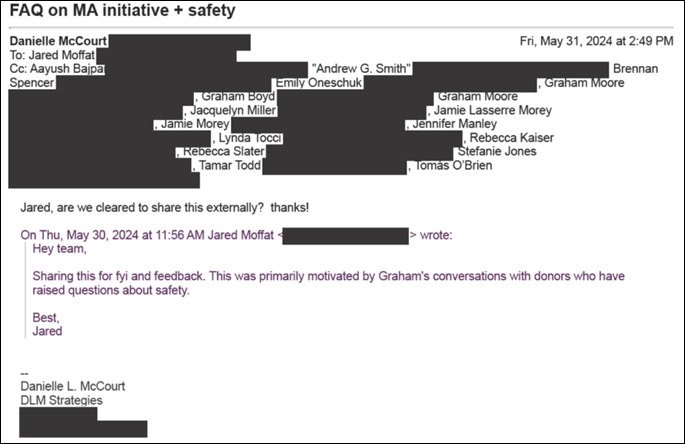
Similarly, in sharing confirmed attendees to an upcoming official campaign event in a ballot question committee group chat on July 9, 2024, Tocci wrote: “13 RSVPs – including Jamie [Morey] and Stefanie [Jones] from Open Circle. So 11 non-staff [(11 confirmed attendees were “non-staff” because the total of 13 confirmed attendees included two staff members, Jones and Morey)]” (emphasis in italics mine).
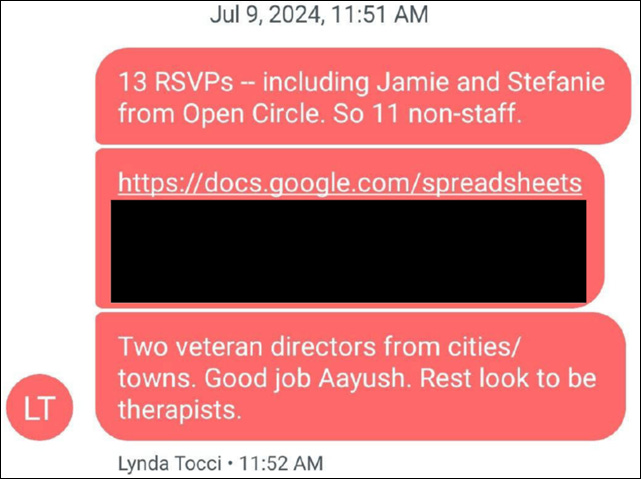
In an earlier June 5, 2024, email, Tocci addressed Open Circle Alliance officers as if they were an integral part of the ballot question committee’s voter outreach efforts in particular. This message—addressed only to Jones, Slater, and 12 individuals formally working on behalf of the ballot question committee, including New Approach executive director Graham Boyd, McCourt, Moffat, Dewey Square Group principal/de facto ballot question committee communications director Jennifer Manley, Oneschuk, Morey, and me—was to contextualize a recent independent poll showing the ballot question polling behind. In the email, Tocci referred to the campaign as “our campaign,” said the poll “just underscore our need to create the events that we’ve been talking about and tell our story to the public,” and concluded with the sign-off, “Go team!!! Let’s roll.” The email addresses Tocci used to include Jones and Slater as recipients were their Open Circle Alliance email addresses.
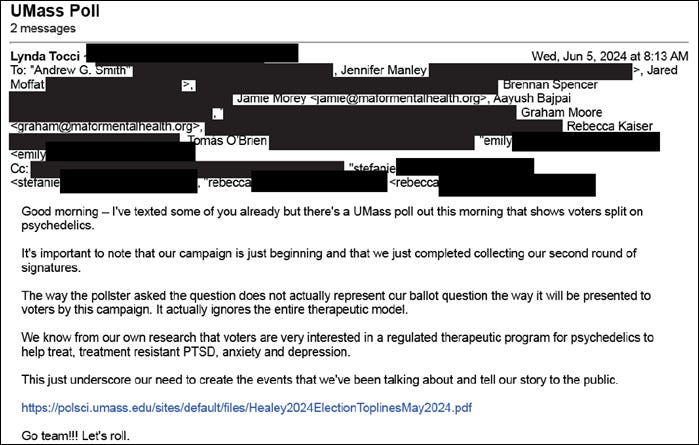
Other notable examples of communication showing Open Circle Alliance’s behind-the-scenes coordination with the ballot question committee include:
On April 30, 2024, as previously mentioned, Oneschuk using her Open Circle Alliance email to schedule a meeting with Moffat and Morey to discuss campaign event planning.
From May 23 through May 28, 2024, in a previously mentioned email thread—including only Moffat, McCourt, Oneschuk, Morey, Jones, Slater, and me (Graham Moore)—Open Circle Alliance and ballot question committee staff considering a time for “a weekly standing meeting for us to all share updates and be coordinated around outreach/coalition building,” at Moffat’s and McCourt’s direction. In response to Moffat’s initial suggested time, Jones replied, “Would this be replacing our current Thursday 11:30-12:30 ET meeting?”—confirming regular coordination predating the meeting under discussion. The email addresses for Jones and Slater used in the correspondence were their Open Circle Alliance email addresses.
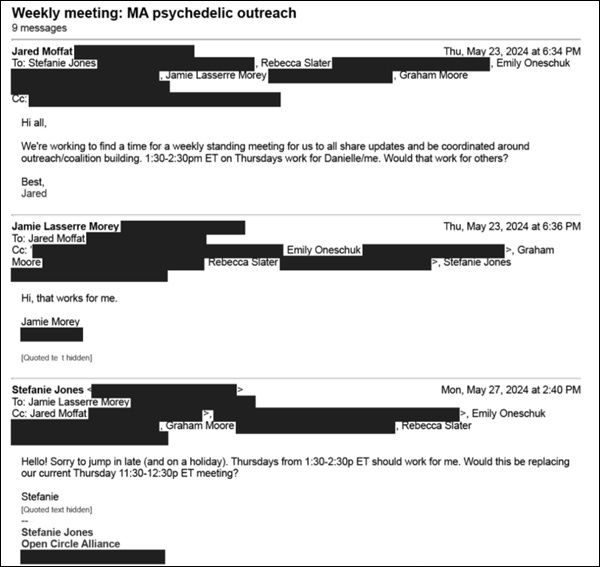
In the evening of May 28, 2024, Dewey Square Group consultant Andrew Smith scheduling the virtual standing meeting with Open Circle Alliance over email, for which Jones and Slater—contacted through their Open Circle Alliance email addresses—were the only invitees who were not formally working on behalf of the ballot question committee. The meeting was a standing campaign all-hands meeting, with other invitees including New Approach executive director Graham Boyd, New Approach legal director Todd, Moffat, McCourt, Tocci, Dewey Square Group principal/de facto ballot question committee communications director Jennifer Manley, Oneschuk, Morey, me, and multiple junior campaign consultants.
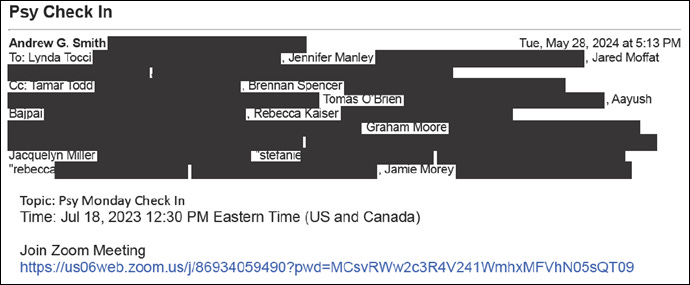
While the meeting was described in error in the body of the email as “Psy Monday Check In” and included a “Jul 18, 2023,” date—presumably carried over from when the ballot question committee was first organized in July 2023—the invitation was for an event dubbed “Psy Check In,” scheduled to be “weekly on Thursday” from “11:00 AM – 11:45 AM.”
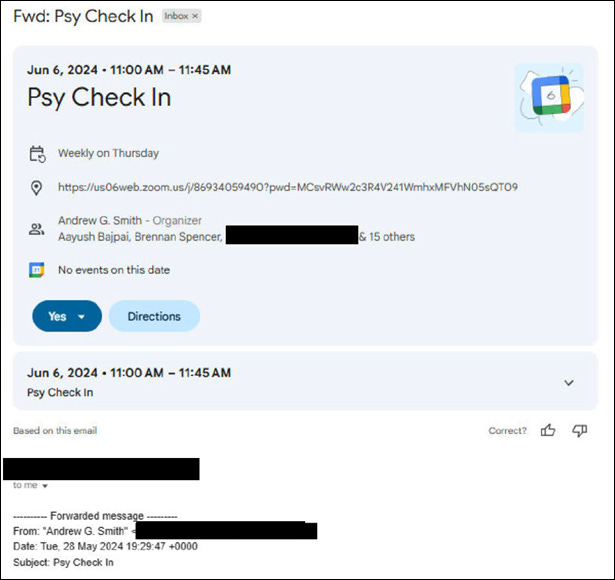
The timeslot had been chosen earlier that day by Moffat in consultation with Jones and Slater—exclusively using Jones’s and Slater’s Open Circle Alliance email addresses—as well as Oneschuk, McCourt, Morey, and me.
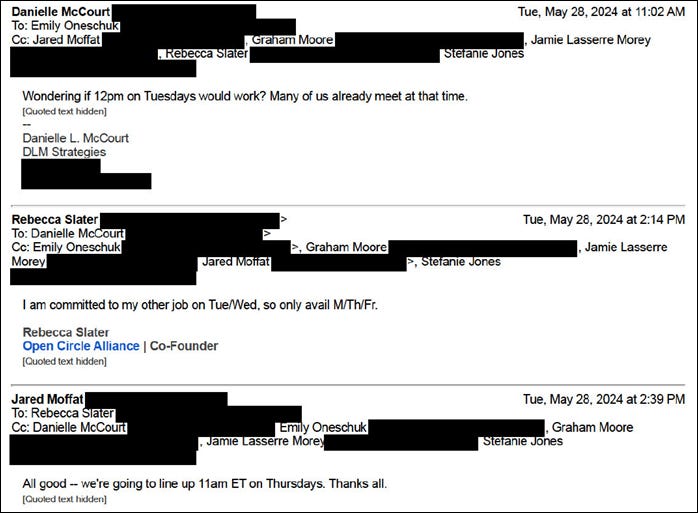
On May 30, 2024, Jones and Slater being among those emailed a meeting agenda—which was sent to Jones’s and Slater’s Open Circle Alliance email addresses—by Smith ahead of the first of the newly scheduled Thursday campaign all-hands meetings. “Open Circle launch” was included as a meeting agenda item alongside de jure campaign topics: an upcoming press conference and a town hall, which were both openly organized by the ballot question committee, as well as a plan for galvanizing physician supporters (“MD campaign plan”).
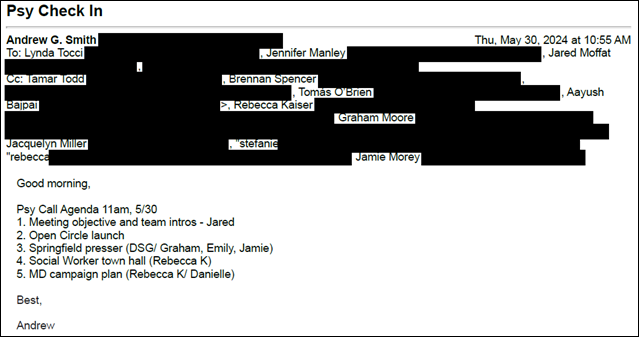
On May 31, 2024—corroborating that helping plan Open Circle Alliance’s launch had been a ballot question committee activity, as indicated by the aforementioned meeting agenda the day before—the ballot question committee recording “Open Circle Launch planning” as a concluded “Grassroots Outreach” meeting in one of its retrospective, internally distributed “weekly reports.”
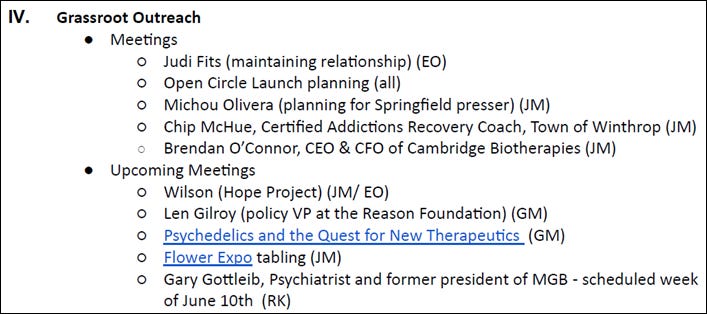
Particularly telling was the word “all,” included in parentheses next to “Open Circle Launch planning” in the document, since this specified that practically “all” campaign team members had participated in the meeting, reflecting that the planning had occurred at an all-hands meeting. The ballot question committee followed a specific convention in its weekly reports: the initials of participating ballot question committee team members were placed in parentheses in each “Grassroots Outreach” meeting entry. Illustrating this, other entries in the May 31 report included “Judi Fits (maintaining relationship) (EO)” and “Michou Olivera (planning for Springfield presser) (JM),” in which “EO” stood for Emily Oneschuk and “JM” stood for Jamie Morey.
On June 4, 2024, in response to Morey proposing the creation of promotional “t-shirts/stickers” for the campaign, Moffat replying in an email: “I like the merch idea, but actually selling t-shirts is a headache from a campaign finance perspective. maybe we could donate them to Open Circle and they could sell them to raise money or something?”
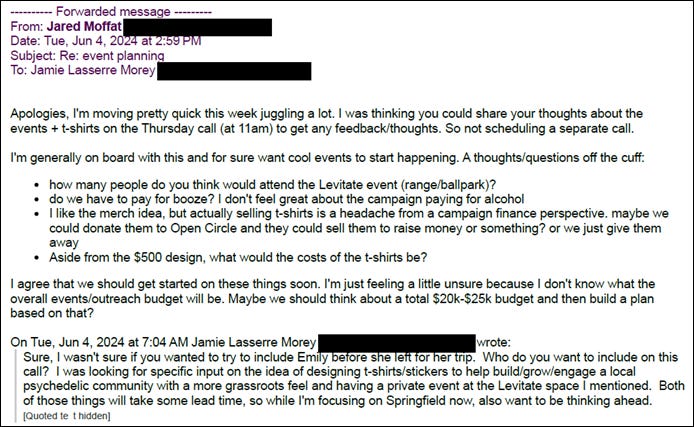
On June 12, 2024, McCourt referring to the ongoing, standing campaign meetings that included Open Circle Alliance in an email, announcing a “check in quickly at 11:45am [on Thursday] immediately following the meeting with Jared and Open Circle.”
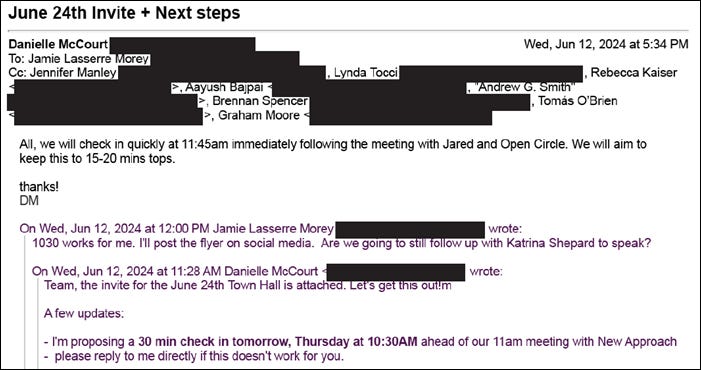
On June 13, 2024, Jones—using her Open Circle Alliance email address and an “Open Circle Alliance” email signature—reaching out to Morey for assistance finding a photographer for Open Circle Alliance’s launch event, writing:
We’re planning for Open Circle’s launch event on June 27 (hope you’re coming!!) and we’re looking for recommendations for a photographer. We’re hoping to find someone that specializes in event photography (especially nighttime / indoor). Do you have any options for us to consider / follow up on?
Morey promptly offered a recommendation, which Jones quickly replied to by inquiring: “How can we get in touch / get pricing from her?” Morey subsequently introduced Jones and Slater to the photographer via an email outside the original thread.
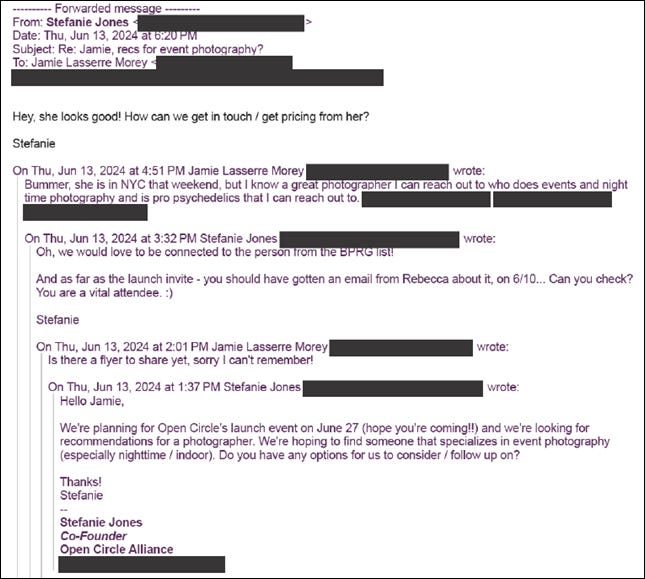
On June 18, 2024, Slater—using her Open Circle Alliance email address and an “Open Circle Alliance | Co-Founder” email signature—being the only individual not formally working for the ballot question committee included in an email thread regarding organizing a veterans-focused campaign event. Also on the email thread were McCourt, Tocci, Oneschuk, Morey, me, and four other campaign consultants, including three of Tocci’s subordinates at Dewey Square Group: Aayush Bajpai, Tomás O’Brien, and Brennan Spencer. In response to Slater assenting “to connect [with Morey] on how we can facilitate sharing info between us (outreach, contacts, etc.) on veteran & other populations,” Spencer chimed in, replying to an email from Slater with: “This is all wonderful stuff. Great work, team!”
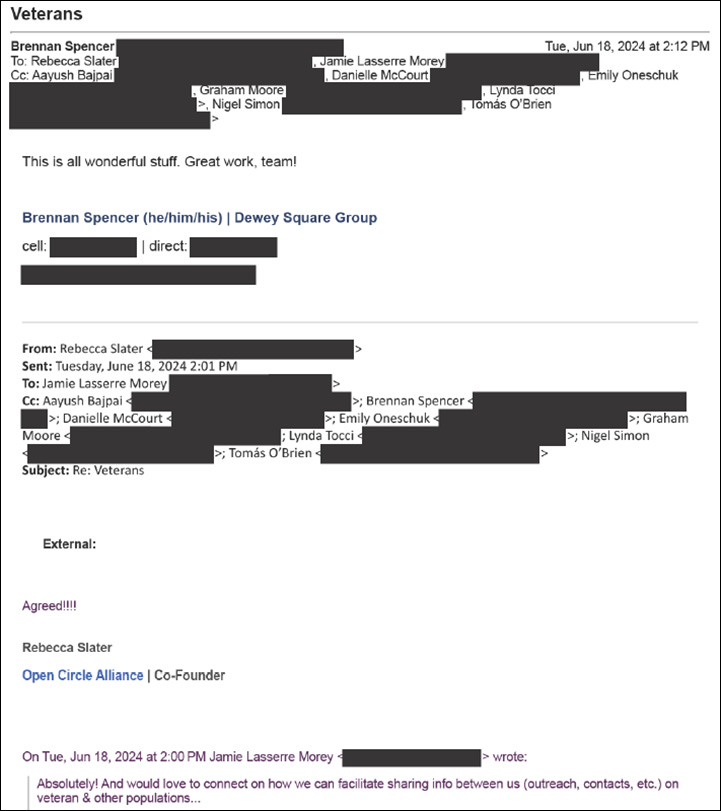
From June 20 through June 24, 2024, Morey and Open Circle Alliance officers discussing the nonprofit’s upcoming launch event in an email thread—which used Jones’s and Slater’s Open Circle Alliance email addresses (Oneschuk communicated with her ballot question committee email address)—demonstrating bidirectional organizational collaboration. Morey initiated the conversation by “following up on [her] suggestion” for Open Circle Alliance’s programming, which was to collect stories from attendees on video that could “give us some really good content to use for the [Yes on 4 campaign] website, social, etc.” Specifically addressing “Emily [Oneschuk]/Rebecca [Slater],” Morey also expressed she was “hoping we can connect sooner rather than later on veteran lists and trying to coordinate who y’all are already in contact with so I’m not duplicating efforts as I’m focused on veterans for the upcoming town hall on the 16th.” Slater responded with immediate cooperation, replying the next day to say that Open Circle Alliance “should be able to provide direction on [programming]” after an internal meeting of the nonprofit and that the officers would “get [Morey] the veterans list later today.” Finally, on June 24, Jones informed Morey that while Open Circle Alliance had ultimately rejected her suggestion, “we would like to talk further about the idea […] so perhaps we can all have a conversation together about what’s possible, a few days after the launch.”
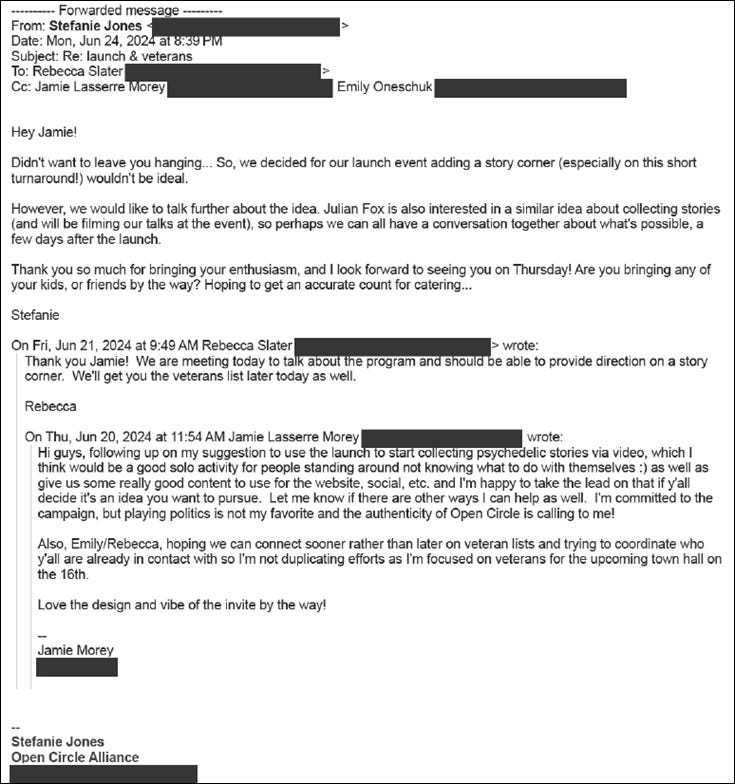
On June 21, 2024, the ballot question committee’s retrospective, weekly report including the following entry in its list of “Grassroots Outreach” meetings: “Open Circle Launch Planning (EO, ongoing).”
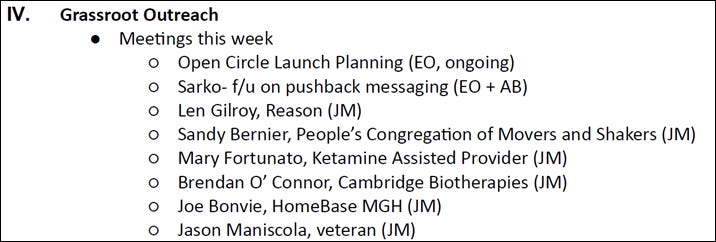
This showed the ballot question committee considered the “ongoing” participation of “EO” (Emily Oneschuk) in planning Open Circle Alliance’s launch event to be labor she was performing on behalf of the ballot question committee. If there had been a strict firewall between Oneschuk’s role for the ballot question committee and her role for Open Circle Alliance, then Oneschuk’s role in planning an event for Open Circle Alliance—a nonprofit she was an officer of—would have had no relevance to the report. After all, the many meetings that ballot question committee staff participated in that were not directly related to campaign work—such as Tocci’s meetings for her non-ballot question committee consulting clients—were never included in the weekly reports. Moreover, even in the case of Heroic Hearts Project—an established nonprofit that explicitly endorsed Question 4—no purely internal meetings of the veterans charity were included in the weekly reports, no matter how relevant to the campaign.
On September 16, 2024, Morey emailing Open Circle Alliance—allegedly at Moffat’s suggestion—to inquire whether the campaign could use Open Circle Alliance’s nonprofit status in order to get the campaign a “non profit booth asap” at an upcoming third party event.
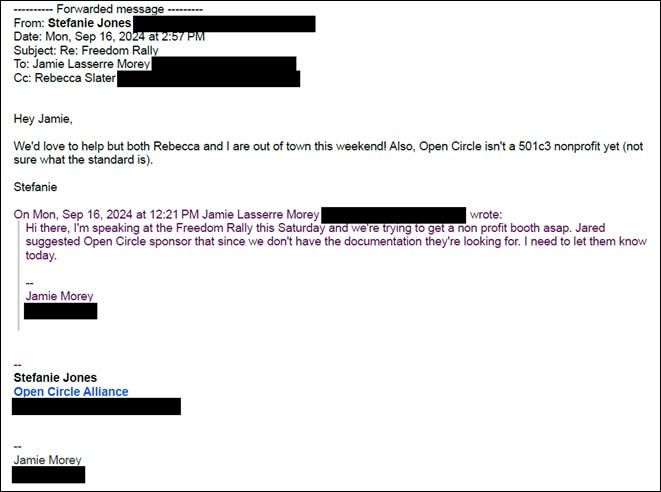
On October 15, 2024, in a ballot question committee group chat, Tocci floating having “Rebecca [Slater], Stefanie [Jones] to call in” as Question 4 supporters—noting “we can have one or two interns [call in] as well”—to the program hosting Oneschuk’s televised campaign debate, which had invited audience members to call in to share their thoughts on the ballot measure after the debate.
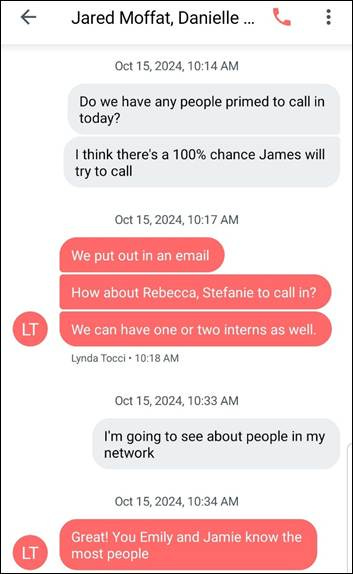
3.4 An Obfuscated Association
Despite the close ties between the two organizations, neither Open Circle Alliance nor the ballot question committee reported any campaign contributions from Open Circle Alliance to the ballot question committee, maintaining that none of Open Circle Alliance’s activities—even paying for food (such as “free mushroom sliders”) provided to attendees at formal campaign events that Open Circle Alliance openly co-organized with the ballot question committee—constituted electioneering.

As previously noted, Open Circle Alliance’s Question 4 factsheets, which debuted in August 2024, contained the disclaimer that “Open Circle Alliance is not associated with the Yes on 4 campaign and strives to present clear and neutral information,” even while the nonprofit’s current treasurer, Emily Oneschuk, was being directly paid over $10,000 per month by the Yes on 4 campaign.
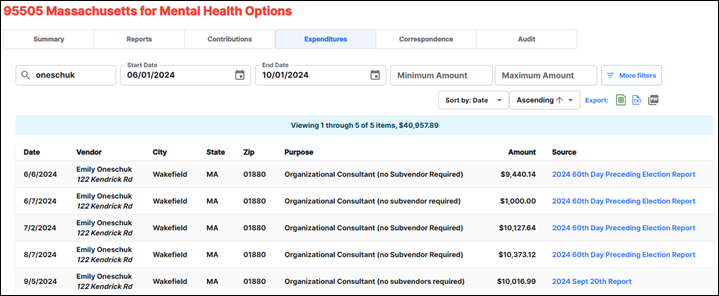
In response to public criticism from Jamie Morey and me related to the nonprofit’s lack of transparency, Open Circle Alliance issued a series of denials in 2025:
On July 21, 2025, The Boston Globe reported that, in response to allegations of campaign finance violations:
Open Circle Alliance said in a statement that it operated independently from the [Yes on 4] campaign and did not receive funding from it or New Approach. Oneschuk “stepped back” from alliance activities last June to work on the campaign, said Stefanie Jones and Rebecca Slater, co-founders of the group.
On August 8, 2025, Open Circle Alliance sent a lengthy email to its distribution list that included a rebuttal of “the claims that Open Circle Alliance was not independent from the Yes on 4 campaign”:
We unexpectedly had to shift our attention and energy to addressing questions about our relationship to the Yes on 4 campaign. These concerns have surfaced in the media and in community conversations, and we felt it was important to share more context with our newsletter community—both by sharing our official statement and offering clarity about our origins and funding.
Since our founding in 2024, we have worked to shape a safe, supportive psychedelic ecosystem in Massachusetts. Unfortunately, our work was misinterpreted as being a secret extension of the New Approach PAC and the Yes on 4 campaign. Two former Yes on 4 campaign staffers, Jamie Morey and Graham Moore, filed complaints with the Massachusetts Office of Campaign and Political Finance (OCPF), alleging that Massachusetts for Mental Health Options violated campaign finance laws through its involvement with Open Circle Alliance, Heroic Hearts Project, and Students for Sensible Drug Policy. Our public statement on the matter is as follows:
The claims that Open Circle Alliance was not independent from the Yes on 4 campaign are false. Open Circle Alliance was founded to foster community and provide education within Massachusetts’ growing psychedelic ecosystem—work that we continue to this day. To see these allegations from individuals we believed to be aligned with our mission is deeply disheartening. We have not been contacted by OCPF, but if we are, we will fully support and respect their process. In the meantime, we remain focused on our mission and activities that bring this community together, rather than drive it apart.
Clarifying our Relationship to New Approach and the Campaign
Open Circle Alliance is not a project or “secret tool” of New Approach, which ran the Yes on 4 campaign, and was not directed in any way by anyone on the Yes on 4 campaign. Nor did the organization receive funding from Massachusetts for Mental Health Options, New Approach PAC, or the New Approach Advocacy Fund.
Early conversations about the need for a psychedelic community education hub included Jared Moffat of New Approach, who is a longtime friend and colleague of Stefanie, one of Open Circle’s co-founders. However, even from its very inception in April 2024, co-founders Rebecca, Stefanie and Emily agreed: Open Circle Alliance would serve a distinct community development and educational purpose that would carry on whether Question 4 succeeded or failed.
Maintaining proper boundaries with the Yes on 4 campaign, while still doing important education work among the psychedelic community about the legislation, was always top of mind. In part due to these considerations, in June 2024, Emily disengaged from all Open Circle operations to focus on the role she had accepted with the campaign. From that time onwards, she remained involved in name only.
Communication is not collusion. Education is not electioneering. We are proud of the work we did in 2024 to bring the psychedelic community together and to and to offer clear, accessible information about what might have been a landscape-changing piece of legislation.
Moving Forward…
It has been dismaying to have the integrity of our mission and actions misunderstood and mischaracterized by community members we’ve sought to support. And yet, we continue onward.
We want to be clear: Open Circle Alliance exists to convene, connect and create, to be a gathering space so no one walks this path alone. We are committed to building up the psychedelic community in Massachusetts to the best of our ability, and we hope to continue earning your trust as we do so.
On October 12, 2025, Lucid News reported on the myriad shortcomings of the Yes on 4 campaign, including a new statement from Open Circle Alliance (also referred to in the article by the acronym OCA):
In a statement provided to Lucid News, Slater and Jones deny that their organization was directly affiliated with the Yes on 4 campaign and stand by the work they did at the time. “Open Circle Alliance did not have a ‘strategy for educating voters,’” the statement added. “Our focus has always been on community-building and education within the psychedelic ecosystem.”
These denials—similar to the disclaimers on Open Circle Alliance’s factsheets—ignored, minimized, and contradicted documented activities that tied the nonprofit to the ballot measure effort. Moreover, the rebuttals made broad claims and addressed strawman arguments rather than specifically contesting key factual details underpinning Morey’s and my assertions.
In our complaints to state regulators and in our statements to The Boston Globe, Morey and I had been unequivocal in claiming the veterans charity Heroic Hearts Project, in collaboration with New Approach, had funded Open Circle Alliance. As previously mentioned, this contention had already been corroborated by Jones herself, who had written in a March 2025 email to Morey and me (among others): “the idea and funding for a community org originated in collaboration with New Approach.” Accordingly, Morey and I had not alleged that the ballot question committee had directly supported Open Circle Alliance financially except by unofficially compensating Emily Oneschuk for both parts of her dual role: grassroots campaign director for Yes on 4 and co-founding officer for Open Circle Alliance. Yet Open Circle Alliance’s public denials did not explicitly address the claims regarding the Heroic Hearts Project funding and its origins; instead, they denied funding specifically from Massachusetts for Mental Health Options (the ballot question committee) and New Approach (New Approach PAC and New Approach Advocacy Fund). Likewise, Morey and I had maintained that Open Circle Alliance was intended by campaign organizers to be complementary to the ballot question committee and persist as an entity beyond the election—filling a political gap created by Bay Staters for Natural Medicine—but Open Circle Alliance presented the claim that “from its very inception in April 2024, co-founders Rebecca, Stefanie and Emily agreed: Open Circle Alliance would serve a distinct community development and educational purpose that would carry on whether Question 4 succeeded or failed” in a rebuttal as if it refuted our contentions.
More significantly, Open Circle Alliance’s categorical assertion that the nonprofit had always operated independently from the Yes on 4 campaign clashed with the reality that it had been officially co-founded by Oneschuk—a fact implicitly acknowledged by Open Circle Alliance’s repeated claim that Oneschuk had quickly distanced herself from the nonprofit. If Oneschuk “disengage[ing] from all Open Circle operations to focus on the role she had accepted with the campaign” was appropriate to maintain boundaries in June 2024, as Open Circle Alliance’s rebuttals indicated, then Oneschuk’s simultaneous operational roles for Open Circle Alliance and the ballot question committee during the months of April and May in 2024 intrinsically undermined the nonprofit’s contention that “the claims that Open Circle Alliance was not independent from the Yes on 4 campaign are false.” Moreover, the language Open Circle Alliance used in describing Oneschuk’s mitigating behavior to its distribution list—“in June 2024, Emily [Oneschuk] disengaged from all Open Circle operations to focus on the role she had accepted with the campaign”—implied Oneschuk had formally joined the Yes on 4 campaign shortly before, or contemporaneous with, when she “stepped back.” In fact, Oneschuk had accepted a high-profile, paid campaign official role in 2023, more than four months before Open Circle Alliance was incorporated on April 19, 2024.
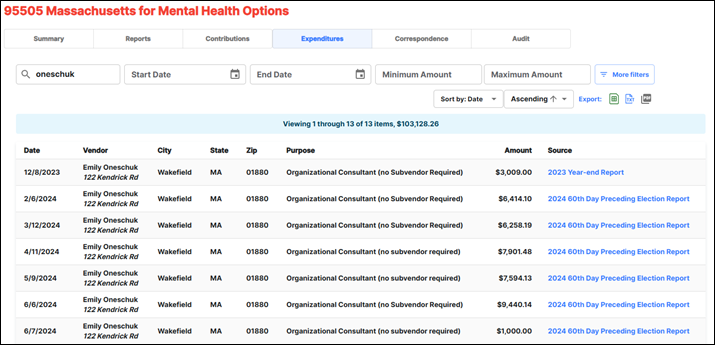
By June 2024, Oneschuk had accepted her role with the campaign more than six months prior. In this context, it would have been more accurate for Open Circle Alliance’s rebuttal to have described Oneschuk’s grassroots campaign director position for the ballot question committee—which Oneschuk had been filling since well before Open Circle Alliance existed—as “the role she had been serving with the campaign” rather than what was actually written: “the role she had accepted with the campaign.” By obscuring the timeline of Oneschuk’s employment with the ballot question committee in arguing that Open Circle Alliance had always been “independent from the Yes on 4 campaign,” the nonprofit expressed a lack of confidence in its own position. If Oneschuk’s dual role did not intrinsically subvert Open Circle Alliance’s claim of independence, then using straightforward language in characterizing Oneschuk’s professional activity would have strengthened the credibility of Open Circle Alliance’s defense.
But the apparent refusal of Open Circle Alliance to concede there had been any significant overlap with the ballot question committee—even though, within certain limits, nonprofit support for ballot measure campaigns was legally and ethically permissible—meant reconciling established facts with Open Circle Alliance’s preferred narrative of autonomy required a degree of rhetorical obliqueness that may have confused even its authors. Illustrating the point, Open Circle Alliance claimed in a rebuttal that it “was not directed in any way by anyone on the Yes on 4 campaign,” overlooking that Oneschuk was specifically listed as a “director” of Open Circle Alliance—at the same time she was grassroots campaign director for Yes on 4—in the nonprofit’s publicly-available articles of incorporation. By definition, then, Open Circle Alliance was directed by an individual on the Yes on 4 campaign: its co-founding treasurer and director Oneschuk.
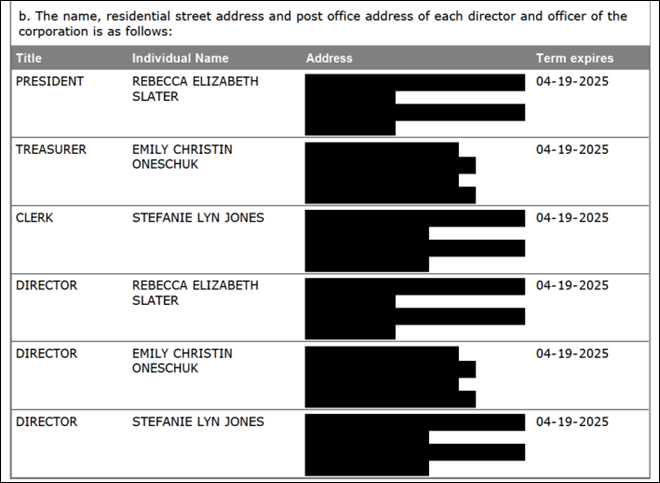
Even ignoring Oneschuk’s role, however, Open Circle Alliance’s contention that it had not been directed “in any way” by a member of the Question 4 campaign—a blanket denial of a vast range of (“any”) directive behaviors—was in contradiction to its officers’ interactions with ballot question committee members over email and text message. In a particularly revealing case, on October 27, 2024, I—in my capacity as Yes on 4’s educational outreach director and using my campaign email address—contacted all three officers of Open Circle Alliance (which I referred to by its acronym, OCA) effectively requesting Open Circle Alliance send a mass email promoting a campaign rally. Technically, my message—addressed to Jones’s and Slater’s Open Circle Alliance email addresses and with the subject line: “Email blast out through OCA promoting October 29 event?”—asked whether Open Circle Alliance “could” send a promotional email to help produce an “awesome” outcome, rather than instructed the organization to do so:
Hi everyone, hope you all are having a wonderful weekend. I was wondering if OCA could send out an email blast promoting the October 29 event? It’d be awesome if we had a big crowd.
But my intended meaning (asking Open Circle Alliance to promote the rally) appeared to have been understood. At 5:14 PM on October 28, 2024, the desired promotional email arrived in my inbox as a subscriber to Open Circle Alliance’s distribution list. A little over an hour later, Jones—using her Open Circle Alliance email address and carbon copying Slater and Oneschuk—replied to the inquiry I had sent Open Circle Alliance the day before, implicitly confirming Open Circle Alliance had acted at my direction: “We sent a message out around 5p. Hope it helps!”
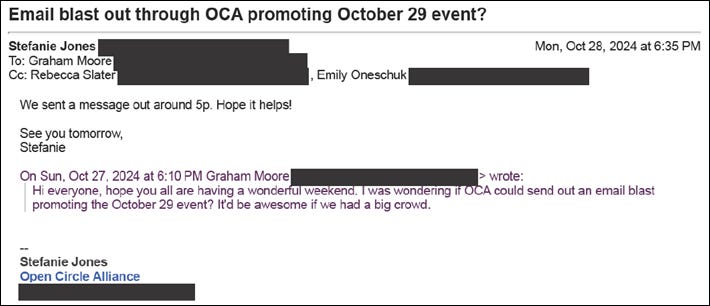
This interaction, while not inherently untoward (I had sent similar messages to organizations openly supportive of the campaign, such as the 501(c)(4) nonprofit Progressive Massachusetts, most commonly known as Progressive Mass) was a clear case of Open Circle Alliance appearing to be directed, in some “way,” by an individual on the Yes on 4 campaign. Furthermore, the consistent inclusion of Oneschuk on the emails regarding Open Circle Alliance advertising the campaign rally contradicted the claim that, after June 2024, Oneschuk had “remained involved [with Open Circle Alliance] in name only.” If Oneschuk had truly been “involved in name only,” Jones would have been unlikely to carbon copy Oneschuk on her answer to me, even if I had included Oneschuk in my outreach in error. My understanding at the time, informed by contemporaneous communications with Oneschuk and others, was that—while Oneschuk strongly prioritized her grassroots campaign director role over her involvement with Open Circle Alliance after June 2024—she remained involved with Open Circle Alliance in a diminished, but more than merely nominal, capacity through the end of the election.
Other examples of Open Circle Alliance appearing to be directed by one or more individuals, other than Oneschuk, on the Yes on 4 campaign include:
Open Circle Alliance having its launched planned in collaboration with ballot question committee staff during a campaign all-hands meeting on May 31, 2024, as previously mentioned.
Open Circle Alliance officers Jones and Slater agreeing to have Open Circle Alliance co-organize a campaign event with the ballot question committee at the invitation of Morey on September 25, 2024—sent to Jones’s and Slater’s Open Circle Alliance email addresses. In response to Morey writing she “thought Open Alliance might want to have a presence at the preshow event,” Jones answered from her Open Circle Alliance email address: “Hey Jamie, very nice! Do you have the exact timing that you’d want us onsite? I will discuss it with Rebecca in our meeting tomorrow.” The details were worked out in subsequent communications, and the event in question—“a special night of discussion, free mushroom sliders (!), and a screening of Music for Mushrooms”—was held on October 6, 2024, as previously mentioned.
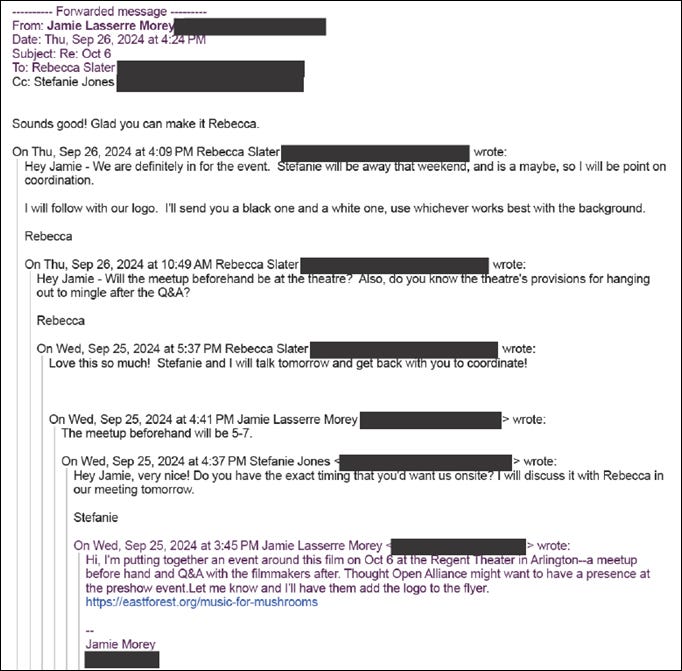
At Morey’s direction, Open Circle Alliance officer Slater acquiescing to using Heroic Hearts Project’s tax-exempt status to avoid paying taxes on Open Circle Alliance’s order of food for the October 6, 2024, campaign event (Open Circle Alliance had not applied for, nor received, tax-exempt status).
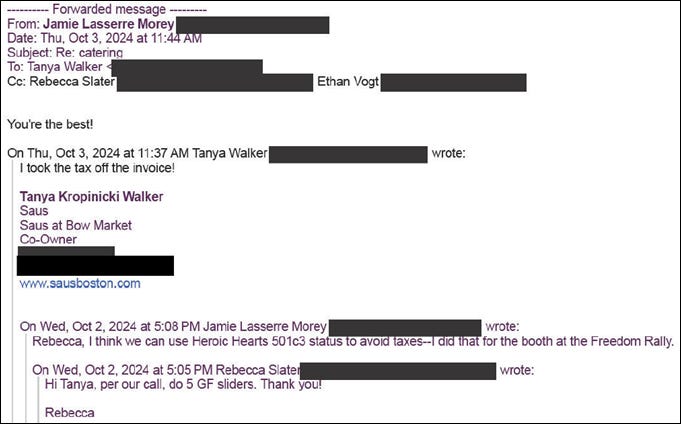
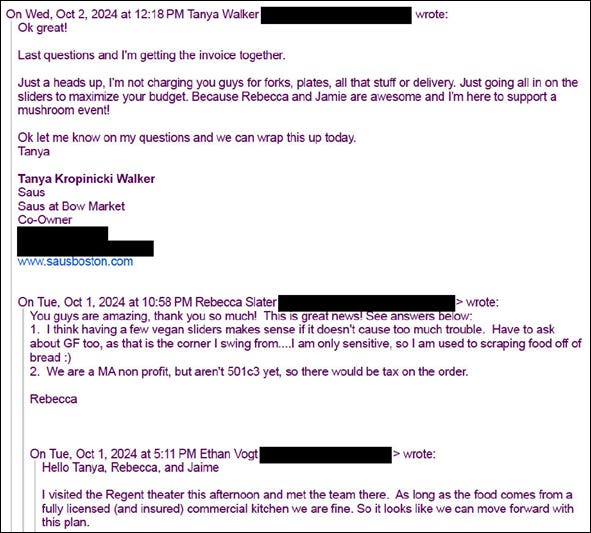
Open Circle Alliance officer Slater—using her Open Circle Alliance email address—asking Morey for “[her] thoughts” about a potential collaboration with the ballot question committee on October 11, 2024, writing: “I don’ t have huge bandwidth, but have a bit and can help. Let me know your thoughts.” After Morey confirmed that “Yes on 4” was going to hold an event, Slater reiterated she could “help,” and then she and Morey arranged a call “to chat about planning details.” The event in question—a second film screening of Music for Mushrooms, with accompanying discussion—was held on November 3, 2024, as previously mentioned.
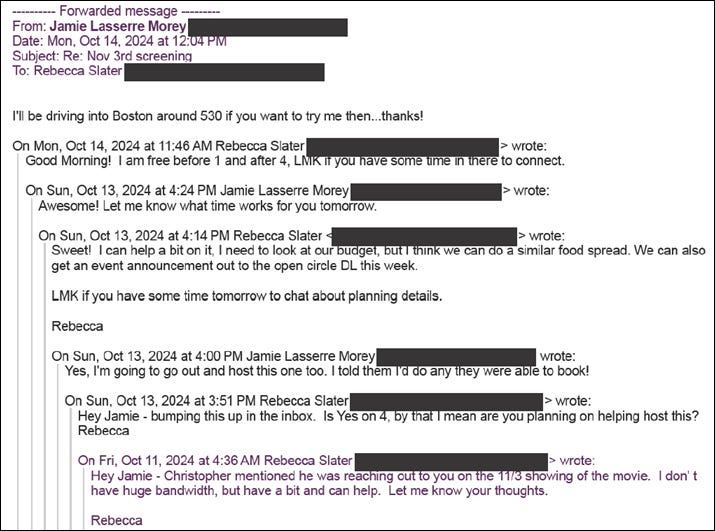
Open Circle Alliance officers Jones and Slater implicitly agreeing to encourage individuals to attend a canvassing event for the ballot question committee, in response to a direct request from Morey, on October 15, 2024. Morey messaged Jones’s and Slater’s Open Circle Alliance email addresses, writing: “Hey, if y’all know of anyone eager to help out on the campaign, please encourage them to attend to the Cambridge canvassing event tomorrow!” Less than two hours later, Slater replied from her Open Circle Alliance email address, carbon copying Jones’s Open Circle Alliance email address, asking for information necessary to fulfill the request: “Hey Jamie - Can you send more details on time/location?”
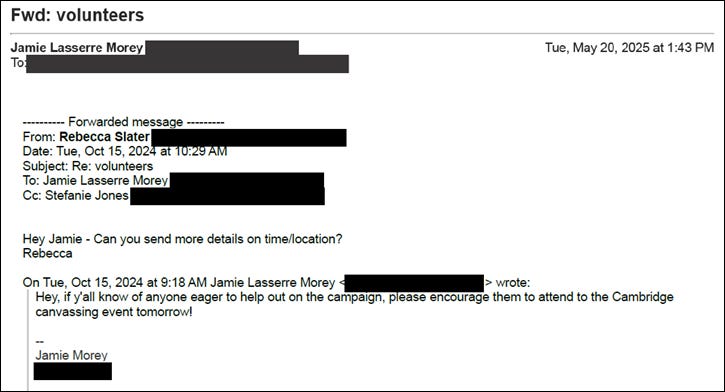
Open Circle Alliance officers Jones and Slater participating in multiple campaign all-hands meetings in the final week of the election, as previously mentioned. These meetings were dedicated to providing unifying direction for electioneering efforts, as reflected in a meeting agenda emailed to attendees—including to Jones and Slater at their Open Circle Alliance email addresses—on October 29, 2024. The agenda explicitly included multiple specific calls to action:
o “Be there [(at the campaign rally Open Circle Alliance promoted)] by 11:15am!”
o “Phone bank today 5:30-7:30 - join us”
o “Help us recruit.”
o “If you’re at the presser, share a picture.”
o “If you’re not at the presser, retweet/repost the campaign accounts.”
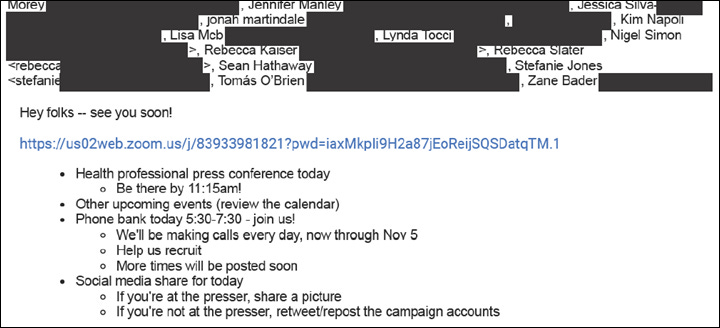
In the wake of a call to action at one of the campaign all-hands meeting they attended, Open Circle Alliance officers Jones and Slater—using directions emailed to their Open Circle Alliance email addresses—canvassing voters in the final week of the election using the ballot question committee’s auto-dialing and texting services, as previously mentioned.
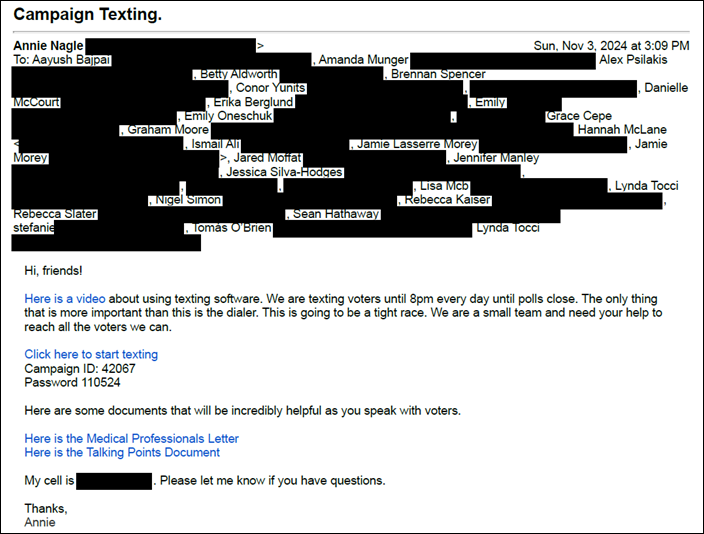
Additional communications—about, rather than to, Open Circle Alliance officers—also reflected that the ballot question committee took for granted that it could direct Open Circle Alliance:
On August 13, 2024, “work notes” that I emailed myself after internal campaign meetings included, “veteran signature gathering could be offhanded to someone else – intern, open circle alliance,” referring to the sign-on endorsement letter for veterans the campaign was circulating.
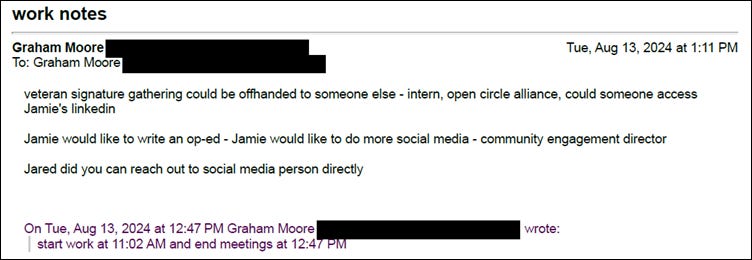
On October 15, 2025, Tocci inquired in an email thread regarding participation in a campaign canvass, “Have we asked Stefanie [Jones] to join?” Less than two hours later, as previously mentioned, Tocci wrote in a ballot question committee group chat regarding who could call into a program in support of the ballot question: “How about Rebecca [Slater], Stefanie [Jones] to call in? We can have one or two interns as well.”
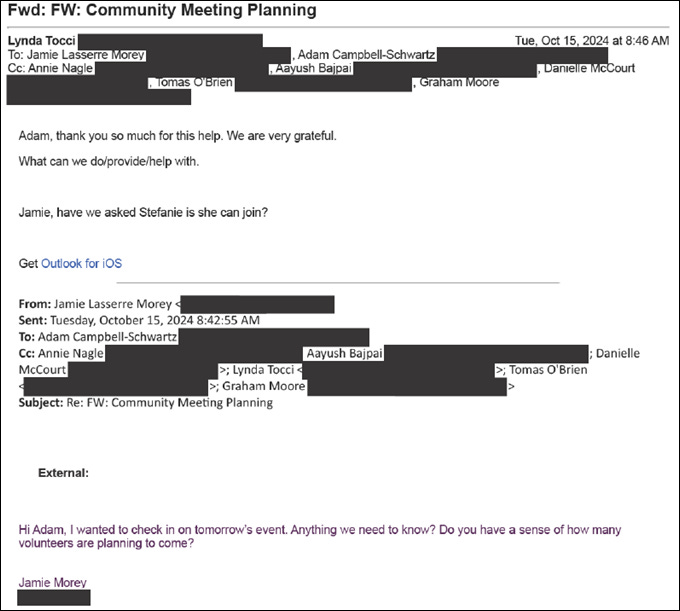
In light of the aforementioned, non-exhaustive evidence, the assertion that “Open Circle Alliance […] was not directed in any way by anyone on the Yes on 4 campaign” (emphasis in italics mine) was clearly inaccurate.
More strikingly, Open Circle Alliance’s claims that “in June 2024, Emily [Oneschuk] disengaged from all Open Circle Alliance operations to focus on the role,” and “from that time [(June 2024)] onwards, she remained involved in name only,” were contradicted by Open Circle Alliance’s own, publicly-available filings to the Massachusetts state government. In Open Circle Alliance’s annual report submitted to the Corporations Division in November 2024, the nonprofit still listed Oneschuk as the treasurer and a director. In Open Circle Alliance’s disclosure of its principal executives to the Office of the Attorney General in Massachusetts in August 2025, Open Circle Alliance stated, “Emily Oneschuk, Treasurer resigned 7/24/2025”—more than a year after June 2024 and just three days after The Boston Globe published an article on alleged campaign finance violations by the nonprofit.
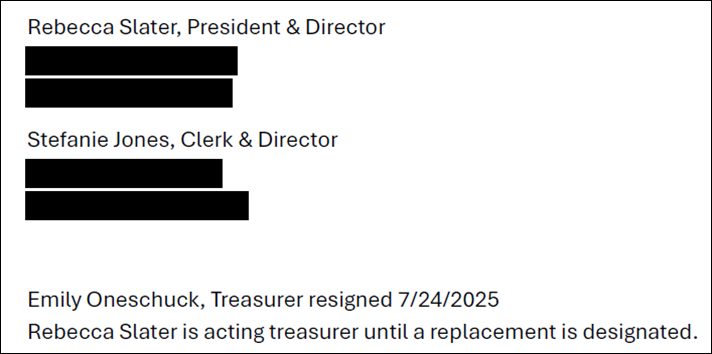
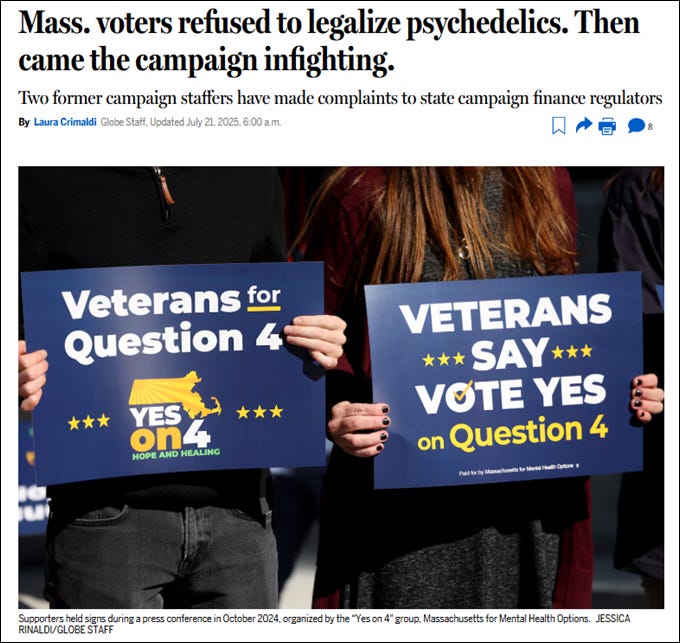
Under Massachusetts law, a nonprofit’s treasurer remains a fiduciary of the organization until the treasurer is either formally replaced or formally resigns; the filing by Open Circle Alliance thus confirmed that Oneschuk held legal authority over its finances long after the date when she ostensibly “disengaged from all Open Circle operations.”
Moreover, Open Circle Alliance never issued a public statement announcing Oneschuk’s withdrawal prior to being contacted by The Boston Globe for the July 2025 article. On the contrary, Open Circle Alliance’s “thank you” email to its distribution list on July 2—less than a week after its public launch party—indicated, with no ambiguity, that Oneschuk would continue to be more than nominally involved in the nonprofit. The message featured Oneschuk in a photograph with her two co-founders, was signed, “Rebecca Slater, Stefanie Jones, and Emily Oneschuk Open Circle Alliance Co-Founders,” and included a declaration from the co-founders that, “We will be planning more events coming up.”
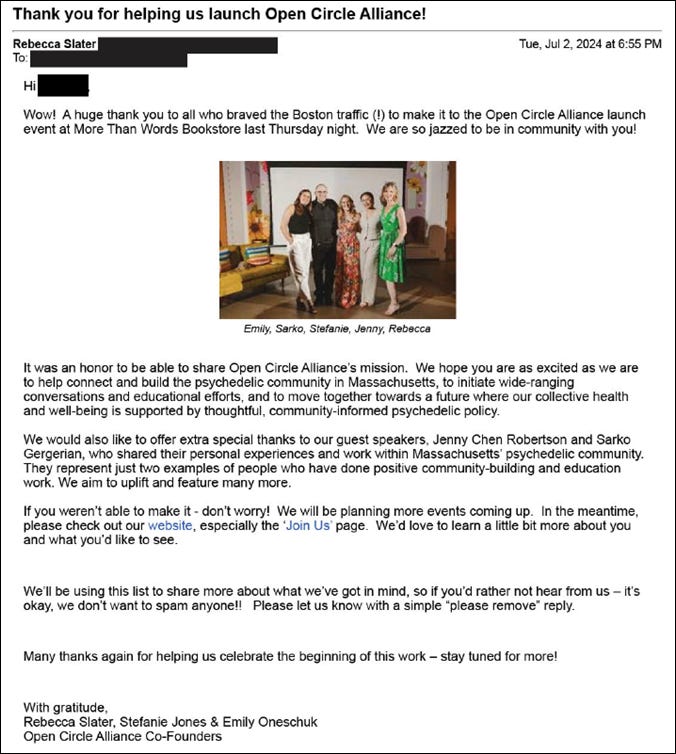
This framing was corroborated by the only contemporaneous media coverage of the launch event—an Instagram post and the June 28, 2024, Psychedelic Spotlight article, written by a journalist who had been in email correspondence with Oneshuk—which gave no indication Oneschuk was stepping back. In fact, the article exclusively quoted Oneschuk as a representative of the nonprofit, who spoke about her shared vision for Open Circle Alliance in the present tense:
‘We are focused on developing the psychedelic community within MA, educating on psychedelic substances and opening conversations about an array of different psychedelic policies, not just therapy,’ said Oneschuk. ‘We want to make sure people know that we are looking at the topic broadly and working to create a community that considers and supports many facets of the space.’
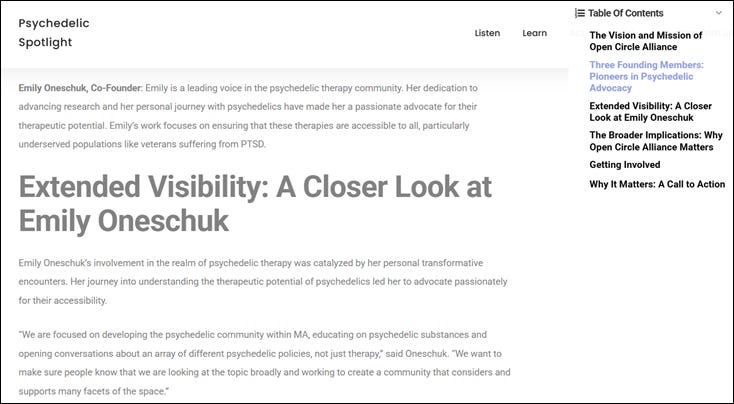
Further corroboration came from reporting by Lucid News in a 2025 article about the shortcomings of the Yes on 4 campaign: “According to multiple eyewitnesses, Oneschuk reportedly spoke about her plans for [Open Circle Alliance]’s future at the group’s official launch party on June 27, 2024.”
If, as Open Circle Alliance had claimed in its August 2025 rebuttal, the decision had been made for Oneschuk to “remain[] involved in name only,” stemming “in part” from “maintaining proper boundaries with the Yes on 4 campaign, while still doing important education work among the psychedelic community about the legislation, [being] always top of mind,” then concealing Oneschuk’s step-back at the June 27 launch party—instead of announcing the transition as a proactive step to mitigate conflict of interest—defeated the purpose.
But instead of publicly claiming—prior to Open Circle Alliance’s July 2025 statement to The Boston Globe—that Oneschuk had “stepped back” from the nonprofit, Open Circle Alliance indicated on its website, and in a February 2025 email to its distribution list, that Oneschuk continued to be prominently involved long into 2025. This encompassed Open Circle Alliance spotlighting Oneschuk on its website—including by displaying her photograph—as a co-founder who “currently serves as the Grassroots Campaign Director for Massachusetts for Mental Health Options” even as Oneschuk starred in a Yes on 4 television commercial. The featuring of Oneschuk on the Open Circle Alliance website remained unchanged until as late as June 29, 2025—more than eight months after the election—and Oneschuk’s biography on the website never claimed or suggested she had withdrawn from active involvement with the nonprofit.
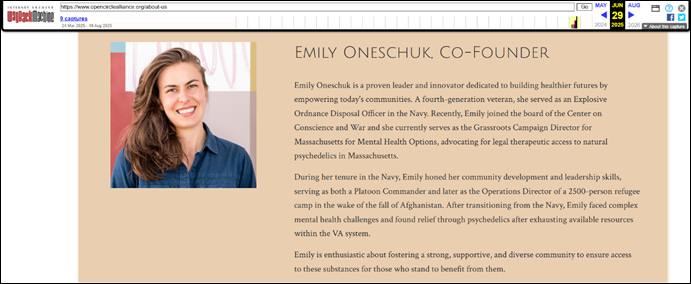
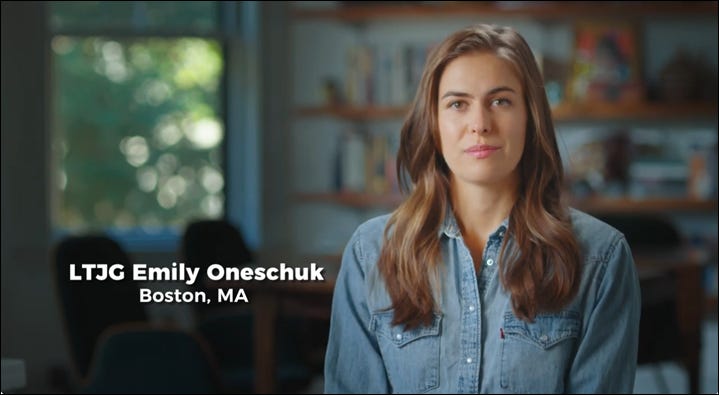
In addition, on February 21, 2025, Open Circle Alliance issued a newsletter that featured Oneschuk, posing directly next to her nonprofit co-founders Jones and Slater, in the center of a group photograph taken at an Open Circle Alliance event earlier that month.
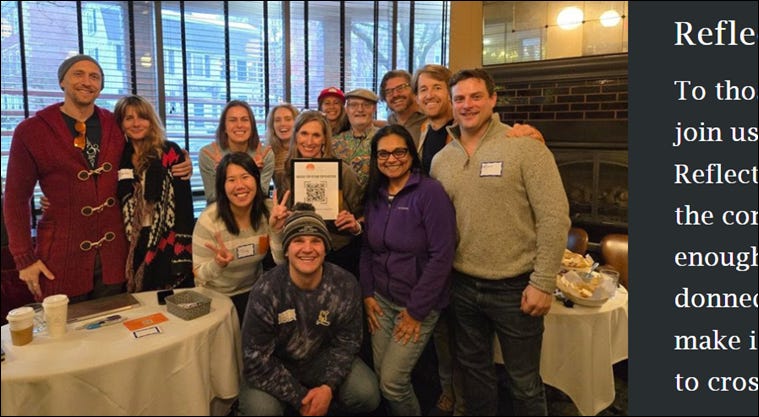
As previously mentioned, my contemporaneous understanding—corroborated by documentation—was that Oneschuk remained more than nominally involved with Open Circle Alliance’s operations at least through the end of the 2024 election. Even assuming Oneschuk substantively reduced her participation in the nonprofit starting at the end of June 2024—since it is indisputable that Oneschuk headlined Open Circle Alliance’s June 27 launch event—it was not accurate to claim that “from that time [(June 2024)] onwards, she remained involved [with Open Circle Alliance] in name only.” This was especially the case considering Oneschuk was replaced as Open Circle Alliance’s resident agent—tangibly reducing her responsibilities for the nonprofit—only on August 7, 2024.
More than a year after that, in its August 2025 rebuttal, Open Circle Alliance wrote, “Communication is not collusion. Education is not electioneering.” Its invocation of these truisms as exculpatory obfuscated that all three of Open Circle Alliance’s officers had engaged in activities—such as explicitly asking voters to support the ballot question and prepping for a campaign debate—that were, by definition, electioneering, and they had done so well after Open Circle Alliance had been incorporated and in collaboration with the ballot question committee, as reflected by Oneschuk’s public-facing dual role.
Furthermore, the selective nature of the boundaries Open Circle Alliance did enforce with the Yes on 4 campaign suggested a tactical concern for the appearance of regulatory compliance rather than a commitment to operational independence. For example, when Morey contacted Open Circle Alliance on August 1, 2024, to request “all photos of the [June] launch event […] to have some of the community and me/Graham [Moore] to possibly use in campaign materials,” Jones initially replied that the photographs could only be made available for Morey’s “personal use” because of the possibility that “to allow the campaign to use the photos from [Open Circle Alliance’s] event in its materials would put Open Circle Alliance in jeopardy of not receiving [its] 501c3 nonprofit status - there are very strict rules about nonprofits not being involved in political campaigns.” However, after Morey clarified that she was “[primarily] thinking of using [the photographs] to potentially highlight community events we attend (like ones we took at a recent veteran event I attended,” Jones—carbon copying Oneschuk and Slater—emailed Morey a link to download the photographs later that same day, without reiterating her prior stance regarding “personal use”:
Here’s the link to the photos: [redacted]
You should be able to download the ones you want directly. If you plan to post any publicly and they include other people, can you check back with us first? For example, there’s one where you’re talking to a woman in a white shirt and we know that she explicitly didn’t want anything posted publicly. And of course please mention the pictures are from the Open Circle Alliance launch and link to us if you can. :)
Let me know if you have any other questions!
Stefanie
Less than four hours after she had expressed caution regarding “very strict rules about nonprofits not being involved in political campaigns” in response to Morey, Jones had seemingly reversed course—implicitly greenlighting the use of the Open Circle Alliance-commissioned images for the ballot question committee on the condition that Morey met three requests:
Morey “check[ed] back with [Open Circle Alliance]” before posting publicly any photograph that “include[d] other people [besides campaign officials],” in case the photographs included any event attendees—such as the “woman in a white shirt” who “explicitly didn’t want anything [(any images of her at the launch party)] posted publicly”—likely to take umbrage with being featured in promotional material.
Morey “mention[ed] the pictures [were] from the Open Circle Alliance launch.”
Morey “link[ed] to Open Circle Alliance if [she could]” when posting the photographs publicly.
With the tacit approval of Oneschuk and Slater, Jones chose promoting Open Circle Alliance through the Yes on 4 campaign over enforcing a previously set boundary.
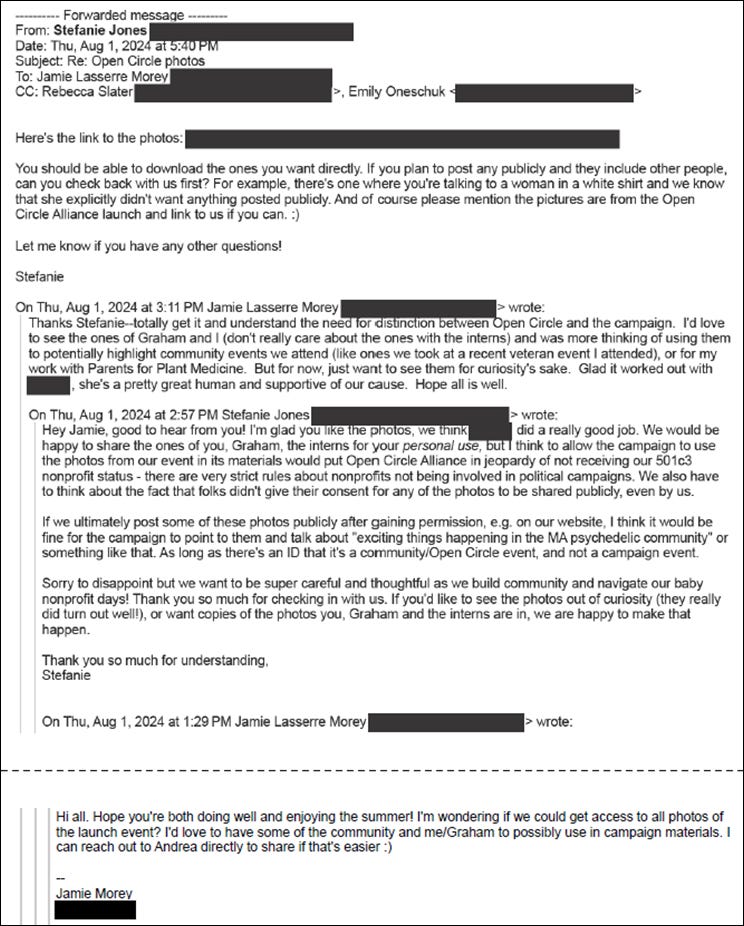
In another revealing case, Open Circle Alliance and the ballot question committee agreed to co-host a “community meeting” in Cambridge, Massachusetts—to be held in September or October—in the second half of August 2024. The event was organized in collaboration with the office of a city councilor in Cambridge, whose legislative aid explained it as follows: “The idea would be to discuss the ballot initiative somewhere in Cambridge in September or October. We’d advertise an event to constituents, similar to some other ‘donuts and discussion’ events we’ve done with other legislators that had a couple dozen residents attend.”
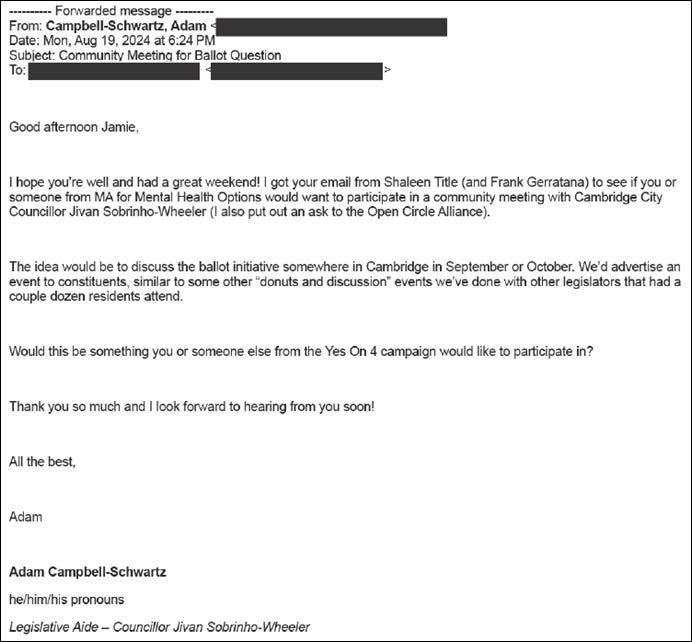
After several weeks of organizing, however, the city councilor floated changing the event into an overt, on-the-ground Yes on 4 canvass—initially framed by his legislative aide as “an opportunity to recruit volunteers to canvass.” And when the ballot question committee embraced this proposal, Open Circle Alliance withdrew from co-hosting, citing that its participation could endanger the nonprofit’s 501(c)(3) status.
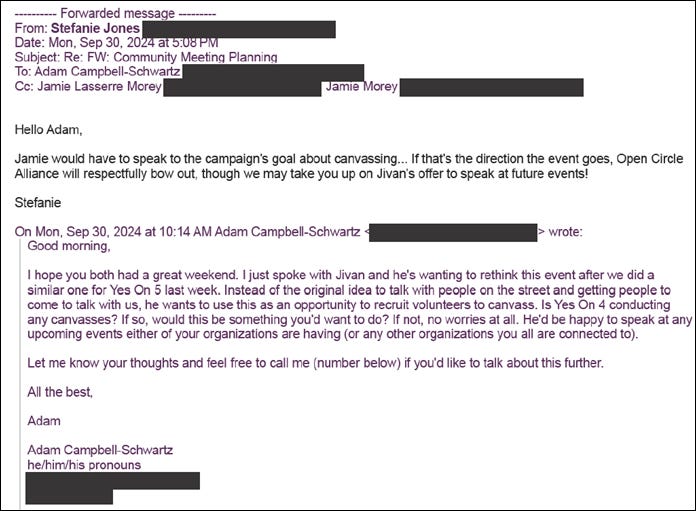
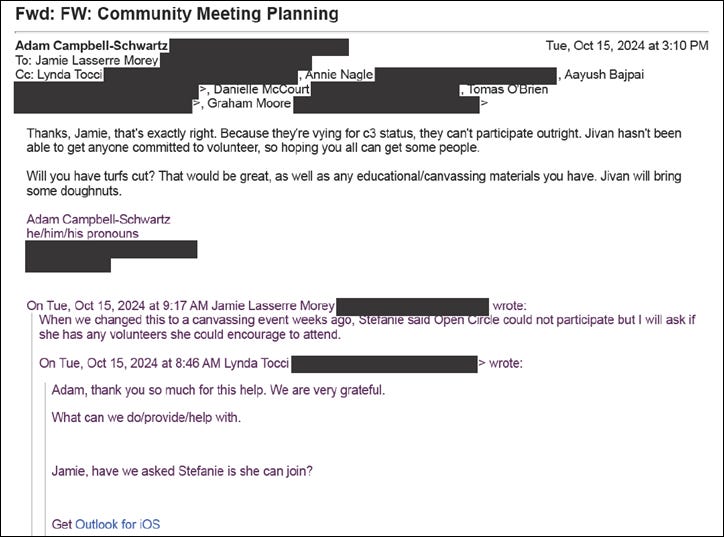
But while Open Circle Alliance considered Jones and Slater door-knocking alongside an elected official as a bridge too far, the nonprofit still permitted Jones and Slater to engage in explicit electioneering, as previously mentioned, via the Yes on 4 campaign’s auto-dialer—an activity that provided more or less the same benefit to the ballot question committee as in-person canvassing. Compared to going door to door, however, urging voters to support the ballot measure over the phone had much less public visibility. A throughline of Open Circle Alliance’s public-facing behavior was maintaining a veneer of strategic ambiguity (such as by prominently featuring Oneschuk on its website while strongly declaring neutrality on its factsheets) that enabled the nonprofit to deny being formally affiliated with Yes on 4 while functionally serving the campaign’s ground game.
Notably, the permissible political activity of 501(c)(3) nonprofits was far more expansive than Jones repeatedly implied in her emails—an application for tax-exempt status would not have necessarily been derailed by a nonprofit donating images to, or door-knocking on behalf of, a ballot measure campaign. Furthermore, the fact that Open Circle Alliance shut down in March 2026 without ever having achieved federal tax-exempt status—and, according to its public filings, had not even applied for federal tax-exempt status as late as March 2025—suggested possible jeopardy to Open Circle Alliance’s 501(c)(3) classification was more a pretextual justification for avoiding certain campaign tasks than a major standalone concern for Jones. In and of themselves, none of Open Circle Alliance’s electioneering activities were unlawful or improper. Cumulatively, however—especially in combination with Oneschuk’s dual role—they did threaten to place Open Circle Alliance beyond the threshold of allowable electoral advocacy. And the structural overlap of the ballot question committee and Open Circle Alliance, through Oneschuk, meant the public disclosure of any contribution to the ballot question committee, no matter how small, invited unflattering scrutiny of conflict of interest.
3.5 A Managed Mirage
Open Circle Alliance did not operate like an independent organization seriously aspiring for longevity. More than five months post-election—even before any substantial controversy regarding the nonprofit had erupted—Open Circle Alliance had still not applied for 501(c)(3) federal tax-exempt status, still had no independent board, and still had no staff or operational members apart from its three co-founding officers: Stefanie Jones, Emily Oneschuk, and Rebecca Slater. As a consequence, the organization’s ability to compete for philanthropic capital was severely compromised. Donations to Open Circle Alliance remained non-tax-deductible, and Open Circle Alliance’s officers continued to operate without board oversight, making financially supporting the organization more expensive and riskier than donating to competitor nonprofits, like MAPS, which provided similar services while maintaining 501(c)(3) federal tax-exempt status and a substantial board of directors.
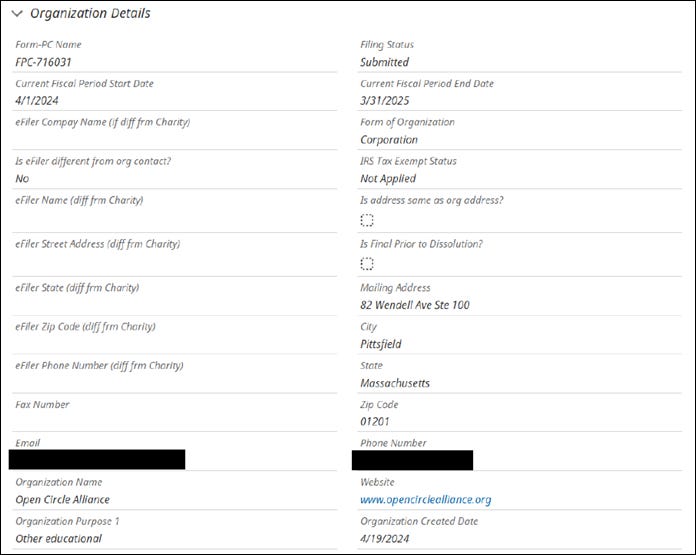
Since its public reveal, Open Circle Alliance continually fell short of its purported objectives as a nonprofit. Although Open Circle Alliance declared in an email to its distribution list that “education is a cornerstone of our programming,” the “upcoming Psychedelic Education series” that it announced in June 2024 never materialized, and “the plan to create more fact sheets on psychedelic topics down the line” that it revealed in September 2024 was never executed. The “veteran-focused programming” that Slater told grassroots advocates in October 2024 that she would “love to commit to offering […] in 2025” also never occurred. Despite telling subscribers to “stay tuned for updates in our next newsletter and on Instagram” in August 2024, Open Circle Alliance never posted on Instagram again—the nonprofit posted on Instagram only twice in its history, and for the last time on August 15, 2024, more than 19 months before it ceased operations.
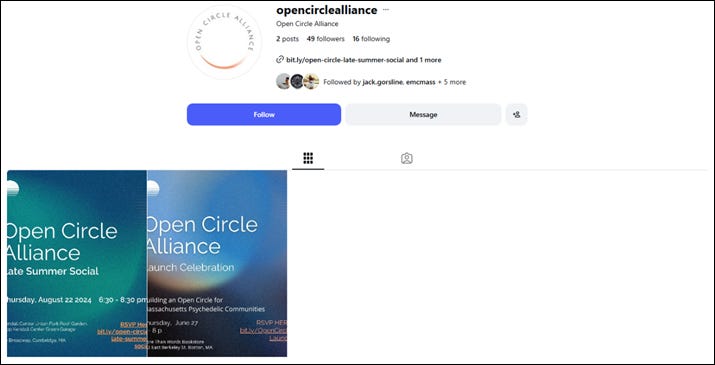
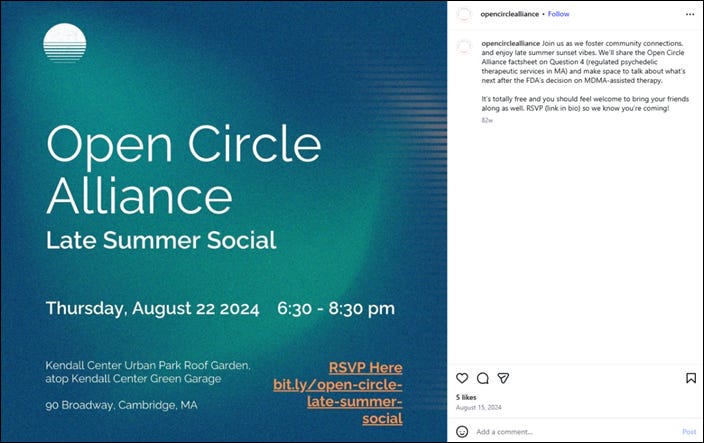
While Open Circle Alliance claimed in February 2025 that “what’s next on our agenda” included “beginning to build out a trusted resource library,” Open Circle Alliance never added to its resource library beyond the Question 4 factsheets. And even though Open Circle Alliance repeatedly claimed—in November 2024, in December 2024, and in January 2025—to be “actively working toward [501(c)(3) tax-exempt status]” in the context of soliciting donations, the nonprofit did not even apply for federal tax-exempt status in February or March 2025. Presumably, the nonprofit never applied, considering Open Circle Alliance shut down without a determination letter from the Internal Revenue Service (IRS) on record.
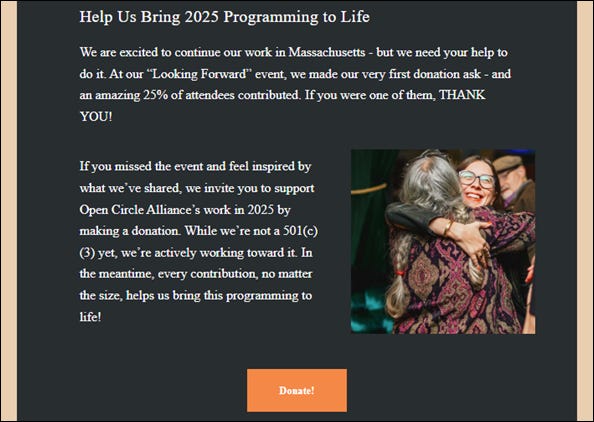

Rather than cultivating robust independent programming and educational material, however, Open Circle Alliance functioned largely as a vehicle for promoting the initiatives of external partner organizations. As previously detailed, Open Circle Alliance was structured and operated like an extension of the ballot question committee in 2024. And this continued even after the election.
Just three days after attending Open Circle Alliance’s “Looking Forward” event in person on November 9, 2024, Dewey Square Group principal and Yes on 4 chief strategist Lynda Tocci incorporated Slater and Jones—using their official Open Circle Alliance email addresses—into an email thread regarding the ballot question committee’s ongoing lobbying efforts. The only other participants were Tocci, New Approach deputy policy director and Yes on 4 campaign director Jared Moffat, Yes on 4 community outreach director Jamie Morey, Yes on 4 educational outreach director Graham Moore (me), and three other Dewey Square Group consultants: Aayush Bajpai, Tomás O’Brien, and Brennan Spencer. Both Tocci and Spencer were registered lobbyists, and the thread served as a forum for sharing Spencer’s curated overview of psychedelics legislation in Massachusetts, which Tocci contextualized with speculation regarding the likelihood that monitored proposals would be re-filed in the upcoming legislative session. In direct response to Slater—while carbon copying Jones and the others on the thread—Tocci revealed a specific planned outreach, a meeting with a state lawmaker, framed as a seamless continuation of Tocci’s work: “Because I can never stop I’m going to see Rep. Lindsay Sabadosa tomorrow.”
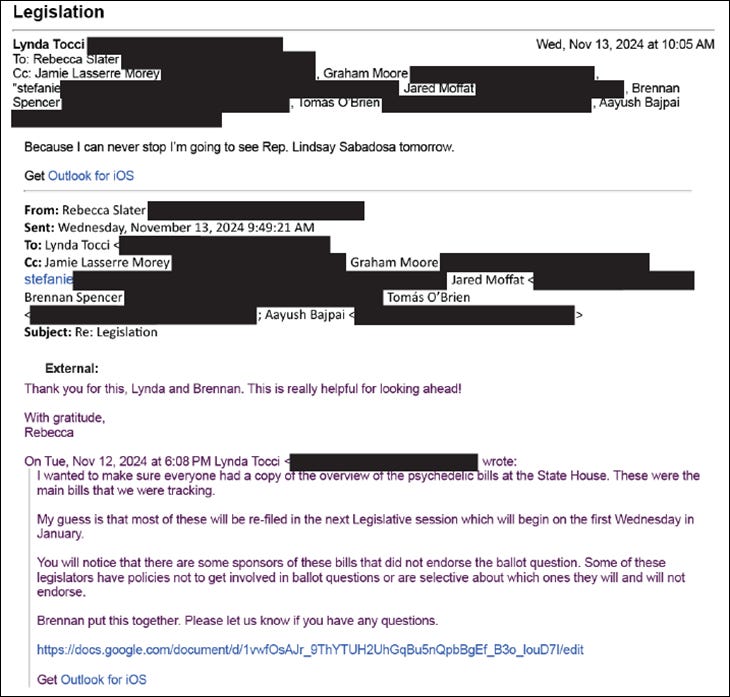
This communication explicitly placed Open Circle Alliance officers inside the campaign’s lobbying circle, where they were privy to the same strategic insight and legislation-tracking data as registered lobbyists and senior staff of the ballot question committee. Illustrating the point, the Yes on 4-branded document Tocci shared specified that “the campaign has been tracking five psychedelics bills at the State House since last summer”—non-public campaign intelligence that, while standard for such a political operation, was not information the ballot question committee had chosen to disclose to the general public or to its broader volunteer base.

Further reflecting the selectivity of Tocci’s briefing, notably excluded from the email thread were any high-profile external stakeholders or campaign surrogates: no lawmakers, no medical researchers, no licensed healthcare providers, no veterans, and no first responders. Even local police officer Sarko Gergerian—who had been one of the ballot question petition’s original signers, testified in support of the ballot question legislation to lawmakers alongside Slater, starred in a campaign commercial, and nominally authored Question 4’s official proponent statement (all for free as a volunteer)—was not brought into the thread. Nor was leading volunteer CJ LoConte—a local veteran who had spoken as a Question 4 proponent to The Boston Globe’s editorial board, represented Yes on 4’s position in a public debate, and starred in a campaign commercial as well—incorporated. Also absent was the campaign’s most prominent physician volunteer: Harvard Medical School instructor and director of training and education at the Massachusetts General Hospital (MGH) Center for the Neuroscience of Psychedelics, Dr. Franklin King—in a personal capacity, Dr. King had championed the ballot question at a state house press conference. Tocci’s inclusion of Jones and Slater—who purportedly led an independent 501(c)(3) nonprofit for which political advocacy was not a primary goal—rather than the aforementioned individuals (Gergerian, LoConte, and Dr. King) with more relevant expertise and personal experience, suggested the participation of the Open Circle Alliance officers in the email thread stemmed more from their structural connections to the campaign than from their demonstrated, personal enthusiasm for legislative advocacy. Furthermore, certain actions by Slater, Open Circle Alliance, and the ballot question committee suggested this involvement of Open Circle Alliance—and of Slater in particular—in lobbying was a continuation of a longstanding strategy by campaign organizers.
Like James Davis (the leader of Bay Staters for Natural Medicine), Slater was elevated by the ballot question committee despite not fitting the demographic profile of the campaign’s preferred messengers (those who voters were most likely to find convincing) according to representative survey data: namely, “doctors, scientists, [hospice] care providers and veterans” and, secondarily, “university researchers [who have studied psychedelics] and police officers with PTSD.”
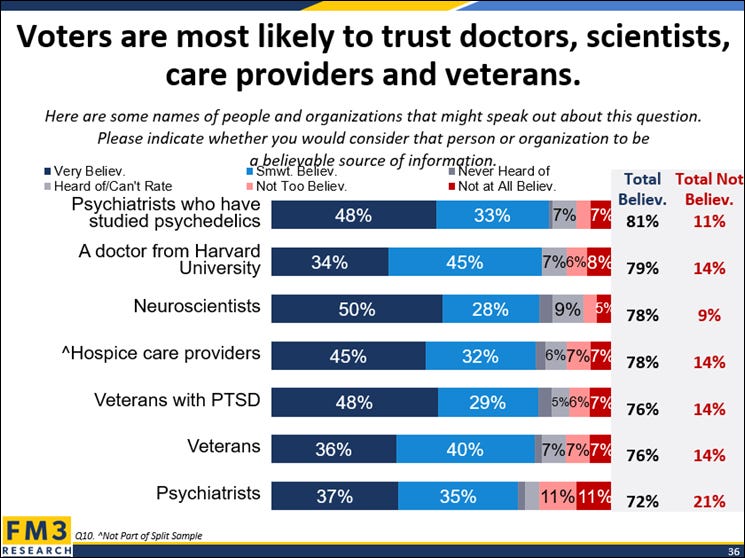
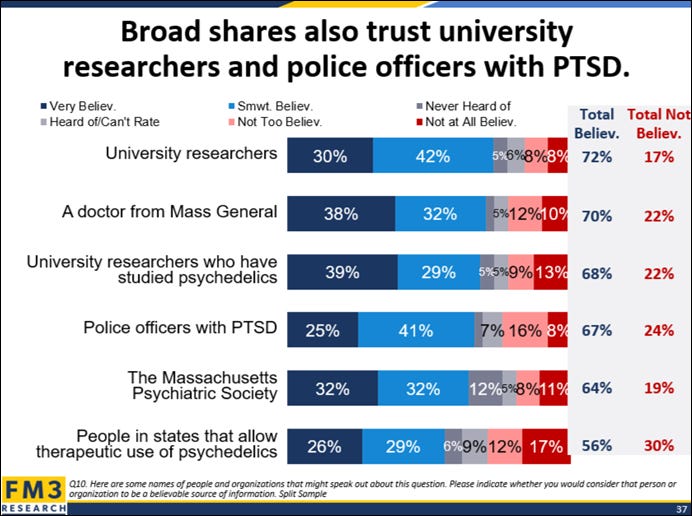
Slater was not a physician, a scientist, a hospice care provider, a veteran, a university researcher, or a police officer with PTSD. She was—as she herself described in her testimony—a defense contractor, an advocate for mental healthcare for veterans, a mother, and a caregiver to a non-veteran family member who struggled with mental illness. And while Slater had a sympathetic biography, it did not explain why—especially in the absence of any directly relevant, high-level expertise, like that of Sam Chapman as a leader of Oregon’s psilocybin program—Slater was chosen to be a face of the campaign at the March 2024 hearing, next to a police officer (Gergerian) and a veteran (Oneschuk), both of whom vividly recounted to lawmakers how psychedelic therapy helped them process their traumas.
Assuming Slater was promoted by campaign organizers to serve an operational purpose—rather than as a matter of personal or political patronage—then her intended role was likely related to the HERO Act, a throughline of her affiliation with the ballot question committee. The HERO Act—expansive legislation to improve the lives of veterans, of which a working group to study psychedelic therapy was only a minor part—had been filed by Governor Maura Healey in November 2023, when the psychedelics ballot measure effort was publicly well underway. While not listed in Spencer’s aforementioned bill tracking document, perhaps because it was not a primarily psychedelics-focused bill, campaign organizers followed the progress of the HERO Act, as demonstrated by the incorporation of testimony regarding the HERO Act into campaign literature and the campaign press release celebrating its passage into law.
And Slater centrally featured in these documents. Most strikingly, Slater—who was not a veteran—was given the sole quotation in the press release rather than the ballot question committee’s own staff member—grassroots campaign director Oneschuk—who was. The foregrounding of a non-veteran (Slater), over a veteran (Oneschuk), in a campaign press release specifically regarding veteran-centered legislation (the HERO Act), not only ran contrary to the campaign’s polling-supported messaging strategy but also could not be explained by any overt, unique connection between Slater and the passage of the bill. Oneschuk, Gergerian, and Slater had all been quoted—through their single joint statement—in the Massachusetts governor’s January 2024 press release on the HERO Act. And neither Oneschuk, Gergerian, nor Slater had been publicly identified as contributing to the HERO Act’s authorship or advancement in any way beyond their testimonies and the joint statement. The fact that Slater’s quotation for the press release was simply lifted word-for-word, typos included, from the joint statement—albeit with co-attribution to Oneschuk and Gergerian excised and Slater’s credentials burnished—suggested there was no politically palatable, public-facing narrative on hand to explain the HERO Act’s special significance to Slater. If there had been, ghostwriting or soliciting original remarks from Slater would have been trivially easy—hardly more difficult than updating Slater’s title—and would have come with far less risk of embarrassment than re-using a months-old quotation from an earlier press release on the same legislation. By happenstance, Marijuana Moment quoted words attributed to Slater directly from the August 2024 press release in its public reporting on the HERO Act—without correcting the “HERO’s Act” error—making the overlap between the governor’s press release and the campaign’s easily discoverable for anyone conducting a basic online search of Slater in relation to the bill.


In fact, as of writing (March 23, 2026), Governor Healey’s January 2024 press release and the August 2024 Marijuana Moment article quoting Slater are the first and second results generated when searching, “rebecca slater hero act,” on Google Search.
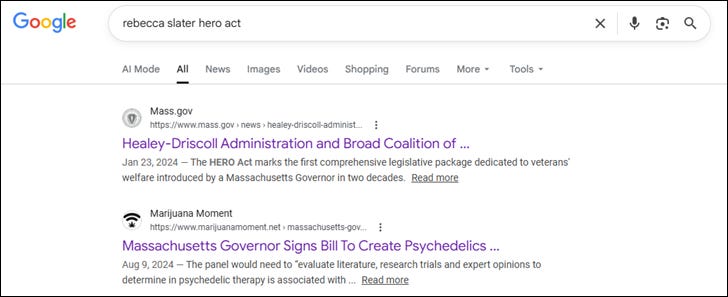
Yet while Slater’s inclusion in the campaign press release stood out for its logistical recycling and its supplanting of a more politically and thematically appropriate messenger—including by appropriating the words of a veteran, Oneschuk (as expressed in the joint statement), without acknowledgement—it was also a continuation of a consistent pattern in Slater’s curated public profile since the beginning of 2024. In legislative testimony, in press releases, on the Open Circle Alliance website, and in campaign literature, rhetorical ambiguity served to inflate her credentials.
In the case of the two ballot question committee factsheets that quoted Slater, the formatting of the titles for Slater and her two co-featured advocates—Gergerian and Oneschuk, each with their own quotations—erroneously suggested Slater was a veteran herself. In both documents, Gergerian, Oneschuk, and Slater were designated as follows:
“Sarko Gergerian, Local Law Enforcement Professional and Psychotherapist.”
“Emily Oneschuk, Local USN Veteran and Grassroots Director for Massachusetts for Mental Health Options [(the ballot question committee)].”
“Rebecca Slater, Local Veterans Support Leader and Non-Profit Ambassador.”
In the absence of any detail regarding the nature of Slater’s touted roles—or clarification that Slater was not a former servicemember—her inclusion in the factsheets with equivalent prominence to Gergerian and Oneschuk implied that Slater possessed a comparable background. And the formulaic construction of the advocates’ titles encouraged readers to draw parallels between their leading identities—“local law enforcement professional,” “local USN veteran,” and “local veterans support leader”—the latter of which technically left ambiguous whether Slater was one of the “local veterans” she was a “support leader” of. But, by placing Slater’s title besides Gergerian’s and Oneschuk’s—which opened with their current and former professional roles as uniformed, frontline personnel—the factsheets invited the assumption that Slater, too, had served in uniform, and she was now helping her fellow veterans.
This was especially the case given that Slater was notably characterized as a “local veterans support leader” rather than as a “local veterans support group leader.” Because the term “support group” is widely recognized as a specific organizational unit, whereas “veterans support” is an abstract category of advocacy, the omission of the word “group” shifted the focus. The most linguistically supported interpretation of the title as written was that Slater was a “support leader” of “local veterans”—implying a direct, authoritative relationship with veteran constituents—rather than a leader of a small, monthly meeting for veterans and non-veterans alike, as was actually the case. Furthermore, the vagueness of the title—which could signify a vast range of altruistic activity from working or volunteering with a state branch of the Veterans Affairs Administration (VA) to helping run a private charity—allowed Slater to imitate the professional gravity of Gergerian and Oneschuk, implying that Slater had provided local veterans much more substantial support than she actually did.
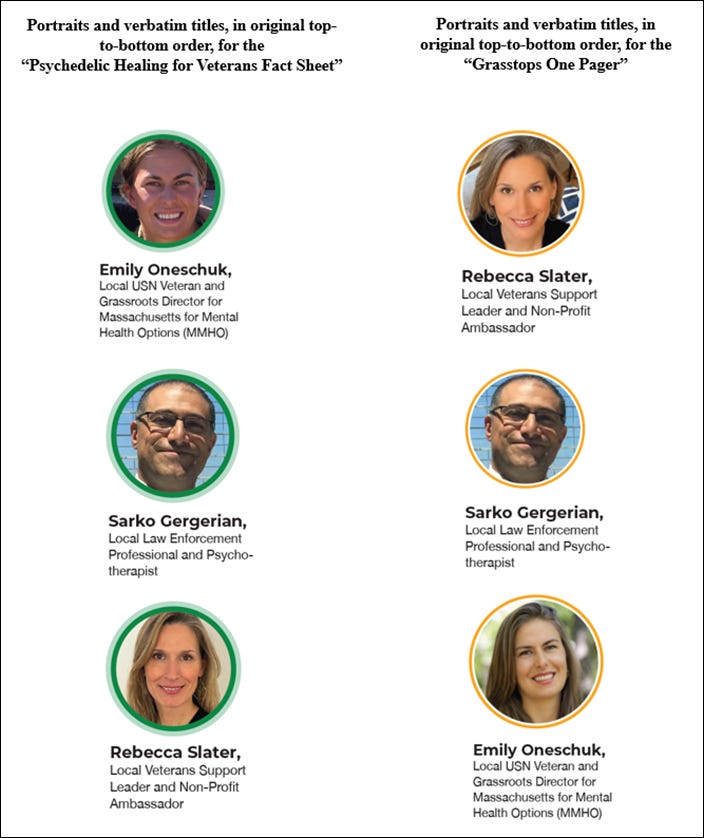
This impression was reinforced by mirroring syntax that treated Slater’s vague secondary role—“non-profit ambassador” for a non-identified nonprofit entity—as if it held equivalent professional weight to “psychotherapist” (for Gergerian) or to “director” of a major political operation (for Oneschuk). Altogether, the factsheets—in common with Slater’s public statements and the Open Circle Alliance website—produced an image of Slater fundamentally at odds with her true history as an advocate.
Regarding the “local veterans support [group]” Slater led, it was a small entity formed as recently as 2022, consisting of once-a-month virtual meetings that typically lasted around an hour. The group did not begin convening regularly until autumn 2022, in significant part because of difficulty recruiting veteran participants—in January 2023, Slater disclosed the group had only 20 members, of which just “25 percent [five out of 20] [were] veterans.” More than a year later, the number of veteran members remained the same—when asked in 2024 to provide the ballot question committee with the contact information of veterans in the affinity group besides Oneschuk, Slater and Oneschuk could provide only four names.
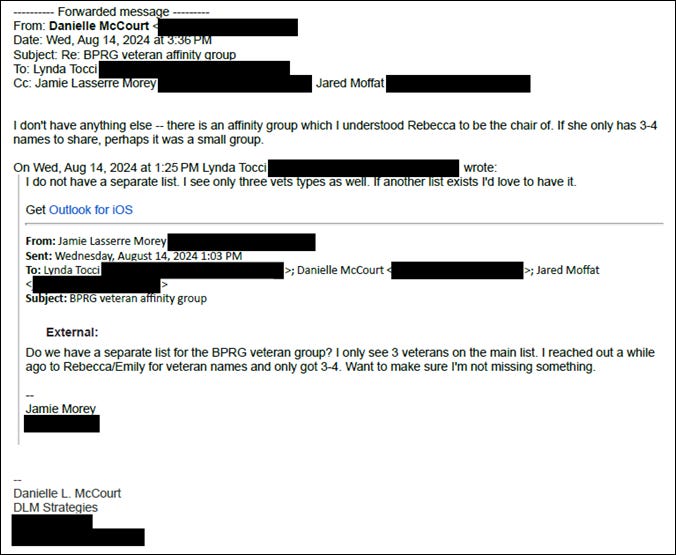
As one of multiple co-founders of the affinity group, Slater had opted to become the primary discussion moderator and administrator of the community a few months into its formation in 2022. Fulfilling the elective role typically required no more than a few hours’ involvement per month, and it entailed oversight of an organization that, as described in the previous paragraph, had only a tiny handful of veterans. This was the basis of Slater’s veterans support group “leader” title, although Slater only referred to herself as a “facilitator” of the group in recorded Boston Psychedelic Research Group meetings prior to 2024. And even by the time Slater invoked her leadership of “a veteran support community within the Boston Psychedelic Research Group” in her testimony in favor of the HERO Act, she had only been facilitating the monthly online sessions of the civilian-majority group for a little over a year.
In addition, as contemporaneously stated on the Boston Psychedelic Research Group website, Slater’s “community”—officially called the “Veteran Connection & Support Affinity Group”—was not actually “within” the Boston Psychedelic Research Group as Slater claimed. In fact, on the web page listing its multiple affinity groups, the Boston Psychedelic Research Group described the communities as follows:
Some breakout groups which we call Affinity Groups have decided to meet outside of the BPRG when they have an affinity for a targeted topic or area of research. Below is a description of each Affinity Group and whom to contact to get more information about them. While we support our Affinity Groups and try to create a space/platform for them to meet and communicate, they are considered separate from the BPRG.
The explanation explicitly categorized the “Affinity Groups” as both “separate from” and “outside of the BPRG” (emphasis in italics mine)—not “within” it—and included a pointed disclaimer: “While we support our Affinity Groups and try to create a space/platform for them to meet and communicate, they are considered separate from the BPRG.”
Furthermore, the characterization of the Veteran Connection & Support Affinity Group as a “local veterans” project was an oversimplification that obscured both its civilian-majority membership and its identity as “a cross country participation,” with members from throughout the United States, as Slater noted in a recorded Boston Psychedelic Research Group meeting in January 2024. In fact, the inclusion of non-veterans, like Slater, had been a core part of the organization’s identity from the beginning. The latter point was reflected in the first sentence of the group’s self-description on the Boston Psychedelic Research Group website: “We are a veteran-centric group of veterans, providers, business strategists who are creating community & synergizing with leading organizations to build a trusted healing path for veterans and their families.”

In citing Slater as a “local veterans support leader” in its factsheets, the campaign was effectively misrepresenting a very low membership (of around 20 members), “veteran-centric,” dispersed, monthly national Zoom call—with majority-civilian participation—as a robust veterans advocacy operation with a level of professional immersion and geographic specificity that was entirely absent from the actual role.
Regarding Slater’s “non-profit ambassador” position—the other advocacy function the campaign and Slater repeatedly invoked—this referred to Slater having joined the Ambassador Program of the veterans charity Heroic Hearts Project, which she had done sometime in the first half of 2022. According to its website, becoming an “ambassador” for Heroic Hearts Project simply meant opting into a network of volunteers organized around a monthly “community forum,” at which the nonprofit shared updates and volunteer opportunities. Attendance of the monthly meetings was not mandatory, nor were individuals obligated to contribute—either financially or through volunteer labor—above a certain threshold to remain ambassadors. In detailing “how ambassadors contribute” in its online description of the program, Heroic Hearts Project conveyed that practically any effort was appreciated, including simply “spread[ing] the word about our mission and how psychedelic therapy is saving veterans’ lives.” Consequently, Slater’s identity as “a non-profit ambassador” did not signify, by itself, any record of substantial advocacy.
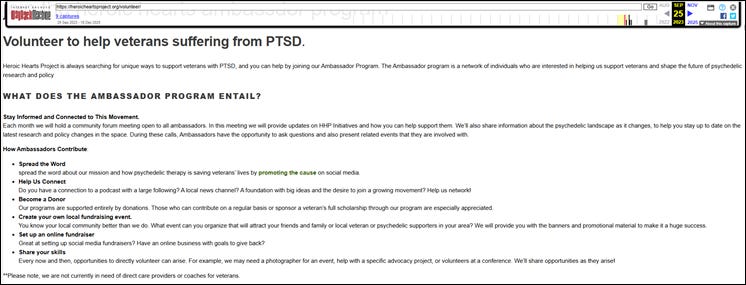
It was plausible that Slater considered her work for the affinity group as work for Heroic Hearts Project, even if for no other reasons than the overlapping missions to help veterans and the fact that Heroic Hearts Project provided at least some support to the project. In a recorded Boston Psychedelic Research Group meeting in May 2022, Slater had disclosed regarding her “seedling” affinity group:
We’ve done some, uh, we’re doing some collaboration with Heroic Hearts, with the Heroic Hearts Project, um, on resource, um, pulling together resources that are veteran-focused, that are, include psychedelics as a component but not the full component. Um, in addition to this group, I serve as an ambassador for Heroic Hearts. So I’m pulling on some of those leads to integrate some, um, some resources.
Although she cited the ambassador role as if it came with distinct responsibilities, “in addition to [those of] this group,” Slater did not share details of what her “serv[ing] as an ambassador for Heroic Hearts” actually entailed.
This ambiguity persisted into Slater’s public identity in 2024. She continually emphasized her involvement with Heroic Hearts Project—as if it was just one component of a multi-part body of work—without specifying how she served the charity apart from her role in the affinity group. This was reflected in her biography on the Open Circle Alliance website, in the paragraph describing her advocacy background:
But this cause is personal. Like so many of us, Rebecca [Slater] was frustrated by the status quo of American mental health care. As a mother, partner, daughter and friend, she shifted her focus to the healing potential of psychedelics for healing complex trauma. This led her to advocacy work with the Heroic Hearts Project, the Boston Psychedelic Research Group, and to her creation of a welcoming and safe online space for veterans and those who serve them — to make connections, share knowledge, and support one another.
In the description, Slater’s undefined “advocacy work with the Heroic Hearts Project, the Boston Psychedelic Research Group” was listed as if it comprised distinct accomplishments from her “creation of a welcoming and safe online space.” Simultaneously, by providing detail only of the Veteran Connection & Support Affinity Group, the paragraph functionally conflated the three items to bestow the institutional credibility of the two established nonprofits on Slater’s relatively minor advocacy initiative.
Slater’s legislative testimonies, too, utilized a strategy of rhetorical proximity to construe her limited, part-time advocacy as a robust vocation. In telling the story of how she “support[ed] and advocate[d] […] for psychedelic therapy for veterans,” Slater claimed:
I lead a veteran support community within the Boston Psychedelic Research Group, which is an educational nonprofit community that includes some of the top researchers from MGH, from Johns Hopkins, and others that are dedicated to bringing these therapies safely into our medical and mental health systems. I’m also a Heroic Hearts ambassador, which is a nonprofit dedicated saving veterans lives by taking them out of this country to South America to do ayahuasca. And the healing stories that come back again: breakthrough and astounding. They also support mental health research. Through this work, I met Emily [Oneschuk] next to me, who will share her story as a veteran.
By nesting a reference to her leadership of a small, virtual support group within a description that mentioned “top researchers from MGH [and] from Johns Hopkins,” Slater imbued herself with the prestige of the world-class medical research institutions. This associative credentialing framed her work as a sophisticated component of a major medical and mental health initiative, masking the reality that her “ambassador” and “lead” roles involved no clinical, academic, or research-based responsibilities. And by claiming she met Oneschuk “through this work”—directly after, in contextualizing her “Heroic Hearts Project ambassador” title, specifying the nonprofit “also support[s] mental health research”—Slater both misleadingly implied she met Oneschuk through Heroic Hearts Project, rather than through her affinity group (as was the truth), and further insinuated she was significantly involved in research, at least in a support capacity.
Unlike for the campaign factsheets—in which “research” was not mentioned and Slater’s “local veterans support” affiliation was foregrounded—a common thread of how Slater was portrayed as a legislative witness and in her biography on the Open Circle Alliance website was the prominent invocation of the Boston Psychedelic Research Group, which—due to its name—implied Slater was a researcher or, at the very least, was affiliated with an institution conducting psychedelic research. However, the Boston Psychedelic Research Group had not conducted research—on the “About Us” page on its website, it described itself as:
The Boston Psychedelic Research Group is a Massachusetts nonprofit corporation committed to the promotion, dissemination, and advancement of psychedelic research. We are a hub for education about the powerful benefits psychedelic-assisted therapy can have in the treatment of a wide variety of mental health issues. We do this primarily by holding monthly meetings where attendees can gather and converse, hear a prominent speaker share his or her work, and participate in a Q&A session.
Based in Cambridge, Massachusetts, the BPRG started in 2018 over an informal dinner. Years later we have almost 1500 members and are growing both in Boston and globally.
With “almost 1500 members and […] growing both in Boston and globally,” the Boston Psychedelic Research Group was not either a traditional research group or as geographically-centered as its name implied. Rather, it was a large online community for enthusiasts of psychedelic research, with an initial membership and origin rooted in the Boston, Massachusetts metropolitan area. The vast majority of its members were not “top researchers from MGH, from Johns Hopkins”; most members were not involved in conducting psychedelic research whatsoever. Like being a “Heroic Hearts ambassador,” being a participant (one of the “almost 1500 members”) of the Boston Psychedelic Research Group, by itself, did not signify any specific responsibilities or accomplishments. Yet by portraying Slater’s affiliation with one of her social clubs, the Boston Psychedelic Research Group, as analogous to Gergerian’s affiliation with his employer, the Winthrop Police Department, the January 2024 press release on the HERO Act reinforced the erroneous impression—produced by Slater’s testimony on the HERO Act the same day it was issued—that Slater was employed by a research group.
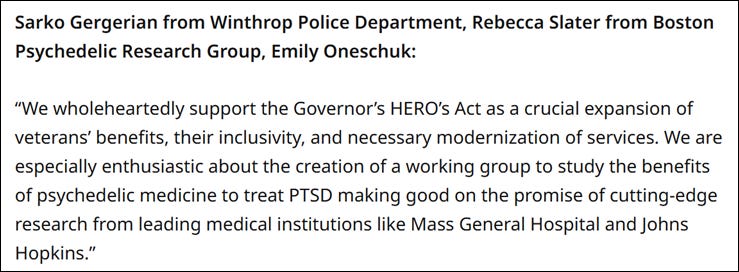
In fact, Slater was not even on the board of the nonprofit, which had notably estimated the average time commitment of its individual board members—including its president—to be just eight hours a month.
And when the ballot question committee quoted Slater as “Veterans Community Facilitator within Boston Psychedelic Research Group” in its HERO Act press release, in which Slater’s quotation explicitly framed her as speaking on behalf of a scientifically-oriented community—“We are especially enthusiastic about the creation of a working group […] making good on the promise of cutting-edge research from leading medical institutions like Mass General Hospital and Johns Hopkins”—the campaign overtly cosigned the misleading narrative.

As previously mentioned, the embrace of Slater as a public-facing surrogate by the ballot question committee was difficult to justify on the basis of her demographic identity—which did not fit the polling-indicated profile of the ideal spokesperson—or her widely known professional history, which was primarily as a defense contractor. Awareness of this fact by the campaign was suggested by—in addition to the consistent obfuscation of Slater’s background in public statements—both the campaign’s evasiveness when the promotion of Slater was challenged internally and Slater’s own references to her lack of relevant experience:
In a June 2024 email thread—including Open Circle Alliance co-founder Jones, Yes on 4 community outreach director Morey, and a volunteer advocate—Slater humorously boasted:
No one born before 1980 has ever learned how to set up social accounts for business faster than I just did. We can now post to social media directly from Canva, mistake proofing our brand from my technical ineptness ;)
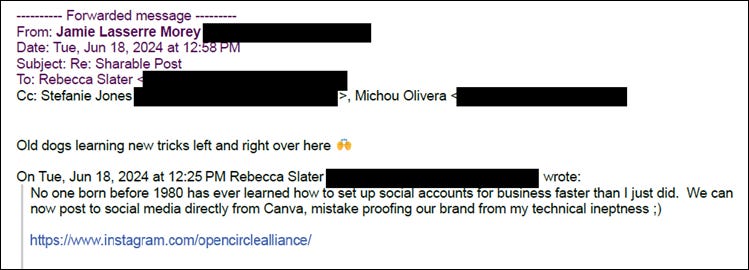
In a July 2024 email soliciting “input” regarding “an Open Circle veterans group” from other advocates—specifically, Morey (the spouse of an Army veteran), the president of the Harvard Undergraduate Veterans Organization (an Army veteran), two nurses (including a United States Marine Corps veteran), and the founder/president of an established nonprofit—Slater wrote:
I am writing to put some momentum towards the development of a purposeful, valuable exchange for MA veterans in the psychedelic space. After facilitating the BPRG veterans group, I have a sense of the need and the opportunities, but have not walked the walk as you all have. Your input is invaluable as we consider how Open Circle might support a group of this nature.
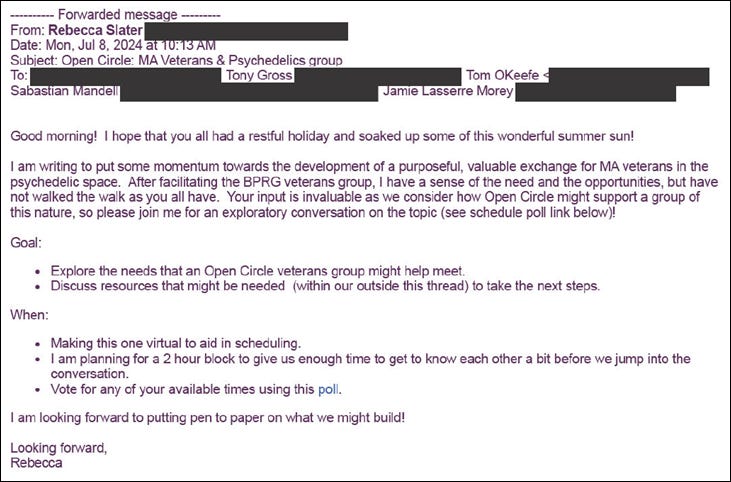
These acknowledgments of “technical ineptness” and lack of lived experience undercut the image of Slater as a subject-matter expert—with “research group” and “local veterans support leader” experience—presented by Slater and the campaign to lawmakers and the public. Months after being repeatedly portrayed, at legislative hearings, as an advocate on comparable footing to an active police officer (Gergerian) and a former servicemember (Oneschuk), Slater was privately downplaying the significance of her “facilitating” a once-a-month virtual affinity group and deferring to a mix of veteran and non-veteran advocates whose relevant experience, she admitted, surpassed her own. And among these advocates, whose input Slater deemed “invaluable,” was Morey, who—along with Oneschuk and others—would be passed over by the campaign the next month in order to give Slater the only quotation in its press release on veteran-centered legislation (the HERO Act).
When Morey directly raised the issue in August 2024 to Yes on 4 campaign director Moffat—expressing she “did not understand why the campaign is choosing to have [Slater] be the one to give quotes for the press release on the HERO act and featured in a social media post telling a story about an unrelated veteran healing their PTSD when I could speak very well and with direct knowledge and passion on that issue […] and doing so would help bring attention to the campaign and our mission of engaging veterans, rather than to BPRG/Open Circle”—Moffat prevaricated.
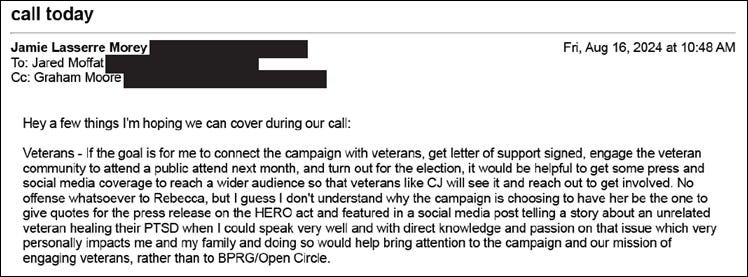
In the subsequent call with Morey and me, he conceded Morey was the better messenger and claimed he would amplify her visibility, but he brushed past explaining why Slater had been elevated in the first place. Moreover, just five days later, the exact, proposed “social media post [of Slater] telling a story about an unrelated veteran healing their PTSD” that Morey had flagged to Moffat was posted by the campaign—in a format the campaign utilized for only two other advocates, police officer Gergerian and a medical researcher, both showcased with clips from the March 2024 hearing in which Slater was visible in-frame. Morey, despite Moffat’s assurances, was never similarly featured—even though she had testified at the same hearing.
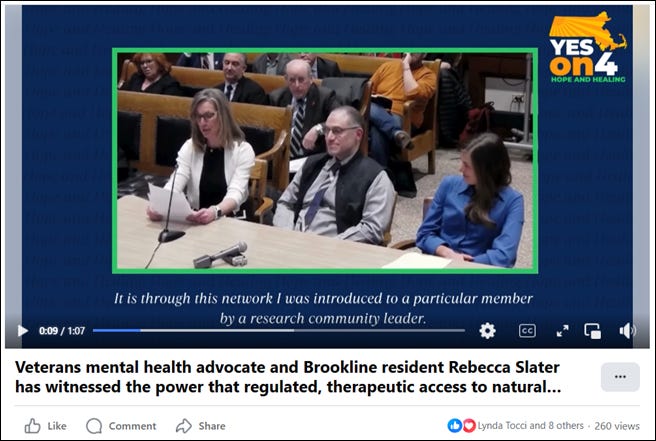
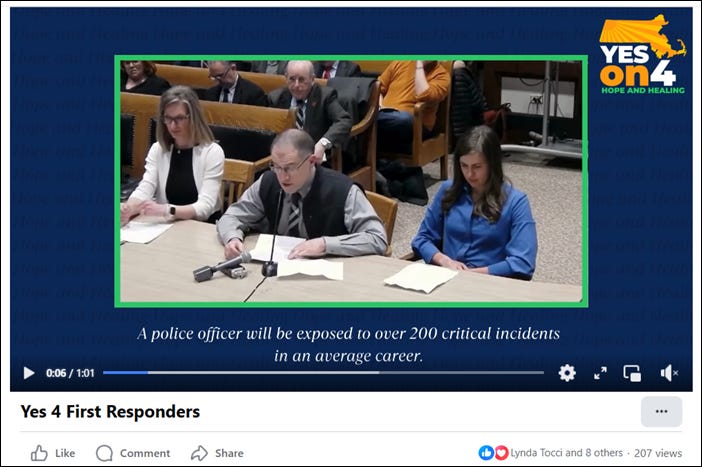
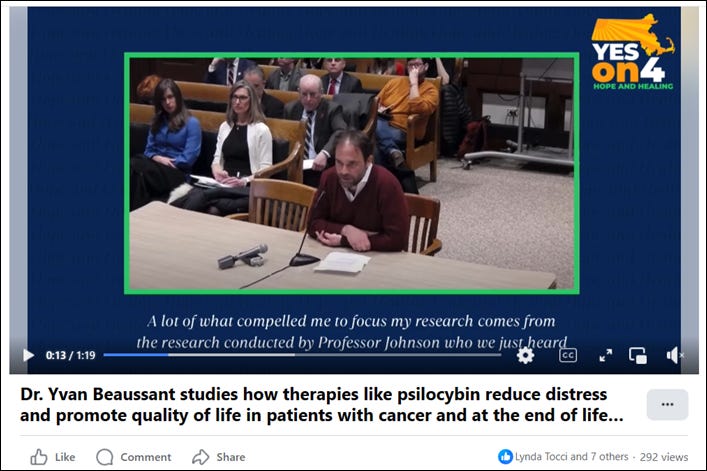
Similarly, Slater continued to be the most prominent face in the “Grasstops One Pager”—visually displayed above Gergerian and Oneschuk—even after I made an explicit recommendation, which was never overtly challenged, to replace her with local veteran CJ LoConte, one of the stars of the campaign’s television advertising.
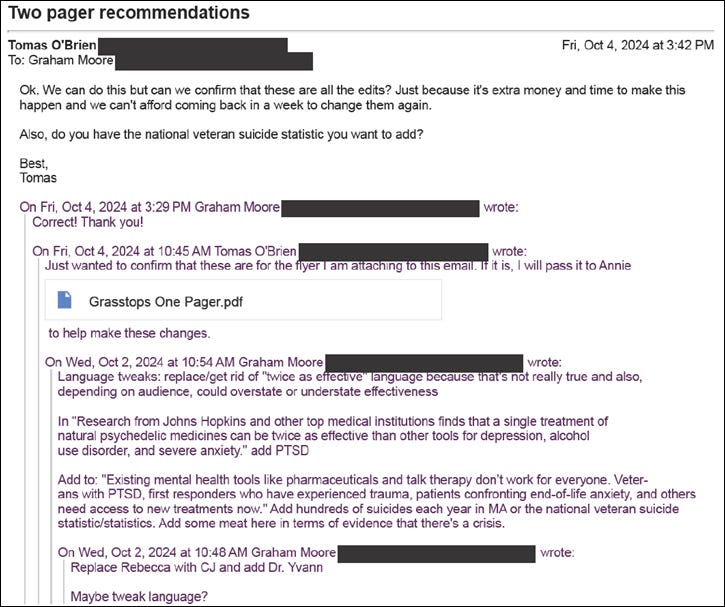
After being told by Dewey Square Group associate Tomás O’Brien “we can do this” (on October 4, 2024) and “I am making the changes to the existing one pager that you suggested a week ago” (on October 8, 2024), the change was never implemented because Yes on 4 campaign manager/ballot question committee chair Danielle McCourt—who O’Brien claimed “[had] to make the decision” because reprinting the document “will cost money”—did not give her approval.
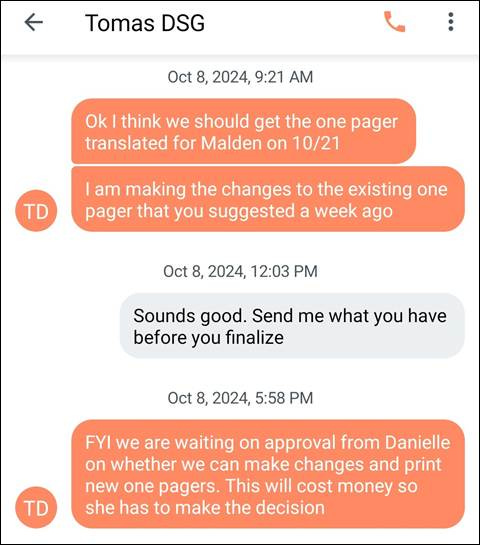
I was provided no explanation for McCourt’s decision, and the only justification for rejection proffered in advance was that printing a new version of the “Grasstops One Pager” could be prohibitively expensive. However, considering the campaign disseminated promotional materials online, had a miniscule canvassing operation, and did, in fact, produce two new versions of the “Grasstops One Pager” “to print”—in simplified and traditional Chinese characters—specifically “for” an event held 13 days after McCourt was asked to approve my suggested revisions, suggests printing costs were not the determinative factor in keeping Slater on the factsheet against my recommendation. In practice, cultivating Slater’s public image as an authority on psychedelics and veterans advocacy was treated as a higher priority by the campaign’s strategic leadership—including McCourt, Moffat, Tocci, and Dewey Square Group principal/de facto ballot question committee communications director Jennifer Manley—than consistently delivering persuasive, polling-backed messaging to voters.
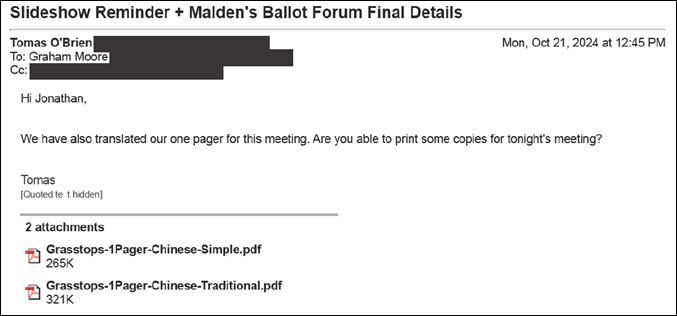
And while this prioritization had unclear electoral utility, it did effectively position Slater as an at least superficially vetted, credible expert—nominally independent of ballot question committee organizers—available as an advisor, an intermediary, and a stakeholder liaison to officials determining appointments regarding psychedelic policy, such as:
The “public-private working group to study the health benefits of psychedelics as treatment for veterans suffering physical or mental disorders related to their service”—established by the HERO Act—with members appointed by:
o “The secretary of veterans’ services.”
The “Massachusetts natural psychedelic substances commission” to oversee a psychedelic therapy industry—which would be established by the ballot question legislation—with commissioners appointed by:
o “The governor.”
o “The attorney general.”
o “The treasurer and receiver general.”
The “natural psychedelic substances advisory board to study and make recommendations to the Massachusetts natural psychedelic substances commission on the regulation and taxation of natural psychedelic substances”—which would be established by the ballot question legislation—with members appointed by:
o “The secretary of health and human services or a designee.”
o “The commissioner of revenue or a designee.”
o “The commissioner of public health or a designee.”
o “The colonel of the state police or a designee.”
o “The governor.”
o “The attorney general.”
o “The treasurer and receiver-general.”
It was, and is, standard practice for state governments to consult with advocacy groups regarding filling appointed positions. And by citing particular “statements of support” in her January 2024 press release for the HERO Act, Governor Maura Healey was indicating both the constituencies the bill was for as well as what organizations—and which individuals—she had heard from and, presumably, intended to keep listening to, specifically (in order of appearance in the press release):
“Peggy Griffin, Chair, Gold Star Wives of America, Greater Boston Chapter.”
“Patrick George, President, Massachusetts Veterans Service Officers Association.”
“Michael Valila, Deputy Adjutant, Disabled American Veterans (DAV).”
“Vincent J. Perrone, LTC (USAF, ret.), CEO, Veterans Inc.”
“John Paradis, Veterans Advocacy Coalition.”
“Paul Jacques, Professional Firefighters of Massachusetts.”
“Sarko Gergerian from Winthrop Police Department, Rebecca Slater from Boston Psychedelic Research Group, Emily Oneschuk.”
“Jenny D’Olympia, PsyD, Director, Military Veteran Psychology and Train Vets to Treat Vets Program and Angela Taveira-Dick, PhD, Associate Director, Train Vets to Treat Vets Program at William James College.”
“Sam Chapman, Executive Director, Healing Advocacy Fund.”
“John Parsons, Executive Director, Public Employee Retirement Administration Commission.”
“Steven Abrams, Armed Services Veterans Affairs Chair, Brockton NAACP.”
“John Nelson, Massachusetts Coalition of Police.”
Notably, Gergerian and Slater were the only individuals in the press release whose noted institutional affiliations included a “from” qualifier—reflecting Gergerian’s disclaimer in his testimony that “these opinions are my own” and indicating Slater did not actually speak for the Boston Psychedelic Research Group—and Oneschuk was the only individual in the press release to have no institutional affiliation mentioned. But, by virtue of both Oneschuk and Slater becoming officers of Open Circle Alliance just a few months later, their joint statement effectively functioned as a proxy for their yet unrevealed organization, as demonstrated by the statement’s repurposing—for the campaign’s subsequent press release on the HERO Act—as a quotation from “Rebecca Slater, Veterans Community Facilitator within Boston Psychedelic Research Group and co-founder of the Open Circle Alliance.” And, as at least a nominal author of one of the only two “psychedelic”-referencing statements cited in the governor’s press release, Slater as an individual was characterized as an authority pertinent to the HERO Act’s psychedelic working group provisions as early as January 2024.
Coinciding with the ballot question committee’s repeated reinforcement of this characterization—most pointedly with its own press release on the HERO Act—Open Circle Alliance overtly advertised itself as a potential vehicle for influencing Massachusetts psychedelics regulation. On its Question 4 “rulemaking” factsheet—produced in collaboration with campaign organizers (behind the scenes) and released to the public the same month that the HERO Act became law—Open Circle Alliance presented itself as the only specified answer to the question, “How can I get involved in rulemaking?” The inquiry—presented as the last of three in a question-and-answer format, following, “What is the Natural Psychedelic Substances Commission?” and “What is the Natural Psychedelic Substances Board?”—implicitly addressed how to attain one of the 25 appointed positions detailed in response to the first two questions. The entire explanation offered by Open Circle Alliance was:
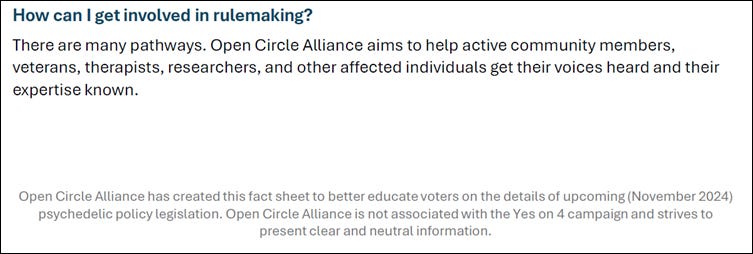
Although mentioning “many pathways,” the conspicuously concise and non-detailed explanation for “how [to] get involved in rulemaking” clearly identified Open Circle Alliance as the primary resource—its ambiguous wording suggesting the “many pathways” might refer to the various avenues through which Open Circle Alliance “aim[ed] to help […] affected individuals get their voices heard and expertise known.” The lack of precision in the answer meant the factsheet alone was not sufficient guidance for those seeking an appointed position, and the only possible source of additional information that the factsheet directed them to was Open Circle Alliance. In fact, there were no external references in the factsheet at all—the document quoted the ballot question without direct attribution, did not cite specific portions of the legislation, and did not share where one could access the full text of the ballot measure.
In communicating with prospective participants of “a potential veterans group within Open Circle,” Slater portrayed Open Circle Alliance as a possible means of influencing the appointed working group established by the HERO Act, too. As of the start of October 2024, there had still not been a “first meeting” of the nascent affinity group, and Slater sent an email to five interested advocates on October 11 to “take another stab at getting this meeting on the books.” Citing the HERO Act as a source for urgency, Slater wrote:
As we look ahead in planning, getting a community and education initiative for veterans going feels important. Outside of Question 4, Healy signed the HERO act into effect in August, opening the door for a public-private partnership assessing the benefits of psychedelics for veterans.
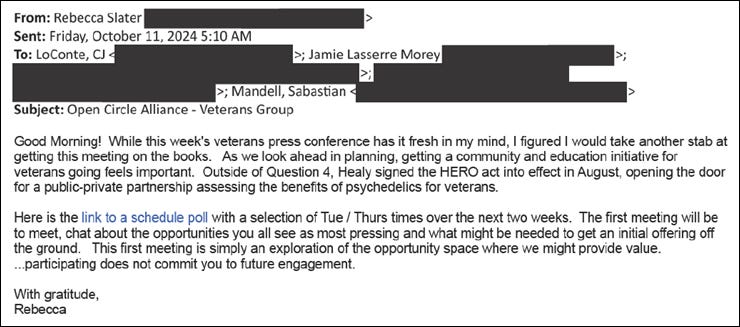
Two weeks later, on October 27, 2024, a meeting had still not been scheduled, and Slater emailed again, “following up on discussions about a potential veterans group within Open Circle,” floating ideas for veterans-focused programming, and asking advocates to let her know “if leading any aspect of this work interests [them]” “within a week” to facilitate an announcement at Open Circle Alliance’s “11/9 event.” Regarding psychedelics policy, Slater revealed:
On the HERO Act, I spoke with the legislative director on Friday—the psychedelic research committee is just forming and there may be where we could be a resource. We’ll reconnect in a month or two as it develops..
While Slater posed the Open Circle Alliance veterans group being “a resource” as a possibility, she subtly revealed that her influence on “the psychedelic research committee” was already an ongoing reality—not only had she recently “spoke[n] with the legislative director,” she had already made plans to “reconnect in a month or two” with the legislative director “as [the psychedelic research committee] develops,” as well. As the HERO Act’s working group was under the purview of the state secretary of veterans’ services, Slater had presumably been in contact with Erik Mayberg, the legislative director of the Massachusetts Executive Office of Veterans Services (EOVS). And, as Slater communicated this information from her Open Circle Alliance email address, she invited the assumption that her communications with Mayberg had been in her official capacity as Open Circle Alliance’s president. Notably, Slater did not explicitly say why—not being a veteran herself and without significant policy, clinical, or research experience—she was speaking with “the legislative director” in the first place, especially in light of the fact—as she acknowledged in the same message—she still could not “commit to offering veteran-focused programming [through Open Circle Alliance] in 2025.”
Nevertheless, additional information in the email suggested as to how Slater was being presented to veterans community stakeholders. After the update regarding the HERO Act, Slater mentioned that she “[had] a call with a contact at the Veterans Collaborative”—a large coalition of veterans organizations, including most of the veterans organizations mentioned in the governor’s press releases regarding the HERO Act—the next day, and she provided “topics on our agenda […] listed below for reference.” The “topics” she shared for the upcoming “discussion” were as follows:
Topics for Veteran Collaborative discussion
1) Our virtual collaboration summits are on the 1st Wednesdays at 3:30pm (except January and July) that you could join. Emily [Oneschuk] has been to some of these! There is always a mix of people doing different kinds of work. We usually have a smaller group in November because service providers are in planning mode for Veterans Day, which may leave a few extra minutes for discussions. We usually are able to give everyone a chance to speak for a few minutes to share what they have to offer or what they need and make connections to other participants. We start with intros for anyone new, then anyone with agencies introduces themselves and their programs or makes announcements. Then I give a quick tutorial or overview of how to use different collaborative resources like the calendar, slack, data, etc. based on time. The last half is for everyone else to discuss their work and events or ask questions, including anyone new who just introduced themselves at the beginning. These are drop in, so you can come to any or all and come and go as you need. The slack bot shares a link to the Zoom archive the day of for those who can’t make the summit when it posts the meeting info.
2) We’ve been collaborating with the Grunt Style Foundation and VFW to organize a harm reduction summit on December 11 in Boston focused on the overprescribing psychiatric/pain medications on and off label as a first line for everything. VA’s research demonstrates this independently increases the risk of suicide or overdose and that women are disproportionately impacted and are more likely to experience guideline discordant prescribing, increasing the risk further. We’ll have panels for impacted veterans and survivors of veterans, along with some experts with a data review. We just finished the first summit in Michigan, which was sponsored by their state veterans services. I would love your input and any insights you have on the issue and if this is something you’re also seeing veterans experience before finding alternative options. We may also have space for more veteran panelists with compelling stories to share around the topic.
This list, apparently written by a Veterans Collaborative representative (presumably Slater’s “contact”) seemed incomplete—if it was a truncated list, that might be explain why Slater labeled it “topics on our agenda” rather than “the topics on our agenda.” The “1)” and “2)” numbering was superfluous for just two items, and the first “topic” was a paragraph describing the Veterans Collaborative’s “virtual collaboration summits” without clearly identifying information to be exchanged on a call. The second “topic,” however, did identify an ask by the list’s author, who—after repeatedly referring to expert health data analysis—solicited Slater for “[her] input and any insights [she] [had] on the issue” of “the overprescribing psychiatric/pain medications on and off label as a first line for everything.” Moreover, the author wanted to know “if this is something [Slater was] also seeing veterans experience before finding alternative options.” In effect, Slater was being addressed as if she were a professional researcher, extensively familiar with veterans’ medical experiences and capable of delivering authoritative “input and […] insights” complementary to those produced by “[the] VA’s research.” And yet, contemporaneously, Slater’s network in the veterans community was insufficient to even reliably offer “veteran-focused programming” through her own nonprofit.
The disparity between the expertise implicitly assumed of Slater in the correspondence and the reality of Slater’s accomplishments suggested the Veterans Collaborative—and presumably other stakeholders turning to Slater out of a genuine desire for specialist input—had been misled into taking the campaign’s highly embellished version of Slater at face value. The consequences of mistaking uninformed opinion for expert advice, especially concerning “the risk of suicide or overdose,” were potentially dire. To the extent the campaign contributed to a non-veteran, non-researcher, non-clinician defense contractor being mistaken as a health expert by institutions—like the Veterans Collaborative and the Massachusetts Executive Office of Veterans Services—dedicated to promoting the welfare of former servicemembers, the campaign was acting at cross purposes to its purported goal of serving veterans.
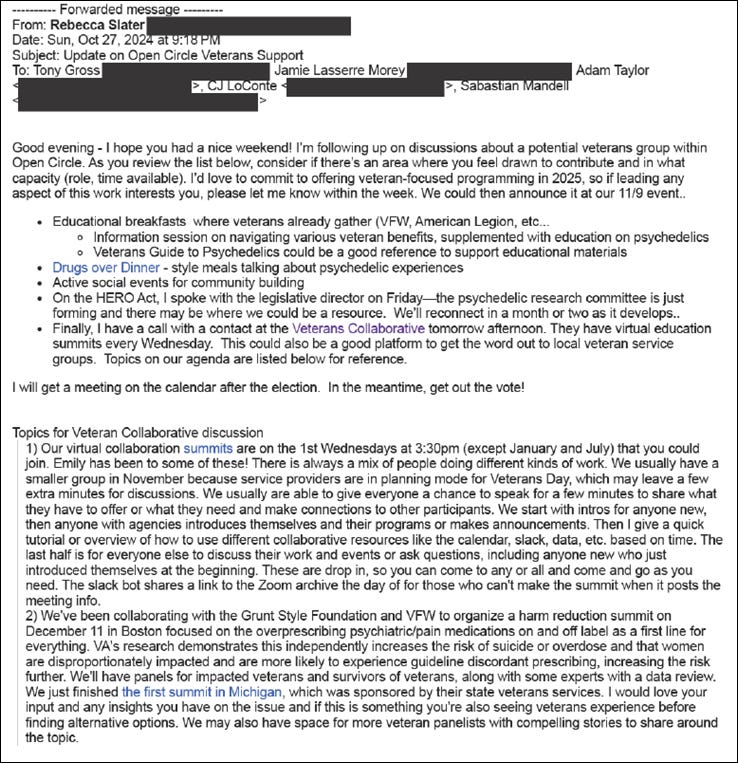
Further illustrating how Slater and Open Circle Alliance were positioned as central stakeholders with regards to psychedelics policy, State Representative Michael (Mike) Connolly reached out to Slater at her Open Circle Alliance email address on January 16, 2025—unsolicited—for input on legislation he was considered filing: a bill establishing “an interagency task force to study the public health and social justice implications of legalizing the possession, consumption, transportation, and distribution of naturally cultivated entheogenic plants and fungi [(natural psychedelics)].” Specifically, Representative Connolly inquired whether Slater “[had] any initial reactions to the text I’m pasting below (it’s from my bill four years ago) and also if you would make any other particular suggestions for folks who should be on this task force.” Moreover, Representative Connolly added that he “[was] contemplating adding Open Circle Alliance to the text.”
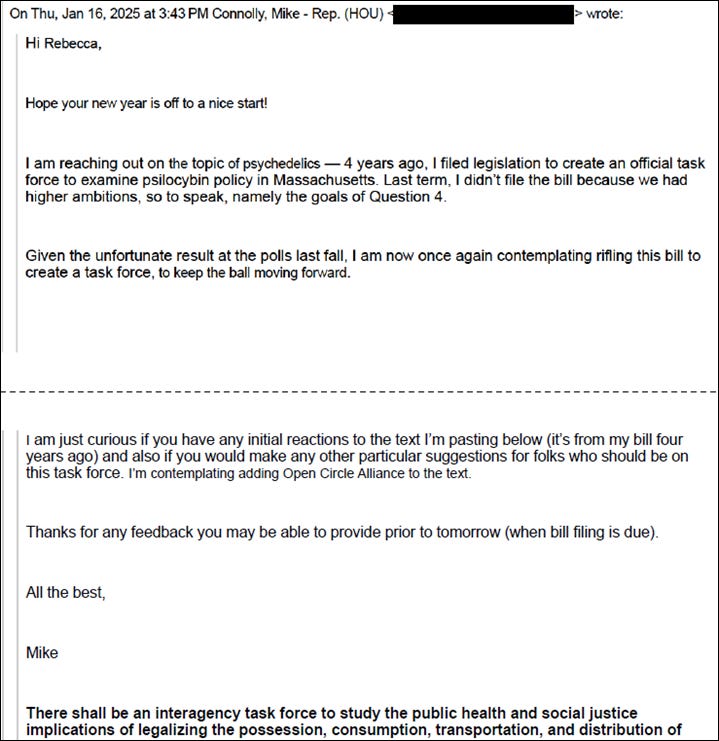
The next day, Slater replied—not to provide detailed policy feedback but to acknowledge receipt of the email and add Jones to the thread:
Hi Mike, thank you so much for reaching out! I just picked this up and am in transit. I included Stefanie on the thread to bring her into the conversation. We will review and get back to you soon!
In addition, Slater pivoted the conversation to the HERO Act, asking whether Representative Connolly was familiar with its task force provision and offering to provide him “a contact name of who is working on it if you are interested”:
Out of curiosity, are you familiar with the provision in the HERO act? It provisioned a public-private working group to study benefits of psychedelics for veterans. I have a contact name of who is working on it if you are interested.
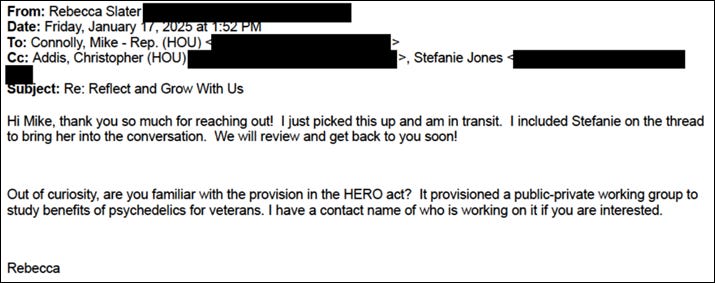
It was ambiguous whether Slater meant her “contact” had already been selected for an appointment to the HERO Act’s working group—i.e. was “working on” the task force as a task force member—or was engaged in determining the appointments. Either way, the offer underlined her insider status—the appointments to the working group were not publicly announced until April 2, 2025, over two and a half months later. Furthermore—as in the discrepancy between the questions posed to Slater by the Veterans Collaborative and her difficulty organizing a veterans support group—Slater’s decision to introduce Jones and describe the HERO Act—rather than give even a cursory opinion on the substance of Representative Connolly’s proposal—suggested Slater was out of her depth. Reinforcing this impression, Jones—who, unlike Slater, had nearly two decades of drug policy experience—subsequently took the lead in the email thread, providing detailed policy feedback while Slater gave none. Jones’s recommendations, which she sent from her Open Circle Alliance email address and framed as reflecting the views of the nonprofit, were (with her original bolding):
1. Increase harm reduction-focused committee members from 2 to 3; reduce racial equity/economic justice from 4 to 3
2. Make section (vi) into two distinct sections and renumber the following: (vi) identify opportunities for public education on harm-reduction for controlled substances; (vii) identify revisions to policies related to the licensing of physical and mental healthcare workers and therapists across the Commonwealth
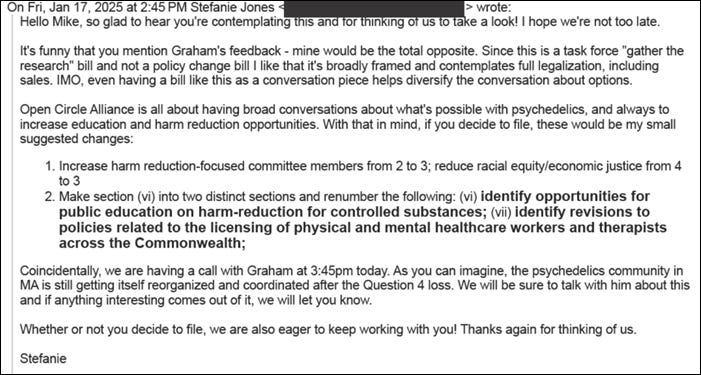
Notably, Jones—a white woman with a non-clinical background specializing in “harm reduction,” as displayed on her biography on Open Circle Alliance’s website—advised changes to the bill’s framework that would increase the authority of individuals like her, and entities like Open Circle Alliance—a “public education” organization—while reducing the influence of others, specifically:
“Racial equity/economic justice” experts, whose committee membership slots would be reduced “from 4 to 3.”
“Physical and mental healthcare workers and therapists,” by splitting the task force’s original mandate to “(vi) identify opportunities for public education on harm-reduction for controlled substances, including revisions to policies related to the licensing of physical and mental healthcare workers and therapists across the Commonwealth”—which would prioritize the incorporation of licensed healthcare workers in “public education on harm-reduction for controlled substances”—into two, distinct directives:
o (vi) identify opportunities for public education on harm-reduction for controlled substances.
o (vii) identify revisions to policies related to the licensing of physical and mental healthcare workers and therapists across the Commonwealth.
This alteration would not only distance licensed health care workers from “harm-reduction” but would rank “public education for harm-reduction” above “policies related to the licensing of [healthcare workers]” in the task force’s hierarchy of priorities as well.
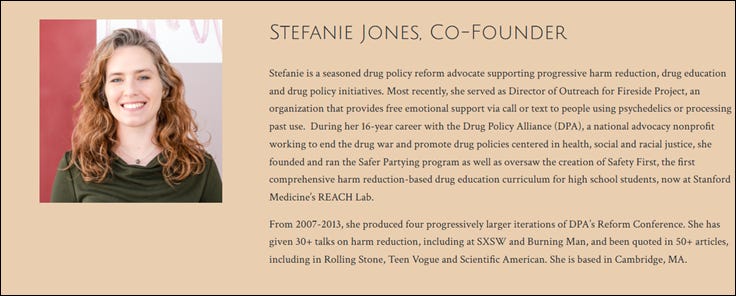
Instead of simply advocating for an expansion of the task force to include greater emphasis on harm reduction, Jones—acting as a representative of Open Circle Alliance—had proposed a zero-sum trade undercutting the voices of racial minorities and medical professionals. Considering the blurred lines between Open Circle Alliance and the ballot question committee, these suggestions (which were not implemented by Representative Connolly) might have been an extension of campaign organizers’ strategy to legitimize Open Circle Alliance—led primarily by two white women, Jones and Slater, without advanced degrees—as an authoritative entity, capable of helping steer policy. The significance of Open Circle Alliance to New Approach executive director Graham Boyd, in particular, was demonstrated a little over a month later, on February 25, 2025, when the Psychedelic Science Funders Collaborative (PSFC)—a psychedelics-focused donor organization, co-founded and led by Boyd—published its “Strategic Roadmap for Collective Philanthropy.” The roadmap highlighted Open Circle Alliance as the only Massachusetts member of “a large coalition of organizations,” through which a proposed, Psychedelic Science Funders Collaborative-funded “Psychedelic Policy Institute” would “help guide the success of the state-by-state psychedelic movement.”
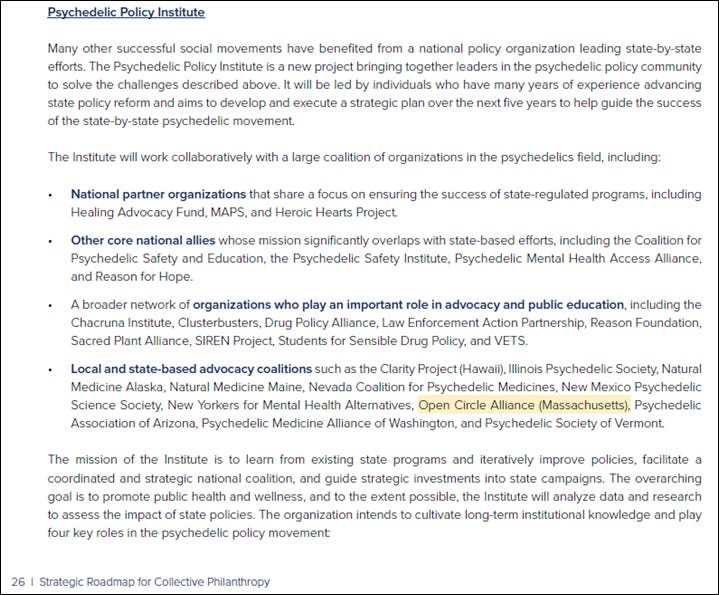
By this time—as reflected in Jones’s exclusively harm reduction-focused recommendations for Representative Connolly’s task force bill—Open Circle Alliance had already begun supporting “communications and public health education” regarding “public health education about risks, contraindications, and safer-use practices related to psychedelics,” identified by the roadmap as one of the “four broad pillars where collective philanthropy is essential” moving forward.
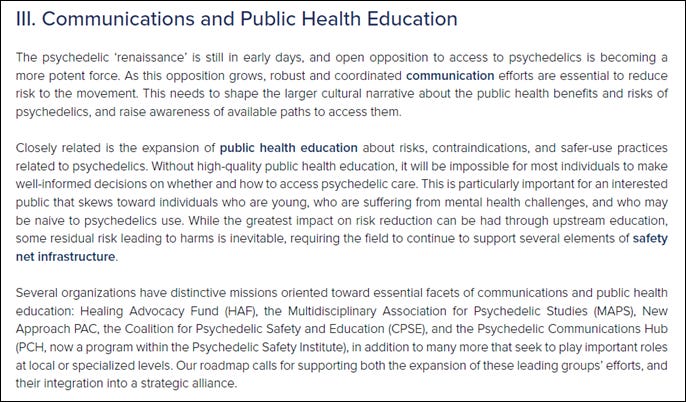
As had been hinted at by its November 1, 2024, “preview” of its post-election plans—in which Open Circle Alliance stated an intention “to continue promoting the Psychedelic Crisis and Intervention Training with partners like MAPS and F.R.E.E. GAIA”—the nonprofit’s public-facing communications had months prior pivoted to a focus on “safety.” In emails to its distribution list before the election, Open Circle Alliance had never used the word “safe” and had used the word “safety” only three times: twice in reference to the Psychedelic Crisis and Intervention Training and once in its June 10 invitation to the public launch party. In emails to its distribution list after the election—during an equivalent duration of approximately six and a half months—Open Circle Alliance used the word “safe” seven times, the word “safety” twelve times, and the phrase, “safe, supportive psychedelic ecosystem,” or a variation of it (like “safe, supportive, local psychedelic ecosystem”), five times. On December 17, 2024, for the first time in nearly eight months of operation, Open Circle Alliance declared to supporters in an email: “Psychedelic safety is central to our mission.”
This shift—similar to Open Circle Alliance’s emphasis on the ballot question despite its live poll showing “advocacy” was not a top concern of its constituents—was not clearly responsive to public feedback. In fact, in its June 2024 survey, Open Circle Alliance had not even included a safety-specific category as a choice for respondents. What the transition did correspond to, however, was Open Circle Alliance’s promotion of safety initiatives of two national organizations—MAPS and the Coalition for Psychedelic Safety and Education (CPSE)—identified as a “national partner organization” and a “core national ally,” respectively, in the Psychedelic Science Funders Collaborative’s roadmap.

Starting on November 1, 2024, Open Circle Alliance had begun promoting the MAPS-developed Psychedelic Crisis and Intervention Training. Less than two months later, the nonprofit’s claim that “psychedelic safety is central to our mission” was the first half of a sentence further advertising the training—“Psychedelic safety is central to our mission, and one vital resource is MAPS’ Psychedelic Crisis and Intervention training”—displayed above a banner reading, “MAPS Supports Massachusetts” and a link to “Get the Training.”
The same email included a commitment from Open Circle Alliance to, “in 2025, expand awareness of this training to city departments and other key groups,” and the message even solicited supporters to provide leads, stating: “Let us know if you have contacts who should learn about it [(the training)]!” Left unmentioned were the nonprofit’s prior commitments and plans for original content that were still unmet or unrealized, including:
“Our upcoming Psychedelic Education series,” announced in June 2024.
“Updates […] on Instagram,” announced in August 2024.
“More fact sheets,” announced in September 2024.
“Supporting community affinity needs (veterans, in this case),” announced in November 2024.
“Community groups,” announced in November 2024.
“Discussion and collaboration groups,” announced in November 2024.
This pattern was repeated in May 2025, when Open Circle Alliance revealed to its distribution list that it was “proud to be a partner of the Before You Trip educational campaign, aimed at young adults who may be considering psychedelic use”—as of writing (April 2, 2026), the now-defunct Open Circle Alliance was still listed as a partner for the Psychedelic Science Funders Collaborative-backed campaign on its website, alongside still active and established nonprofits like Veterans Exploring Treatment Solutions (most commonly known by its acronym, VETS).
In the email announcing the collaboration, Open Circle Alliance again solicited assistance promoting the initiative of an external partner—in this case, the Coalition for Psychedelic Safety and Education—encouraging supporters to “check it out and help us broadcast these materials widely.” The message detailed “some quick actions you can take to support this important work,” directing readers to:
“FOLLOW [and promote Before You Trip] on Instagram.”
“CREATE your own psychedelic safety content,” using the campaign’s toolkit and tagging the campaign.
“INCLUDE campaign messages in your own content.
o “Find a message arc in the Campaign Toolkit” to incorporate into your “talks, presentations, podcasts, or interviews.”
“SEND people to BeforeYouTrip.org to learn more.”
What was not detailed was what independent programming Open Circle Alliance was developing or its progress regarding even recently stated goals to:
Achieve 501(c)(3) tax-exempt status, last emphasized in January 2025.
“Build out a trusted resource library,” announced in February 2025.
To the extent there was even superficial institutional follow through, it appeared calculated to give Open Circle Alliance’s partnership with Before You Trip the veneer of a community-driven decision. In its February 21, 2025, email to its distribution list, Open Circle Alliance had characterized “What’s Next on Our Agenda as:
We are beginning to build out a trusted resource library. Additionally, we are engaging in conversations with facilitators to learn more about how Open Circle Alliance can support their needs. There is so much expertise in this community, and we look forward to exploring these topics with you.
And while the resource library was never expanded, in Open Circle Alliance’s next email to its distribution list—which proclaimed, “OUR SPRING PROGRAMMING IS BLOOMING,” on April 21, 2025—the nonprofit suggested it had “engag[ed] in conversations with facilitators” behind the scenes:
Now, we’re moving toward more focused conversations and deeper dives into some of the questions you’ve told us matter most:
What’s needed to safely prepare for and integrate a psychedelic experience?
What support do facilitators need to consistently provide safe and effective support?
Details are still unfolding keep an eye on your inbox for more details!
As in 2024—when Open Circle Alliance construed its promotion of the Question 4 factsheets as a response to community “feedback,” brushing over the fact the nonprofit’s survey data indicated “education on the upcoming ballot question” was a relatively low priority for its constituents—out “of the questions you’ve told us matter most” in 2025, Open Circle Alliance chose to highlight just two questions pertinent to Before You Trip, directly ahead of debuting Open Circle Alliance’s involvement in the “digital-first campaign developed by the Coalition for Psychedelic Safety and Education (CPSE)” to promote “safer practices [that] will allow those choosing to engage with psychedelics to do so with less risk and greater benefit.” And this online-only collaboration was the full extent of Open Circle Alliance’s supposedly “blooming” “spring programming”—in fact, Open Circle Alliance did not hold another public event after February 2025. Although the nonprofit claimed, in the same May 2025 email advertising Before You Trip, that it was “COOKING UP A FALL EVENT SERIES”—fall programming, like with most of the nonprofit’s publicly-shared plans for content, did not materialize. After sending just two more emails to its distribution list—the first, on August 8, 2025, simultaneously advertising “the MAPS Integration Workbook” and denying inappropriate collaboration with the Yes on 4 campaign, and the second, on March 27, 2026, announcing its closure—Open Circle Alliance ceased operations.
Whatever its true intentions—from start to finish—the nonprofit had practically functioned more like a long-running infomercial for a string of external partners than like an independent public charity.
3.6 An Unclear Return
The resources invested in Open Circle Alliance were substantial. On the part of the ballot question committee, the largest, overt contribution was the labor of grassroots campaign director Emily Oneschuk. Oneschuk was paid $103,128 by the ballot question committee and played a key role in the organization as the most visible, public-facing spokesperson as well as the only campaign official who was a veteran. To my knowledge, Oneschuk considered her compensation from the ballot question committee to encompass remuneration for her work for Open Circle Alliance—facilitated by her contract’s stipulation that she was “to provide consulting and professional services for CLIENT or their designee.” Even if Oneschuk had desired, completely of her own volition as a volunteer, to spend extensive time launching Open Circle Alliance, she could only have done so with at least the tacit approval of her employer, the campaign. Either way, the ballot question committee sanctioned the diversion of one of its most highly-paid contractors—Oneschuk, the central face of the campaign—to co-founding a new organization, at least nominally tangential to the goal of electoral victory. Oneschuk’s work for Open Circle Alliance directly interfered with her ability to be a campaign leader in 2024—illustrating the point, within just 24 hours from June 21 to June 22, Oneschuk texted me twice to inform me she was unavailable to discuss campaign matters, including an issue deemed “urgent,” because of her participation in “an open circle call” and an “open circle meeting.”
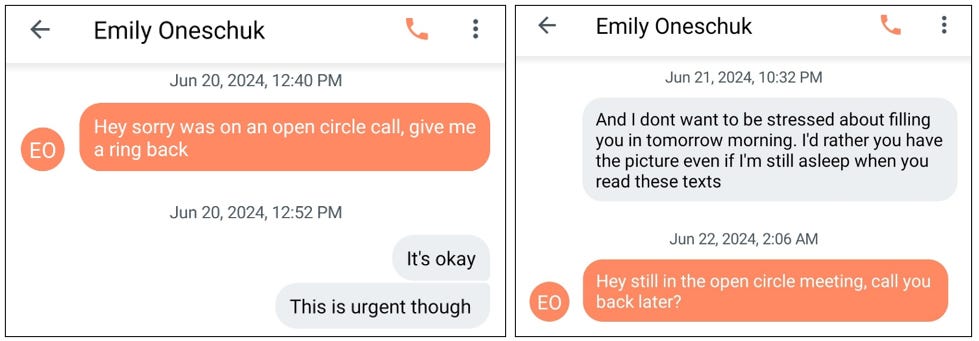
Oneschuk’s prioritization of her engagement with Open Circle Alliance—which was outwardly characterized to state regulators as a purely volunteer activity—over her leadership of the ballot question committee—the overt justification for her receiving a six-figure salary—was consistent with what Oneschuk conveyed to me: the ballot question committee was paying her to co-found the new 501(c)(3) nonprofit.
In addition, the more behind-the-scenes involvement of other campaign consultants—particularly Yes on 4 campaign manager/ballot question committee chair Danielle McCourt, New Approach deputy policy director/Yes on 4 campaign director Jared Moffat, and multiple consultants from Dewey Square Group—with Open Circle Alliance was a major contribution to the nonprofit venture as well. The presence of multiple Dewey Square Group consultants at Open Circle Alliance’s June 2024 launch party—to my knowledge, encouraged to help fill the venue for optics—was an emblematic demonstration of this. A photograph taken at the event of Dewey Square Group associate Aayush Bajpai—the same individual who gave Oneschuk and Open Circle Alliance co-founder Rebecca Slater a “shout out” for supporting the HERO Act on behalf of the campaign—was centrally featured, without identifying Bajpai as a Dewey Square Group employee, in a montage Open Circle Alliance shared with its distribution list in April 2025, “celebrating a year of connections.”
Direct financial contributions supporting Open Circle Alliance, however, came primarily from Heroic Hearts Project, a federally tax-exempt 501(c)(3) nonprofit, whose “mission or most significant activities”—according to its 2023 and 2024 tax filings—were “to build a healing community that helps veterans suffering from military trauma recover and thrive by providing them with safe, supervised access to psychedelic treatments, professional coaching, and ongoing peer support.” Nevertheless, the end result of Heroic Hearts Project’s de facto sponsorship of Open Circle Alliance, encompassing more than $120,000 spent by the veterans charity, did not include any “veteran-focused programming” by the new nonprofit. Furthermore, the sole veteran among Open Circle Alliance’s co-founders, Oneschuk, received no compensation from this spending. Instead, the Heroic Hearts Project payments went directly to Open Circle Alliance’s two non-veteran co-founders exclusively:
$64,123 to Open Circle Alliance president Slater.
o $56,000 “in support of ‘Public Education Related to Natural Psychedelic Medicine’ […] from April - November 2024,” according to a public filing.
o $8,123 “as expense reimbursement IAW [(in accordance with)] Memorandum of Understanding between Open Circle Alliance board members and Heroic Hearts Project,” according to a public filing.
$56,000 to Open Circle Alliance clerk Stefanie Jones “in support of ‘Public Education Related to Natural Psychedelic Medicine’ […] from April - November 2024,” according to a public filing.
As previously mentioned, Moffat informed me he had actively fundraised for Open Circle Alliance in early 2024—presumably directing donations to Heroic Hearts Project—effort that could have been spent soliciting additional resources for the ballot question committee.
The lack of strategic transparency regarding these diverted funds extended to the nonprofit’s formal accounting, which featured fiscal incongruities that masked the true nature of spending. Strikingly, the $8,123 “expense reimbursement” paid to Slater was over $2000 more than Open Circle Alliance reported for its “total expenses” during the same period: just $5,487. In addition to this discrepancy, the claimed reimbursement was notable as a departure from standard operating procedure for nonprofit organizations—an independent charity would typically reimburse an officer like Slater from its own treasury and add the reimbursement to the sum of its expenses. But by having Heroic Hearts Project directly subsidize its operations—and by burying disclosure of the subsidies by reporting them as “financial interest additional information” at the end of its state-mandated filing—Open Circle Alliance presented a misleading picture of its scale and independence to any observer who did not thoroughly review its financial disclosures, effectively understating its operating budget by an order of magnitude (claiming $5,487 in “total expenses” when the true costs of operations exceeded $120,000). While the filing itself technically left ambiguous whether all or some of the $112,000 for “Public Education Related to Natural Psychedelic Medicine” was incidental to Jones’s and Slater’s roles for Open Circle Alliance, Slater—in an effort to dispel mistrust of Open Circle Alliance stemming from a lack of transparency—explicitly stated to local advocates in a March 2025 group call that she had been paid $7,000 per month by Heroic Hearts Project for her Open Circle Alliance work. Jones’s and Slater’s contracts “in support of ‘Public Education Related to Natural Psychedelic Medicine’ […] from April - November 2024” paid them each $7000 per month for eight months, for a total of $56,000 each, leaving no doubt Slater was referring to her contracted role in the nonprofit filing.
In the same call, however, Slater denied Open Circle Alliance was significantly connected to New Approach, which prompted swift rebuttals in emails from former Yes on 4 community outreach director Jamie Morey and former Yes on 4 educational outreach director Graham Moore (me) the next day. Morey, specifically citing the misleading disclaimer on the Open Circle Alliance factsheets and internal emails from the campaign, wrote:
Hi Rebecca and Stefanie,
In follow up from our conversation yesterday, I wanted to further expand on the lack of trust issue and be direct with you. I know firsthand from multiple conversations with Jared [Moffat] that New Approach created Open Circle with a stated goal of engaging and educating the community to support the ballot question. Regardless of the fact that the money for your substantial part time salaries (and I assume additional operating costs which you haven’t yet disclosed) came through Heroic Hearts, this doesn’t change the fact that Open Circle was created by and for New Approach. To say otherwise is not truthful.
Open Circle Alliance was repeatedly untruthful with the community at large, by attempting to appear completely separate and uninvolved with the Yes on 4 campaign, when that was not the case. The statement below appears on all of the fact sheets on OCA’s website: [screenshot of the disclaimer stating “Open Circle Alliance is not associated with the Yes on 4 campaign and strives to present clear and neutral information”].
However, even though you and Stefanie eventually did try to publicly distance yourself from the campaign as the months went on, Open Circle was absolutely and undeniably associated with the campaign, and the two of you were on regular New Approach/Dewey Square Group meetings organized by Jared for the purposes of “coordinating outreach and coalition building,” as evidenced by the two emails below (and many others).
[screenshot of an internal email showing coordination between Jones and the Yes on 4 campaign].
[screenshot of an internal email showing coordination between Slater and the Yes on 4 campaign].
After all that Graham and I have been through over the past year with dishonesty/betrayal from James Davis/Baystaters and Jared/New Approach/DSG--and seeing the damage that both have done to the psychedelic community in this state--working with people that I feel are trustworthy and honest with me (and others) and aligned with my values is essential. I don’t feel like that is the case with OCA knowing all that I know (which is much more than the few examples I’ve shared in this closed group email). Every organization and individual will make their own decision on who they want to work with and why, but I wanted to follow up with the group to provide a little more detail on my comments during our meeting yesterday and to give you some of the clarity you were seeking.
Jamie
I followed up with longer email expressing frustration at the persistent discrepancy between how Open Circle Alliance was marketed to certain stakeholders—particularly myself and other community members—and what it had publicly accomplished, especially in comparison to other local advocacy groups—the Safer Psychedelics Association of New England (SPAN) and the Entheogen Melanin Collective (EMC)—who had participated in the call and were included in the subsequent email thread:
Rebecca, I want to chime in and provide additional clarity. Stefanie publicly said Jared Moffat of New Approach came to her with the idea for Open Circle Alliance during her December 18, 2024 Chacruna panel, which aligns with what Jared told me dating all the way back to the beginning of 2024.
I have a text from Jared from February 21, 2024, referring to Stefanie being brought onboard. The same day, I thank him over text for “coming up with this innovative model” referring to Open Circle Alliance. Jared told me he/New Approach was fundraising for Open Circle Alliance and that he was involved with the proposal of an organization to replace Bay Staters for Natural Medicine. Emily Oneschuk gave me a similar explanation about the origins of the organization. Jared had initially pitched me to join Open Circle Alliance rather than the campaign.
Of course, Jamie and I are not sure what your mandate was from donors. We were led to believe that Open Circle Alliance was going to help with outreach/public education above and beyond what could be done by unpaid volunteers. This outreach and public education never materialized. OCA held 3, small public events targeted toward existing supporters in Cambridge and Boston during the campaign. EMC held the same # of events, albeit with a successful focus on expanding the movement to better include people of color.
I speculate that OCA was intended to help with development. It is no secret, Rebecca, that you are very well-networked with high net worth individuals. However, the ballot measure campaign’s fundraising was anemic for most of the year.
Early in 2024, Emily Oneschuk stopped being a full-time organizer, leaving the campaign’s outreach even more severely understaffed and underfunded than it already was, since Emily, Jamie, and I comprised the grassroots outreach team and only Emily was intended to be full-time. Jamie Morey was hired to run campaign events but given an event budget of only $2500 for the entire campaign. For a substantial period, I was the campaign’s only full-time staff member. I was paid $36,200, excluding expenses, for everything I did. CJ LoConte was paid $0 for his extensive service on behalf of the campaign, including being featured in most of the campaign advertisements on TV and digital, being featured in high-profile media coverage such as in the Boston Globe, participating in the Boston Globe editorial meeting, and publicly debating the opposition.
In comparison, you and Stefanie were each paid full-time salaries. OCA received $7000 for a single event, the launch party, as compared to Jamie’s $2500 for all campaign events. And, being frank, we don’t see the work. And, considering neither you nor Stefanie mention OCA in your LinkedIn histories or bios, perhaps you don’t either. OCA is still not a registered 501c3 despite hundreds of thousands of dollars of funding. OCA’s board is smaller and less impressive than SPAN’s, which was spun up in far less time than OCA had. OCA got less media coverage in 2024 than EMC.
We don’t see the signs of good faith effort to help the ecosystem. To my knowledge, OCA has not made any introductions to donors for ANY of the grassroots organizers on these calls, which would be most helpful given how well-networked you and Stefanie are. You cannot provide credible mentorship in operating orgs like SPAN, Mass Healing, EMC because you don’t have a record of accomplishment in the space.
You shouldn’t be surprised that there is distrust from advocates who busted their asses as volunteers to make plant medicine accessible while you and Stefanie seemed to be overpaid by a deep-pocketed super-PAC to do very little and keep it a secret.
I’ve had nice interpersonal interactions with both you and Stefanie, and I wanted Open Circle Alliance to succeed. But this dynamic is not working and is not sustainable.
Unless Open Circle Alliance can adopt radical honesty and transparency about how the money was spent, from whom, and for what in terms of its activities so far, it’s going to be impossible for the org to be accepted.
Jones’s initial reaction to Morey’s and my claims was to dismiss them out of hand, replying to the email thread:
Oh wow. I had a whole response written, but then received your email, Graham.
There is so much wrong information in your email and Jamie’s that quite frankly I’m overwhelmed and don’t even begin to know where to start to address it. Just about 90% of all your assertions combined are totally wrong and incorrect.
This is the gist of what I’m taking away from your two emails: that you think Open Circle Alliance is a tool of New Approach. That you and Jamie are mad about the money that went to Open Circle and to Rebecca and me, personally. And that you somehow think we’re holding onto secret donor relationships, in order to lord it over the rest of the groups here. ??? Or something.
This is a REALLY WEIRD and honestly quite hurtful take.
I will need some time with this, and to check in with Rebecca, before responding again.
Stefanie
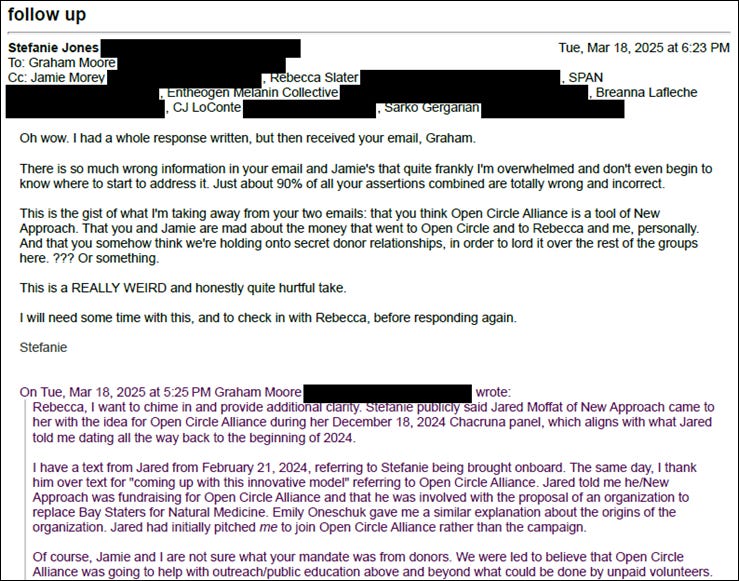
I answered this retort in an email by providing additional evidence of Open Circle Alliance’s close affiliation with New Approach, while simultaneously attesting that any misrepresentation on my part was “unintentional” and that I “welcom[ed] clarity” (text in italics in the original email is underlined):
I think a cooling off period is appropriate, but I’m not a liar. In addition to my contemporaneous notes on the 12/18/24 Chacruna panel, in which Stefanie claimed the genesis of Open Circle Alliance was Jared Moffat of New Approach having a conversation with her in early 2024 and disclosing a problem to be solved (disunity of MA psychedelics community), then subsequently introducing her to Emily Oneschuk and Rebecca Slater to solve it, attached are the 2/21/24 texts I referred to.
In inquiring as to the individual Emily Oneschuk led me to believe might be hired to be “a new campaign director,” Jared clarifies that “Emily was probably thinking of Stefanie.” He goes on to note she has not been hired (yet) and would not be overseeing the whole campaign. Why would Emily “probably be thinking of Stefanie” as a possible campaign director for the campaign if Stefanie was not already closely affiliated with the campaign or those running it?
In a conversation over the phone, Jared told me about his/New Approach’s vision for Open Circle Alliance as part of the campaign/movement, which led me to compliment his “innovative model.” Jared replied by saying he was “Excited to put all this into motion.”
As Jamie referenced, there is extensive internal documentation of Open Circle Alliance’s close collaboration with the campaign and, of course, Emily Oneschuk was campaign staff while simultaneously co-founding OCA! But I decided to throw in a few, relatively innocuous, May 2024 texts, with Jared alluding to Stefanie’s role in de facto campaign outreach [the “few, relatively innocuous, May 2024 texts” were attached to the email].
During the 12/18/24 panel, Stefanie identified educating people about the ballot question as one of Open Circle Alliance’s core goals, along with bringing the psychedelics community in MA together. She also confirmed OCA held just 5 events in 8 months (apparently counting 1 post-election event and the May 2024 soft-launch event) to accomplish those goals (so only 4 that could help ballot measure).
Who would be incentivized, in 2024, to put $200,000+ into a new organization to 1. unite the psychedelics community in MA specifically (problem identified by Jared Moffat per Stefanie) and 2. educate the public about the psychedelics ballot question? Presumably: the same donors/kinds of donors who funded the formal campaign/New Approach.
Why would Heroic Hearts take money that could go to saving veterans’ lives and give it to an organization, staffed primarily by non-veterans, to unite MA’s psychedelics community? Heroic Hearts prioritizing MA’s psychedelic community over veterans seems like a stretch to me.
If I get anything wrong, it is unintentional, and I welcome clarity.
In response to this elaboration, Open Circle Alliance’s next and final contribution to the email thread was a joint statement from Jones and Slater that rejected further discussion regarding “accusations about rate of pay and efficacy”—which it derided as “personal attacks”—but appeared to concede key factual details even as it maintained Open Circle Alliance’s denial of inappropriate coordination:
Hello all,
We have talked over and over (and over) our response to these emails.
Unfortunately, all our responses cannot overcome our anger, frustration and hurt at these accusations and the way they came about.
We are only responding now to the entire chain to refute certain points:
1. Although the idea and funding for a community org originated in collaboration with New Approach, once created, Open Circle Alliance operated with its own distinct objectives - which from the start, were not primarily concerned with the passage of Q4. The org has always had independent decision making and continues to operate in this manner. Any perception that we were trying to hide our relationship to New Approach was an unfortunate misunderstanding of us trying to demonstrate clear separation. One that ideally could have been cleared up with direct conversations with us (which did not happen).
2. While disagreements over funders and approaches to the work are natural sources of conflict and misunderstanding in advocacy, accusations about rate of pay and efficacy are personal attacks. They have been received that way by us. We will not be responding to or further engaging with these insulting claims. Further, they seem to be an extension of the dissatisfaction with how New Approach decided to spend its money, which makes us completely the wrong targets for this critique.
We are considering our place in the community and how to move forward. If any of you have any other questions or responses, we ask that you come directly to us and not belabor this email chain.
Regards,
Rebecca & Stefanie
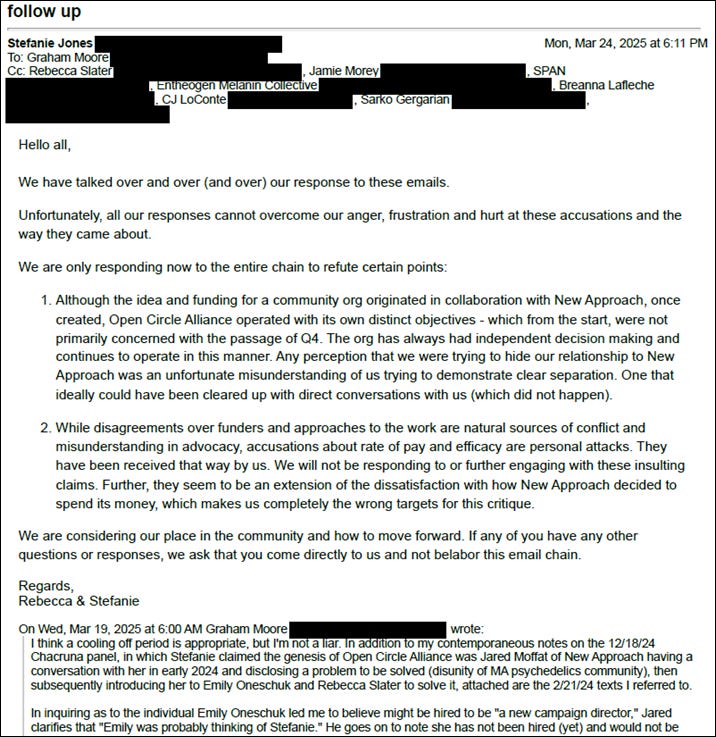
Although the message was framed as a reply “to refute certain points,” Jones’s admission that “the idea and funding for a community org [(Open Circle Alliance)] originated in collaboration with New Approach” marked a stark reversal from the nonprofit’s earlier stance, as expressed by Slater on the group call. Moreover, while Jones and Slater labeled the inquiry into their pay as “insulting,” they conspicuously declined to dispute that they had been paid by Heroic Hearts Project for their roles in Open Circle Alliance or that Open Circle Alliance’s effective operating budget had exceeded six figures. By “refuting” minor points while remaining silent on the facts of the compensation and finally acknowledging New Approach’s foundational role in their “independent” startup, the leadership of Open Circle Alliance effectively corroborated the existence of the shadow-payroll system they had originally obscured. Moreover, Jones’s and Slater’s refusal to provide any meaningful, additional transparency during subsequent calls with participants on the email thread other than Morey and me—even though these community members claimed to have sought clarification with an open mind—cemented the mistrust that Slater had tried to dissipate.
A series of similarly contentious interactions with Moffat in the first half of 2025 culminated in further corroboration that the $7000 per month contracts served as compensation for Jones’s and Slater’s work for Open Circle Alliance. On January 20, in the wake of state legislation on psychedelics having just been filed with the support of the ballot question committee, Moffat recommended a virtual meeting “soon, tomorrow, or Wednesday”—with him, Morey, Yes on 4 surrogate and Morey’s nonprofit co-founder CJ LoConte, Yes on 4 chief strategist Tocci, and me—“to discuss next steps and make sure we’re coordinated.” Moffat’s recommendation to urgently “get on the same page” as Tocci came despite my expressed reservations regarding Dewey Square Group’s political influence moving forward. Speaking on behalf of LoConte, Morey, and me, two days earlier, I had emailed Moffat:
Our preference would be to leave [Dewey Square Group] alone and reach out/engage with them as useful to us on an as-needed basis. […] We also do not want journalists to keep going to [Dewey Square Group principal] Jennifer Manley for psychedelics movement and campaign information.
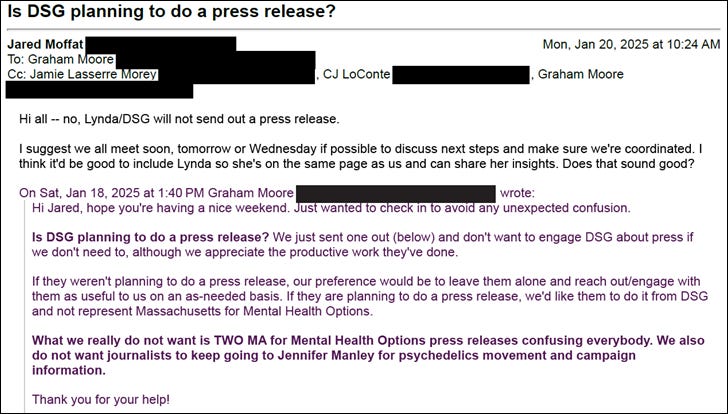
In response to Moffat’s subsequent, aggressive push for proactive alignment with Tocci, I sent Moffat four, consecutive emails, which he later characterized as a “lengthy tirade.” Leaving Morey and LoConte—who had been carbon copied by Moffat in his message—on the thread, I initially replied to Moffat in less than an hour with a single email: a personal acceptance of his proposal, caveated with an entreaty for him to “help facilitate a more balanced relationship” with the campaign’s Dewey Square Group consultants, who had continued to professionally marginalize Morey and me, contextualized by a frank assessment of Dewey Square Group’s operational performance:
Speaking just for myself, I think a meeting tomorrow, with the five of us AFTER the decrim Boston meeting could be a good idea.
I think we could benefit from cover from you, Jared [Moffat]. Actions speak louder than words and Lynda [Tocci] has yet to demonstrate she respects our insights, with no increase in humility even after the resounding election loss that I less and less think was unavoidable. I can’t blame anyone for doing what they thought was best at the time, but Lynda doesn’t fundamentally get this issue or how it plays to Massachusetts voters and I think it was a mistake to not have anyone who does be in a position of strategic leadership. Jamie and I were on the ground, talking to MA voters before, during, and AFTER the campaign in a way Lynda never was AND we had a history of speaking with legislators about it as well. We actually know things.
DSG and company had an opportunity to demonstrate their unique usefulness after Nov. when they were presented with a menu of legislation we, the kinds of people who are needed to provide support for legislation at hearings, were excited about and given a mandate to help drum up support for “10” bills in Danielle [McCourt]’s words. Then, they “doubled down on Decker,” didn’t give Jamie, CJ, and I a single meeting or lead, and everything was left to us to actually accomplish the team goal. And one of Lynda’s go-tos, when her authority has been challenged, has been to soft blackmail the movement by flexing her insider connections and her importance to “getting things done” (“how will anything get a vote without Mariano?”, etc.) rather than showing interest in growing as a team.
Lynda “thumbing down” and getting upset about retail sales, criticizing me just a few days ago for a LinkedIn post hyping up the legislation I personally drafted with my lawmaker and a psychiatrist... it’s getting more and more insulting as the consequences of Q4’s loss to people like me, Jamie, and CJ on the ground sinks in more and more. The Decker thing is great, and a real accomplishment, but it’s not a gift from DSG to the movement... they basically had to get something done to save face and Decker was an easy get because they knew her.
I want to have a positive relationship with Lynda (I think we all do) but she has yet to seem open to that on anything but her uncompromising terms. If you can help facilitate a more balanced relationship, that would be awesome. The 3 of us can all play ball but it feels like we get our lunch eaten every time we play nice (which has been the entire time, regardless of strong opinions expressed behind the scenes to you like in this email).
Having sent this message at 11:02 AM on a Monday, 38 minutes after Moffat had suggested the meeting, I interpreted Moffat’s non-response during the entirety of the day’s standard working hours as a premature dismissal of a pressing concern, and I escalated my communication accordingly. At 9:07 PM in Massachusetts—6:07 PM in Moffat’s state of California—I sent an explanatory follow-up, carbon copying LoConte and Morey again:
Look at the most recent texts between me and Lynda (from Friday). I’m coddling to her feelings and there isn’t a single congratulations or thank you from her. If she doesn’t want to work with us, that’s fine, but her being territorial about this issue is insensitive. It’s my existence that’s being criminalized under the status quo and one would think, given her background, she would be more sympathetic. And neither she nor her colleagues have demonstrated they can deliver on this issue, no matter how many millions they are paid. So just a little extra kindness and taking a back seat seems more than merited. My hand is still open.
The text thread from days prior that I attached to the email showed that—even after Tocci had reached out to me solely to criticize a personal, relatively low-visibility LinkedIn post about a bill I authored; a post that she admitted she “didn’t spend too much time looking at so maybe [she] missed the intention”—I had responded graciously, including thanking Tocci for her professional contribution, and, in turn, Tocci had not afforded me the courtesy of even a cursory reply to my “thank you.”
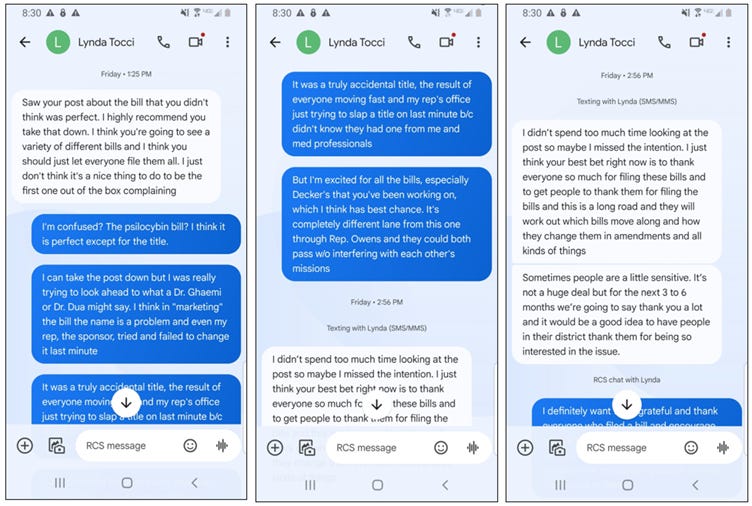
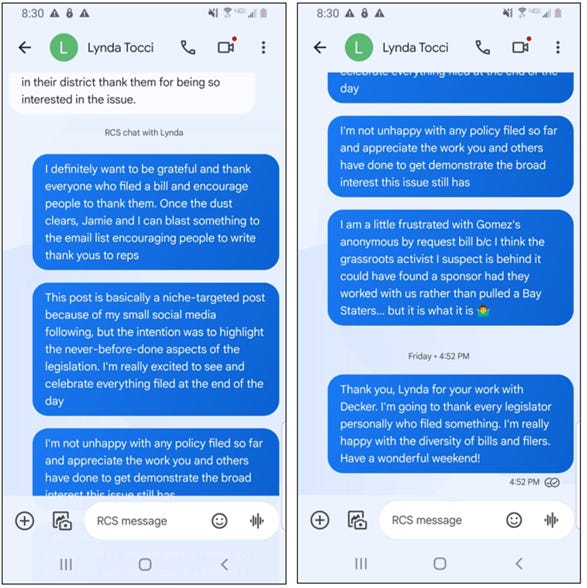
A few hours later, I sent two more short, explanatory follow-ups, detailing specific operational failings by Dewey Square Group consultants. I carbon copied LoConte and Morey on these communications as well. At 11:29 PM, I emailed:
Just a refresher, Lynda [Tocci]’s well-paid consultants didn’t even know basic relevant information as late as September/October 2024. Did we lose by 14 points just because Tomas didn’t know the policy allowed distribution? No. But if I hired lawyers (or political consultants) to fight for a policy, I’d expect them to know it inside and out. Every issue with Danielle [McCourt]/DSG campaign that was identified was brushed aside as unimportant because they “knew how to win” and we [(Morey and I)] didn’t. Then, on top of the mediocre communications, social media, presentations, etc., we lose spectacularly. And then... Lynda still purports to be the expert with nothing to learn from us and her big accomplishment is getting her friend to copy/paste a bill you gave her.
Attached to this message were screenshots of emails in which Dewey Square Group consultants demonstrated an acute lack of preparedness late in the campaign:
A screenshot of a September 18, 2024, email, in which Dewey Square Group senior associate (and dedicated lobbyist for the ballot question committee) Brennan Spencer revealed that, in his presentation that evening, he had justified Question 4’s decriminalization provisions with an implausible falsehood—“you need [144 square feet of space] to even get enough of the active psychedelic component [in psilocybin mushrooms to have a significant effect]”—rather than a campaign-approved, fact-based talking point.
A screenshot of a September 26, 2024, email, in which Dewey Square Group associate (and longtime Yes on 4 campaign consultant) Tomás O’Brien revealed he still did not known Question 4’s decriminalization provisions allowed individuals to give away home-grown psychedelics—he had become aware of his ignorance in response to a request for correction made by an attendee of one of his recent presentations.
A screenshot of an October 9, 2024, email, in which Dewey Square Group associate (and longtime Yes on 4 campaign consultant) Aayush Bajpai revealed he still did not know “what does it look like when folks grow psychedelics at home usually,” nor did he have an answer on-hand available for reference, despite Question 4’s decriminalization provisions allowing home cultivation of psychedelics having long been established as a key concern of voters.
Finally, at 11:55 PM, I emailed:
And the cherry on top was DSG betting the house on a campaign spokesperson they recruited to advertise psychedelics for veterans [(Oneschuk)]... who was a veteran struggling, by her own admittance, with her mental health despite using psychedelics, [Redacted: private details regarding Oneschuk’s health], and who repeatedly tried walking away.
This message referred to Oneschuk’s public and private admissions of struggling with mental health issues despite the use of psychedelics—for example, a MassLive article published in August 2024 quoted Oneschuk as saying, “I still go to therapy, I still have days where I don’t understand the point of existence”—as well as her desire, which Oneschuk repeatedly expressed to campaign leadership internally, to resign from the campaign.

In elaborating on “the stigma” of psychedelics, Oneschuk had even revealed during a televised, October 2024 campaign debate, broadcast on public radio, that her “doctor at the VA [(Veterans Affairs Administration)]” had explicitly asked her to “please stop using [psilocybin mushrooms],” remarking:
So I’m not a doctor, but I am a patient, and I do have a doctor. And I went to my doctor at the VA and she said, “What are you doing for your PTSD and depression, anxiety?” And I said, “I’m doing psilocybin mushrooms.” And she said, “Do you sauté those?” And I said, “No,” um, and I told her what they were and she went white as a sheet and said, “Please, stop using them.”
And I was like, “That was not the response I had hoped for, right?” I was hoping for a conversation. I was hoping for some, you know, being informed. I was hoping for some curiosity. And what I feel like, you know, and Dr. Ghaemi mentioned, like, you know, people, right, there’s a lot of people that have mental health issues that are probably using these already. In fact, the highest case usage we see is people with depression who are probably not talking to their doctors about them because of the stigma, because they fear what could happen if they were open.
Although Oneschuk attempted to use the anecdote to argue psychedelics should be normalized as mental health treatments, the disclosure that Oneschuk’s treating physician considered “PTSD and depression, anxiety” as active diagnoses—and reacted with visceral alarm (turning “white as a sheet”) rather than “curiosity”—suggested the physician had not observed clinical evidence of improvement justifying the risks of ongoing psilocybin use. That a “doctor at the VA,” privy to Oneschuk’s private medical history, had responded to the psilocybin reveal with an urgent plea for Oneschuk to stop—rather than with cautious optimism or gentle misdirection—challenged the veracity of campaign’s narrative of a “healing” Oneschuk as its-standard bearer. Had the public also been made aware that, behind the scenes, Moffat casually referenced “the trauma of the campaign” as an explanation for Oneschuk’s diminishing operational role—or that Oneschuk had already had to be convinced to resume her role once after resigning—Yes on 4 would likely have been dead in the water.
Moreover—in addition to undermining the campaign’s political viability—the exploitation of Oneschuk was another expression of the hypocritical, institutional callousness that Tocci had exhibited in her recent interaction with me. Just as senior leadership (Tocci) of the ballot question committee Massachusetts for Mental Health Options—purportedly devoted to helping mental health patients—did not think it necessary to even perform niceties behind-the-scenes with a patient and caregiver (me) regarding my own legislation, the campaign had seriously jeopardized the health of a local veteran (Oneschuk) out of political expediency. Contributing to my indignation was the fact Morey and I had been effectively extorted by strategic leadership into participating in the mistreatment of Oneschuk. So long as the ballot question committee was unwilling to seriously entertain replacing Oneschuk as the face of the campaign, an electoral victory for Question 4—which Morey and I considered a moral imperative—appeared contingent on Oneschuk continuing to perform her role in at least a superficial capacity. Consequently, Morey and I had both participated—me much more so than Morey—in coaxing Oneschuk’s continued involvement in service to what we considered the greater good.
We partially salved our consciences by delivering frank assessments regarding Oneschuk’s health to Moffat during the campaign, which were brushed off. For example, in September 2024, Morey texted Moffat that she and I were “concerned” about Oneschuk and that our knowledge “puts all of us in an awkward position.” Rather than disputing Morey’s matter-of-fact observation that Oneschuk “[was not] really healed in the way she’s been made out to be publicly” or Morey’s contention this information was “not the well kept secret that you and Dewey hopes it is,” Moffat signaled recognition. Alluding to prior familiarity with Oneschuk’s condition, he asked: “Are there things I don’t know about or is it just Emily [Oneschuk] going on retreats etc?” When Morey clarified that there were “things you don’t know about,” Moffat answered with telling ambivalence: “Ok I can’t talk now but maybe this weekend if you’re around we can discuss.” His response suggested the inquiry to Morey had been intended more to determine what she knew than to bring him up to speed about Oneschuk—he showed little interest once Morey claimed to have new details to share. The lack of urgency presented a dual indictment of Moffat’s mismanagement: either he was already well aware of Oneschuk’s evolving circumstances and reluctant to draw attention to them, or he was being professionally negligent. By deferring a critical report of operational risk from another director-level official (Morey) he had personally vetted—and would later bonus—to a hypothetical weekend chat, Moffat effectively abandoned his fiduciary duty of due diligence as Yes on 4 campaign director.
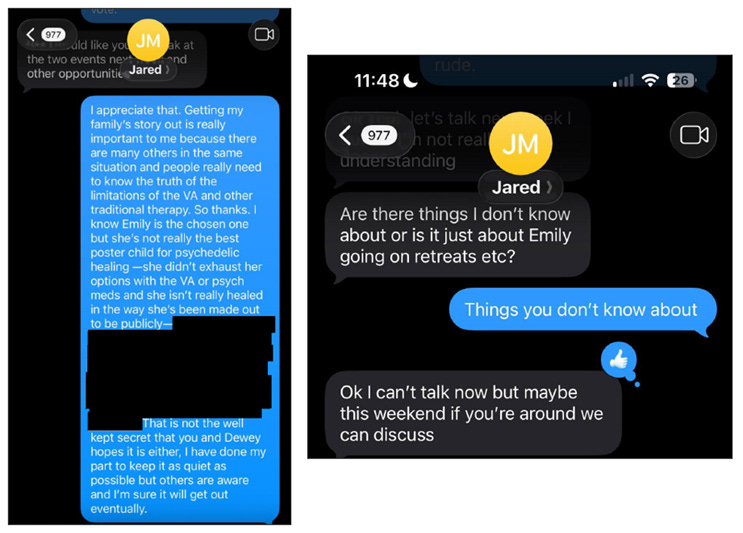
Months later—and in the wake of the resounding election loss that such negligence invited—Moffat’s reaction to my “lengthy tirade” was similarly dismissive. In a terse, three-sentence reply to my four critical emails—delivered the day after I sent them, on January 21, 2025—Moffat registered that he “[didn’t] agree with most of this” but did not specify a point of contention:
I don’t agree with most of this. I also don’t think it’s a good use of time to debate. If you all want to meet and align on a strategy now that the bills are filed, let me know.
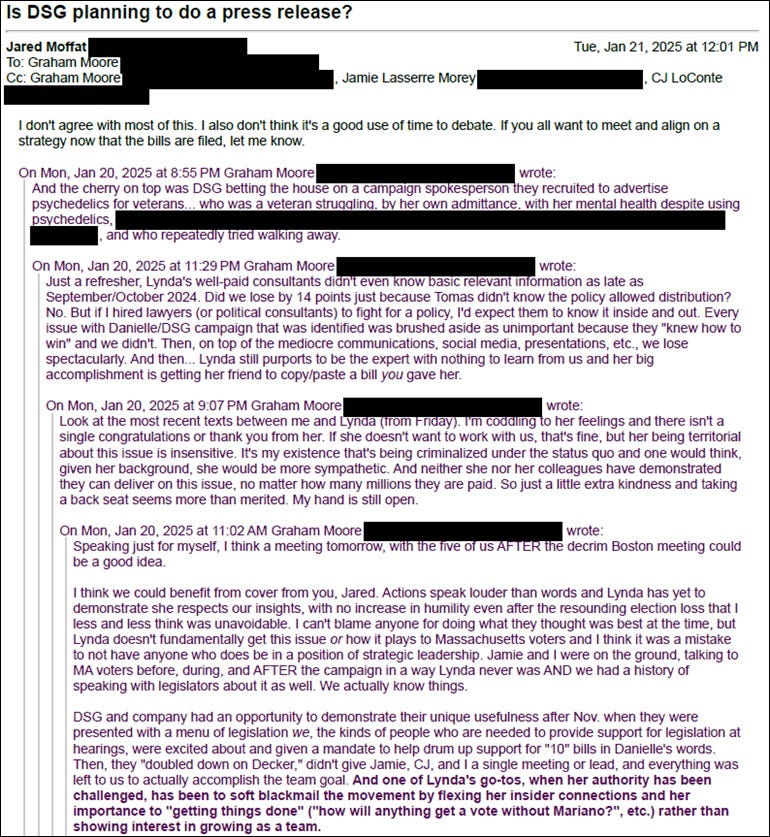
Moffat’s lack of interest in clarifying pertinent facts of the campaign’s conduct through dialogue—as expressed by his opinion that it was not “a good use of time to debate”—and his non-acknowledgement of my plea for “help facilitat[ing] a more balanced relationship” with Dewey Square Group, demonstrated he did not think my documentation-supported professional opinions merited meaningful engagement. Accordingly, I did not respond again to the thread nor participate in Moffat’s meeting—Moffat had dispelled any illusion that I would be treated as a peer in “align[ing] on a strategy” with him and Tocci. Considering my collaborative relationship with Moffat effectively over, my final unsolicited outreach to him, a brief email on January 31, 2025, was solely to determine the status of $6000 in bonus compensation I was owed—after Moffat admitted in his written reply that “[he] might have dropped the ball [regarding effecting the payment],” he completed the payout a few days later.
A month after this, I was surprised by a text message from Moffat on March 3, 2025, including Morey and I—unilaterally and without prior notice—in a group chat with Moffat and journalist Jack Gorsline. Specifically, Moffat sent Morey, Gorsline, and I a screenshot of an X post by Gorsline, in which Gorsline wrote:
Hilariously, I actually approached a prominent Q4 volunteer who now works with a New Approach PAC shell group [(Open Circle Alliance)] about creating this event series over a year ago and was told “what’s the point?”
Imagine if the DSG/New Approach cabal had partnered with MA cannabis industry leaders.
The screenshot—which did not mention Morey or me, and was shared with us by Moffat weeks before we raised issue with Open Circle Alliance on March 18—was provided without any contextualizing commentary. Gorsline almost immediately replied to the image, texting the group chat:
Hi Jared [Moffat] - this is my post and entirely, 110% my opinion so if you’d like to discuss further can talk later today 1 on 1
This doesn’t have anything to do with Jamie [Morey] and Graham [Moore].
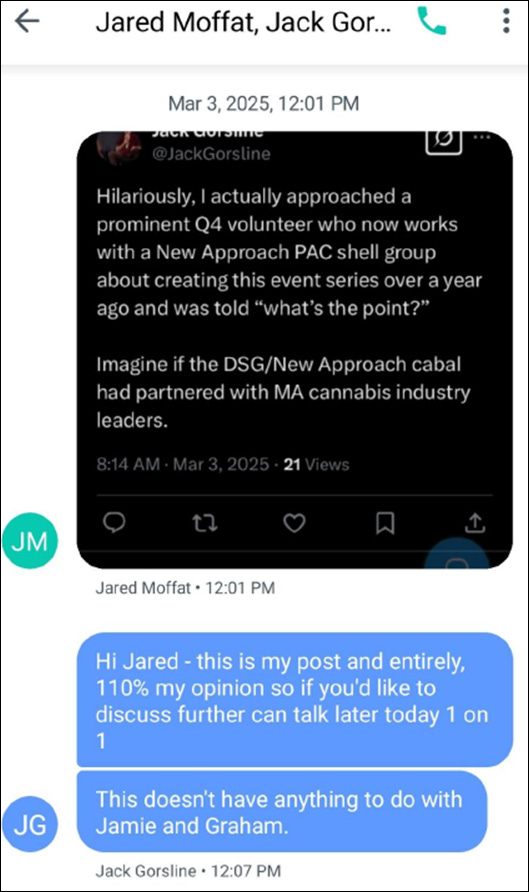
Moffat retorted in the thread three minutes later, “We all care about the movement, and I want them to be aware of what I consider destructive behavior on your part.” This initiated a prolonged back and forth between Gorsline and Moffat in the group chat, in which Moffat disputed Gorsline’s characterization of Moffat’s culpability for the ballot measure campaign’s perceived shortcomings.
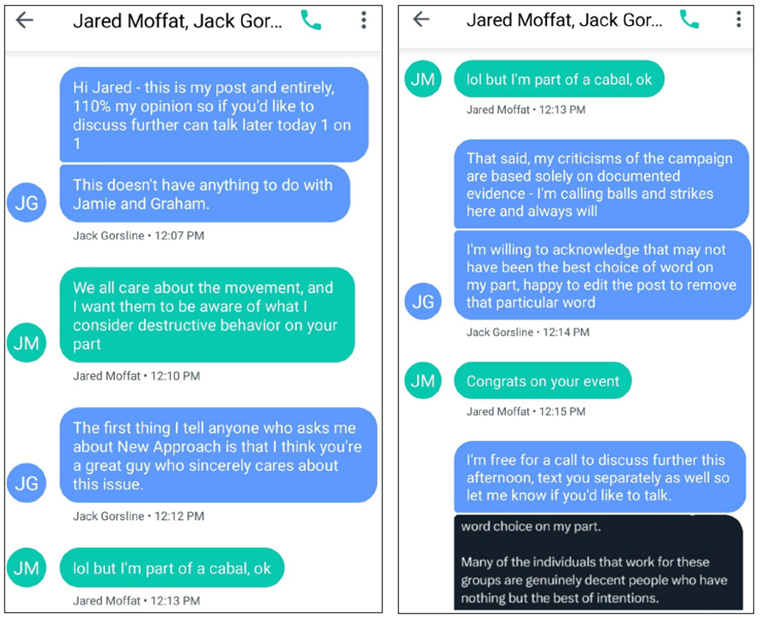
After Gorsline finally commented, “Involving Jamie and Graham in this conversation at all feels pretty unprofessional - so if you’d like to speak further you can text or message me privately,” Morey and I made our only contributions to the thread, primarily to register our disapproval with being included. Morey wrote:
Hey Jared [Moffat], I am only responsible for myself and the 4 humans I grew in my body—not Jack [Gorsline] or anybody else. I’m happy to talk about anything you’re concerned about next week though (we are on a rare family vacation while we have house repairs done).
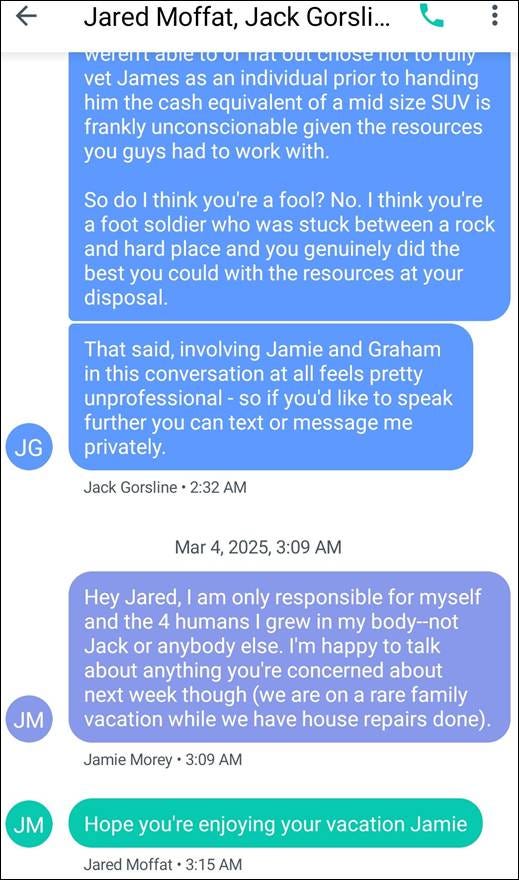
I chimed in: “I would also like to be left out of this thread.” In response to Moffat answering Morey with, “Hope you’re enjoying your vacation Jamie,” Morey reiterated she was “happy to chat towards the end of next week,” and the thread subsequently concluded with Moffat replying to a message of Morey’s with a like.
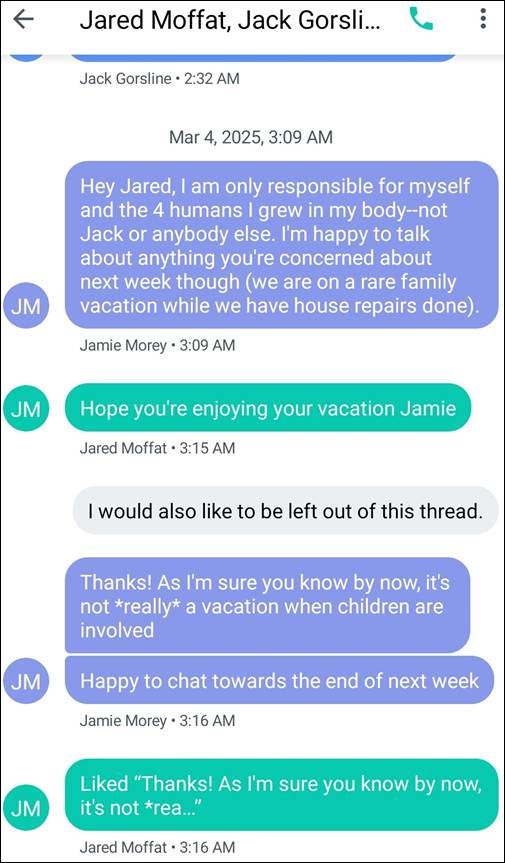
According to Morey, Moffat took her up on the offer of “a chat” around two weeks later. During the call, Moffat allegedly expressed anger toward what he perceived as harmful and unfair criticisms of the Question 4 campaign originating from Morey, Gorsline, and me. In particular, Moffat allegedly claimed that I had been “going across the country” harming his reputation. Morey told me she responded by disputing his characterization of my behavior, emphasizing that she and I should not be conflated with Gorsline, and politely restating good faith criticisms of the ballot measure campaign, which Moffat dismissed as overstated or inaccurate as during previous interactions. When this information was relayed to me by Morey, I took especial umbrage at Moffat’s false claim that I had been aggressively tarnishing his reputation. In fact, I had never left Massachusetts since the end of the campaign, and my most substantive criticism of the campaign to an out-of-state audience had been delivered—explicitly upon request—to a small group of national advocates at a single, closed-door meeting. Moreover, the discrete gathering had not been the subject of news coverage or, to my knowledge, any public commentary on social media, further undercutting Moffat’s narrative that I had been barnstorming the nation. My frustration with the mischaracterization of my activity surfaced when Moffat reached out to me—again, unsolicited—in May 2025, leading to a text message conversation that quickly turned to the subject of Open Circle Alliance.
On May 14, 2025—five days after I had emailed the Question 4 campaign’s television advertising firm, soliciting information on Yes on 4’s “advertising strategy”—I received a text message from Moffat: “Hey Graham, hope you’ve been well. Want to catch up sometime?” I responded candidly the next day, expressing skepticism of Moffat’s ostensible goodwill in light of his past behavior—including his remarks to Morey—but agreeing to speak at his convenience:
Hi Jared, I’m more than a little suspicious of this outreach and this expression of goodwill considering how dismissive you were of my frustrations in January.
I also did not appreciate you looping me into that thread with Jack [Gorsline] or telling Jamie [Morey] I’ve been going “across the country” trashing you, which is patently untrue
If you want to know something, ask. Tell me what time works for you and we can speak today.
Seemingly in reaction to my confrontational tone, Moffat replied by devaluing a prospective conversation as “probably not a good use of our time” and implicitly admitted his outreach had been triggered, at least in part, by my recent outreach to the campaign’s advertising firm (“the media buyer”):
I saw you reached out to the media buyer. Also hoped maybe I could understand where all the hostility is coming from. But probably not a good use of our time
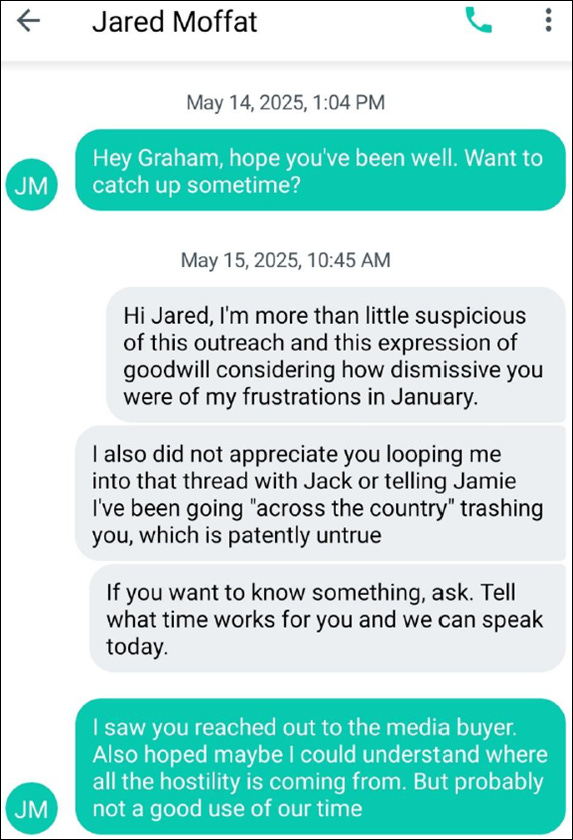
My answer to Moffat was to appeal, one last time, to our erstwhile rapport as colleagues, entreating his acknowledgement of what I considered to be legitimate “frustrations” with the management of Yes on 4—including the high compensation for Open Circle Alliance’s officers, in particular:
I’m still in MA, trying to move things forward. If there’s a better way to advertise for next time, I want to know.
Is there a reason you’re concerned about me reaching out to them [(“the media buyer”)]?
Jared [Moffat], you and I had a lot of frank conversations over the course of the campaign. I busted my ass for your campaign. You’re smart enough to know why certain things would rub me the wrong way, like finding out from Rebecca [Slater] that Emily Oneschuk was paid $70,000 through Open Circle Alliance on top of the ~$100,000 for MMHO. So $170,000 for Emily Oneschuk for what she did. $140,000 to Stefanie [Jones] and Rebecca [Slater] (per Rebecca [Slater]). ($70,000 to Rebecca [Slater] and $70,000 to Stefanie [Jones])
And it is what it is but I was bummed out when DSG basically didn’t help us with the legislative push and Lynda was criticizing my form.
And hosted you in my house, gave you all sorts of important information, worked my ass off, and, yes, sent you some angry rants (which I would not do again)
If you’re honest with yourself, you would be upset, too, in my position.
Moffat responded by tersely claiming “[my] facts [were] wrong,” cursorily acknowledging my feelings (“sorry you’re upset”), and characterizing my actions as inappropriate:
Your facts are wrong. Sorry you’re upset. I would not act how you do if I were in your position
I reacted by asking Moffat to “correct my facts” and explaining the reasoning behind compensation figures:
Jared [Moffat], please correct my facts. Rebecca [Slater] said she and Stefanie [Jones] made $7000 per month for OCA. Emily [Oneschuk] had the same position as them, so reasonable to assume she made the same. $7000 x 10 months of OCA = $70,000.
Moffat answered: “Emily [Oneschuk] was paid by the campaign and not OCA, she was a friend/volunteer to them.” In disputing only the payments made to Oneschuk—and not the $7,000 monthly compensation for Jones and Slater—to “correct my facts,” Moffat implicitly confirmed the considerable salaries of two of Open Circle Alliance’s co-founders, including his “longtime friend[] and colleague[]” Jones. He notably did not clarify that I had overestimated the total amounts paid to Jones and Slater by assuming they had been compensated for 10 months—from March 2024, when Open Circle Alliance began forming in earnest, through the end of 2024—rather than for eight. This omission may have been to avoid scrutiny of the true timeline of the payments—from April through November 2024—which suggested a connection to the November election.
I thanked Moffat for the information he did provide, and then I inquired what specific, recent behavior of mine he had found “so inappropriate,” texting: “Thank you for clarifying. And what do you think I’ve done that’s so inappropriate since January?” In response, Moffat cited my critical emails in January—which he described as “deeply unproductive and unhelpful”—and claimed I possessed a “constant looking for malice in others […] [that] [didn’t] serve [me] well”:
The last interaction we had was when you wrote your lengthy tirade on the email chain with CJ. I found that to be deeply unproductive and unhelpful. I didn’t like how you brought CJ into a very unpleasant conversation that had nothing to do with him.
I have always tried (and will always continue to try) to be a resource and support for you, to help you find your footing and be effective in the movement. I believe that is what Lynda [Tocci] has tried to do too in her own way. The constant looking for malice in others and unwillingness to see people as humans doing their best or at least humans operating from a worldview that is different than yours doesn’t serve you well. I just don’t understand it. This loss was a loss for all of us, not just you and Jamie [Morey]. A lot of other people feel the pain of it too
While I disagreed with Moffat’s assessments of my character and actions, rather than dispute them, I tried to shift the conversation back to establishing “the facts”—essential to my underlying goal of understanding how the Question 4 campaign had operated. Accordingly, I replied: “Okay, Jared [Moffat], I hear you. What other facts did I get wrong?” Moffat demurred in his answer and, instead of specifying additional inaccuracies on my part, essentially reiterated his characterization of me as “constant[ly] looking for malice.” Treating my factual concerns as not meriting engagement, he claimed an “antagonistic dynamic [with] [me], Jamie [Morey], and Jack [Gorsline]” and an “attempt to create a [negative] narrative” was “really unhelpful”:
[I don’t know], I just think the antagonistic dynamic [with] you, Jamie [Morey], and Jack [Gorsline] --and the attempt to create a narrative about how Dewey and New Approach and Open Circle all suck--is really unhelpful. I don’t have an agenda, just want us to all be friends and focus on the actual work
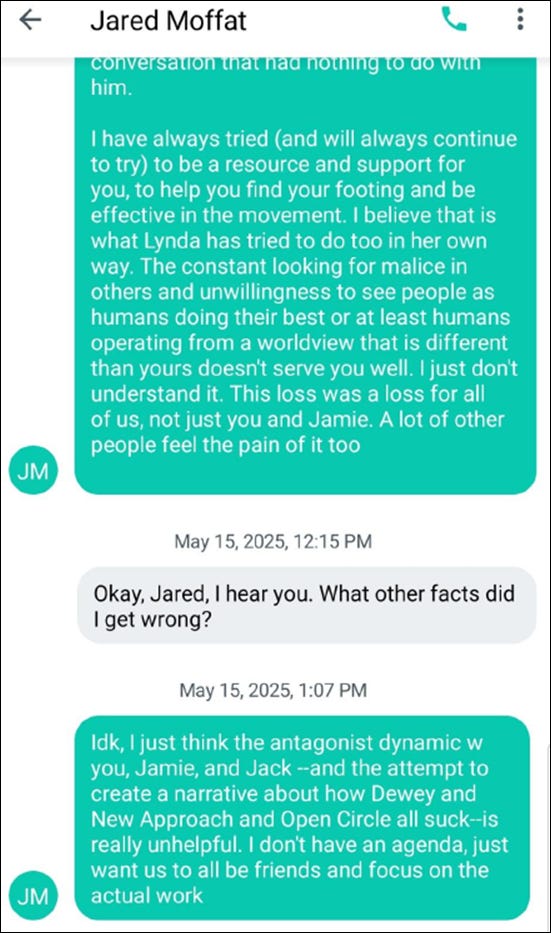
Unable to work closely or “be friends” with someone who repeatedly refused to entertain an in-depth, fact-based discussion on the failure of our high-stakes, multimillion-dollar professional project, I did not reply. In fact, as of writing (April 14, 2026), I have not contacted Moffat since this May 2025 text message exchange, the primary utility of which was to corroborate the Heroic Hearts Project funding of Open Circle Alliance.
As for what achievements the over $120,000 in Heroic Hearts Project funding—particularly the $112,000 in salaries for Jones and Slater from April through November 2024—actually paid for, the picture remained murky. In a December 2024 email to its distribution list, Open Circle Alliance touted its accomplishments so far (referred to as “our progress”) in a fundraising pitch as:
“8 Months [of operations].”
“5 Events.”
“150+ Attendees.”
“10+ Ally Groups.”
“250+ Email Reach.”
“Resource Library.”
“Events Calendar.”
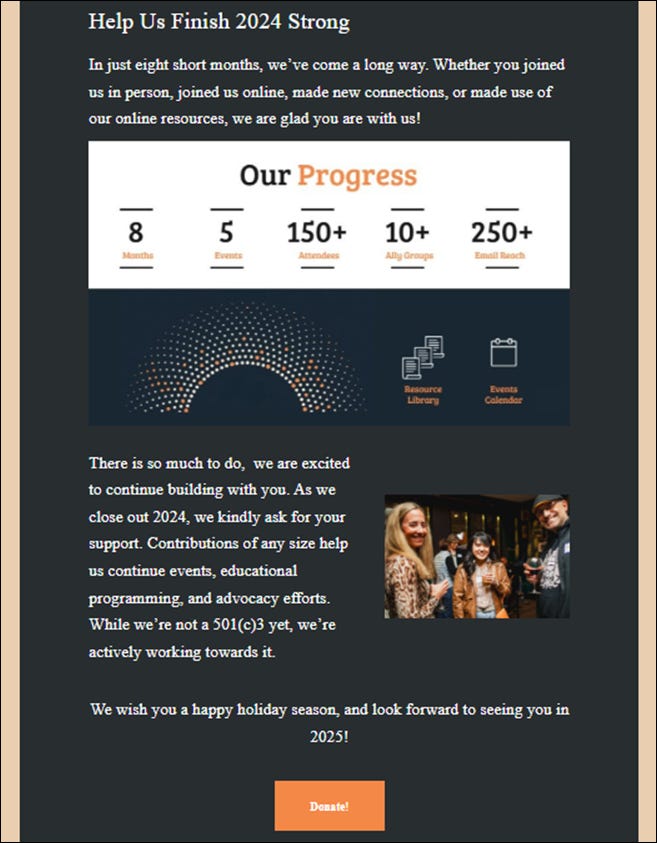
By “5 Events,” the nonprofit seemed to refer to its five public events, four of which (all but the June launch party) were reflected on the nonprofit’s events calendar:
The June 27, 2024, “public launch event” (not on the events calendar)
The August 22, 2024, “Late Summer Social” (on the events calendar)
The October 6, 2024, Music for Mushrooms screening and discussion co-hosted with Yes on 4 (on the events calendar)
The November 3, 2024, Music for Mushrooms screening and discussion co-hosted with Yes on 4 (on the events calendar)
The November 9, 2024, “Looking Forward” event (on the events calendar).
The omission of the public June event from the events calendar appeared to be an oversight, as opposed to the seemingly intentional exclusion of the private events—while the June launch party was the only public event not reflected on the calendar, Open Circle Alliance’s two private events were omitted retrospectively and prospectively. When the events calendar was debuted on October 18, 2024, it included entries for Open Circle Alliance’s previously-held public events on August 22 and October 6, in addition to advertising its upcoming public events scheduled for November 3 and November 9; the calendar did not have entries for either its private soft launch “gathering” held in May or its upcoming private “Zoom Town Hall / Q&A for Plant Medicine Guides” scheduled for October 30. By drawing attention solely to its public events in its newsletter—at the cost of understating its activities while soliciting donations—Open Circle Alliance demonstrated it placed a high value on obscuring the scope of its operations from the general public. By contrast, Open Circle Alliance had promptly notified senior leadership of Yes on 4—including McCourt, Moffat, and Tocci—of both its private events, suggesting the nonprofit considered itself more beholden to campaign powerbrokers than grassroots donors.
As far as public-facing work, Open Circle Alliance’s accomplishments at the eight-month mark were not commensurate with its six-figure funding. For context, famous startup incubator Y Combinator awards promising nonprofits $100,000 grants to launch scalable, high-impact initiatives. Even though Jones and Slater cumulatively received $112,000 for their work for Open Circle Alliance from April through November 2024, during this same period, their organization openly did very little related to its stated purpose to “convene stakeholders for education, community building and advocacy activities related to psychedelics.” Apart from understating the number of events Open Circle Alliance had held, the summary of “progress” in the December 2024 email substantially inflated the nonprofit’s work. While boasting of “8 Months [of operations]” suggested Open Circle Alliance had been robustly active for those eight months, in fact, the nonprofit publicly appeared to have spent most of that time relatively dormant:
Open Circle Alliance did not hold a public event or make a social media post until its third month of operation (June 2024).
Open Circle Alliance did not have a resource library until its sixth month of operation (September 2024).
Open Circle Alliance did not have an events calendar until its seventh month of operation (October 2024).
Open Circle Alliance sent less than three (2.25) emails to its distribution list per month, mostly advertisements and repeat reminders of its events. For example, no less than three emails—“Save the Date 8/22: Late Summer Social,” “RSVP Today: Late Summer Social on 8/22,” and “See You Tomorrow: Summer Social Event Details”—encouraging attendance of its single event in August 2024.
Seemingly cognizant of this sluggish pace of development, Slater herself characterized Open Circle Alliance’s recent acquisition of “tech platform basics” as “at long last” in an email to a small group of veterans-focused supporters on October 30, 2024: “At long last, we have some tech platform basics...including an events calendar, squarespace for easier email blasts, including the ability for you to easily unsubscribe.”
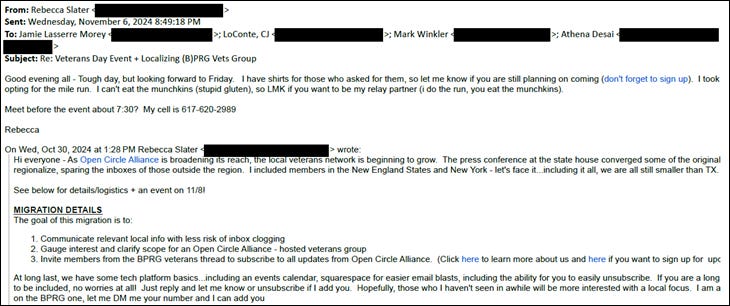
Relatedly, while Open Circle Alliance had been an official host of five publicly-advertised events over an eight-month period, at least three of those events had been largely or primarily organized by external partners:
For the June 27, 2024, “public launch event”:
o The venue and food for attendees had been arranged primarily by campaign surrogate Jenny Chen Robertson, working exclusively in a volunteer capacity.
o The event photographer had been recommended and put into contact with Open Circle Alliance by Yes on 4 community outreach director Morey.
The two events featuring screenings of Music for Mushrooms and co-hosted by the Question 4 campaign—held on October 6 and November 3, 2024—were almost entirely organized by Yes on 4 community outreach director Morey.
As for the claim that Open Circle Alliance had garnered “150+ Attendees”—this figure was reached by totaling the cumulative attendance across all events rather than counting unique individuals. For example, because I attended three Open Circle Alliance events, I was counted three separate times toward that total, despite being a single individual. Given the high rate of repeat attendance among the nonprofit’s core circle, the number of people who actually participated in Open Circle Alliance’s programming was considerably lower than the 150+ figure suggested.
The highlighting of “10+ Ally Groups” as an accomplishment of Open Circle Alliance was more misleading. The nonprofit did not include a definition of an “ally group,” never listed its “ally groups” on its website or in any mass emails, nor did it even employ the term “ally groups” or “ally group” in any other email to its distribution list or on its website. Absent clarification of what an “ally group” was or any substantiation of the “10+” figure, the information was functionally meaningless as a metric of “progress.” A charitable interpretation was that the “ally groups” referred to distinct organizations Open Circle Alliance had publicly partnered with or collaborated with in some way apart from the ballot question committee (which Open Circle Alliance explicitly, albeit falsely, claimed to “not be associated with”). As of the date of the fundraising pitch, only seven entities—four shy of “10+”—met this speculative criteria for “ally groups”: the Entheogen Melanin Collective, FREE Gaia, Heroic Hearts Project, MAPS, Parents for Plant Medicine, Students for Sensible Drug Policy, and the Veteran Alliance for Psychedelic Access. And these affiliations were hardly evidence of impressive coalition building—Jones had spent more than a decade working for Students for Sensible Drug Policy, Open Circle Alliance had effectively been funded primarily by Heroic Hearts Project since its inception, MAPS and FREE Gaia marketed MAPS’s proprietary training through Open Circle Alliance, and Open Circle Alliance’s involvement with the other groups was primarily limited to co-promotion.
But while the involvement of heavyweights like Heroic Hearts Project, MAPS, and Students for Sensible Drug Policy did not demonstrate authentic grassroots momentum for Open Circle Alliance, it did contribute to an unflattering picture of Open Circle Alliance’s actual footprint. Despite such high-level institutional access within the drug policy and advocacy space, Open Circle Alliance—by its own account—mustered only “250+ Email Reach” after eight months. Whether this referred to 250+ emails sent by Open Circle Alliance or 250+ contacts in Open Circle Alliance’s distribution list (it was not clarified), this paucity of outreach suggested either ineffectiveness or a lack of effort by the nonprofit. Even assuming Open Circle Alliance acquired 250+ contacts—the more complimentary interpretation—this would mean an uptake of a little over one email sign-up a day for the 242 days between Open Circle Alliance’s incorporation on April 19 and Open Circle Alliance’s fundraising message on December 17, 2024.
Making this rate even less impressive, Open Circle Alliance launched with a substantive number of contacts curated by the ballot question committee. For example, I had never explicitly agreed to have my email address added to Open Circle Alliance’s distribution list—my email address, along with those of other campaign volunteers, were given to Open Circle Alliance by the ballot question committee, without prior consent from campaign volunteers, to seed the nonprofit’s outreach. And this kind of asset sharing was ongoing—as a campaign official, I personally provided the email address of a particular campaign supporter, without his prior consent, to Slater upon request for his “email or phone number […] to send him the [Open Circle Alliance] launch invitation” in June 2024.
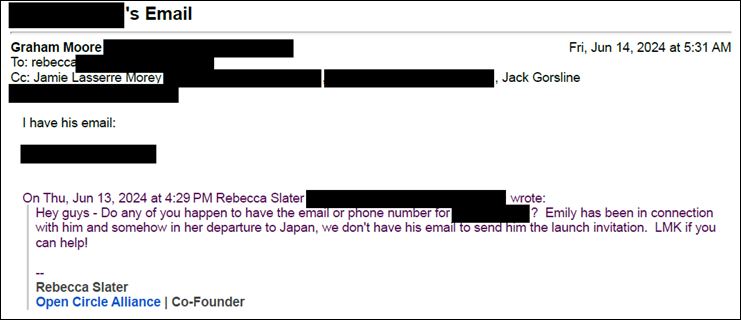
Consequently, the “250+ Email Reach” was more a reflection of the quiet transfer of campaign resources to Open Circle Alliance than an accurate metric of community growth. Because Open Circle Alliance was widely, and accurately, perceived as an extension of the campaign, this cross-pollination of data effectively occurred without friction—I was unaware of any complaints from campaign volunteers who, to my knowledge, were by and large pleased to be kept in the loop regarding Open Circle Alliance as a functionally adjunctive organization. Reflecting this conflation in supporters’ minds, in a September 2024 email, Morey flagged that an attendee of a recent campaign event had directed follow-up questions to Slater.
As already elucidated, the last two points of “progress” Open Circle Alliance mentioned in their December 2024 newsletter—the “resource library” and the “events calendar”—were slim offerings. The resource library was never updated beyond the three factsheets on the ballot question uploaded in September 2024, and the events calendar—sharing “events hosted by Open Circle Alliance, along with those of by other groups dedicated to building supportive communities, promoting psychedelic education, and advancing advocacy”—had been introduced as late as October 17, 2024, and had only previewed eight “events” so far, three of which were ballot question committee-organized events and only one of which was solely hosted by Open Circle Alliance.
In practice, Open Circle Alliance’s publicly-advertised activity consisted mainly of repackaging contributions by at least nominally external parties, as demonstrated by:
A functional operating budget of over $120,000 in mostly out-of-state funding from Heroic Hearts Project and the ballot question committee (particularly in the case of Oneschuk’s labor) branded as that of an independent, locally-driven Massachusetts initiative.
Foundational organizational infrastructure—including Oneschuk as a spokesperson, strategic and operational input from McCourt, Moffat, and Tocci, and community contacts—lifted, without public acknowledgement, from the ballot question committee.
Half of Open Circle Alliance’s four public events prior to election day organized primarily by the ballot question committee.
A resource library that solely featured materials regarding Question 4 prepared in collaboration with the ballot question committee.
An events calendar that primarily showcased non-Open Circle Alliance events.
The promotion of MAPS’s Psychedelic Crisis and Intervention Training.
The promotion of the Coalition for Psychedelic Safety and Education’s Before You Trip campaign.
A rhetorical presentation of two other Massachusetts advocacy groups—in a January 2025 email soliciting donations for Open Circle Alliance—that misleadingly implied Open Circle Alliance held closer ties to the independent organizations that it actually did. When confronted regarding the mischaracterization by Morey, Open Circle Alliance sent its distribution list a correction just two days later.
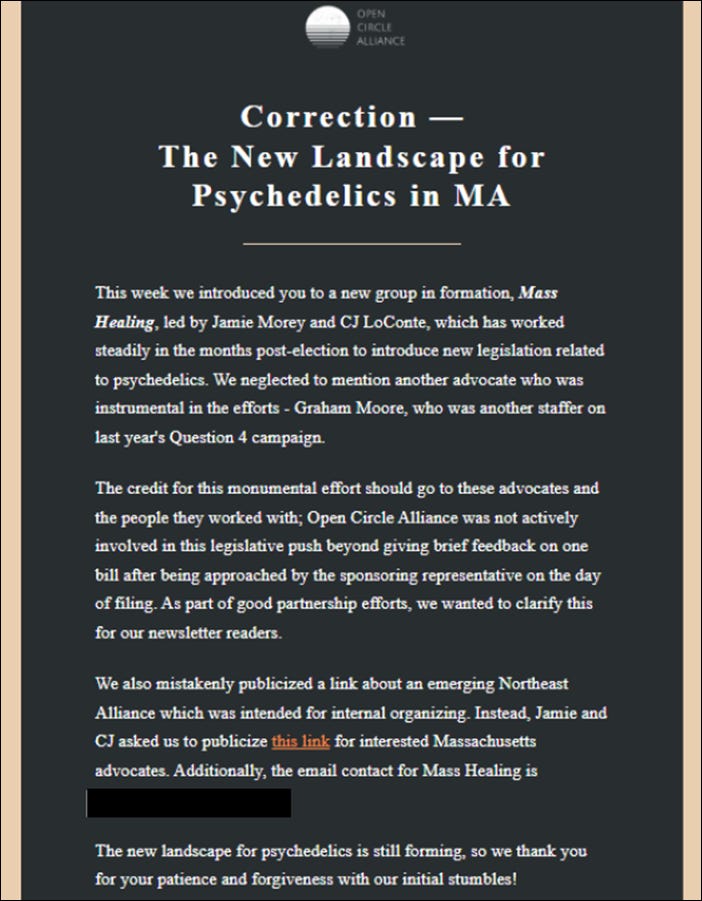
As reflected in Slater’s unsuccessful October 2024 request for volunteer assistance sufficient to enable “veteran-focused programming” by Open Circle Alliance the following year—as well as the nonprofit’s final, publicly-advertised event being a February 2025 “gathering” tied to two non-affiliated, local psychedelics conferences—Open Circle Alliance’s offerings for the general public seemed opportunistically curated based on what resources were available in the short-term rather than carefully tailored in service to the organization’s overt goals of education and community building.
And despite being well compensated for their part-time Open Circle Alliance roles—for example, as contemporaneously known to campaign organizers, Slater continued to be employed by Lockheed Martin for the entirety of Open Circle Alliance’s lifespan—both Jones and Slater communicated they had only narrow bandwidth to devote to public programming. On August 16, 2024, Slater apologized to Morey over email for a delayed response, writing: “I haven’t been able to get my head above water.” In another email ten days later, Slater reiterated she felt overwhelmed and claimed she “[was] overcommitting”:
Hey Jamie [Morey]! I hope you enjoyed your family time. I can relate – [Redacted: name of Slater’s family member] and I are both burning the candle at both ends and could use some of that. As anxious as I am to get this off the ground, I find I am overcommitting, so I am using the last few weeks of Aug to wrap up loose ends, package us up nicely to present to potential donors, and build a strategy for the fall/winter. Knowing that we are in the fits of ‘Back to School’, I’ll put something out there for the larger group after Labor day.
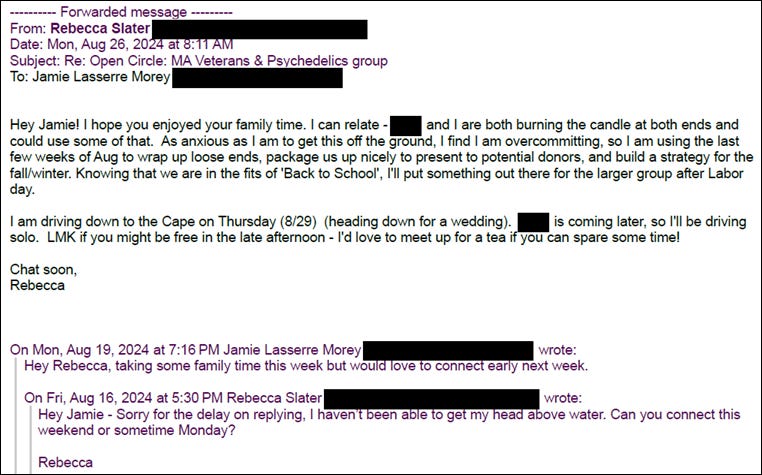
A couple weeks after this interaction, on September 5, 2024, Jones emailed a prospective collaborator for a community event that she and Slater’s soonest availability to participate was the evening of “September 24”—three weeks away—and offered only “Thursdays” and “Tuesday evenings” from “late September into October”:
Thursdays are the best days for us, starting September 26th. Second choice would be Tuesday evenings, starting September 24. Anything through late September into October should be fine, except maybe Thursday, October 3.
Jones’s and Slater’s narrow capacities were additionally underlined just a week later, on September 12, when the evening of September 24—a date Jones had originally proposed—was among four specific time slots floated for the event by another organizer. Jones hastily replied by email less than five hours later to reveal that “September 24 [no longer] work[s] for me” and to put forward “Thursday, October 10,” as an alternative. When a scheduling conflict on October 10 led the organizer to suggest Tuesday evening on October 8—another date Jones had indicated earlier would work for both her and Slater—Jones revealed that Slater could no longer make October 8. Jones and Slater had prioritized Open Circle Alliance’s holding of public events low enough that, in only seven days-time, they had already booked alternative commitments for days they had claimed to be available for community engagement.
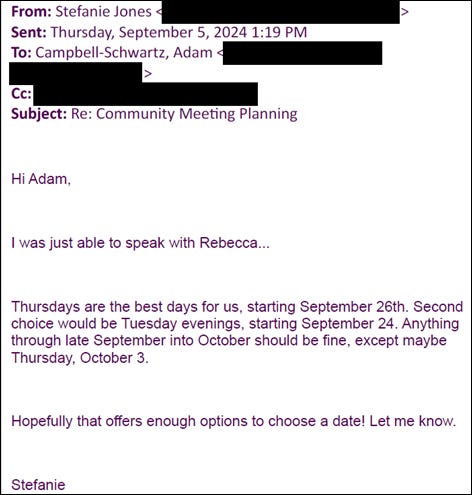
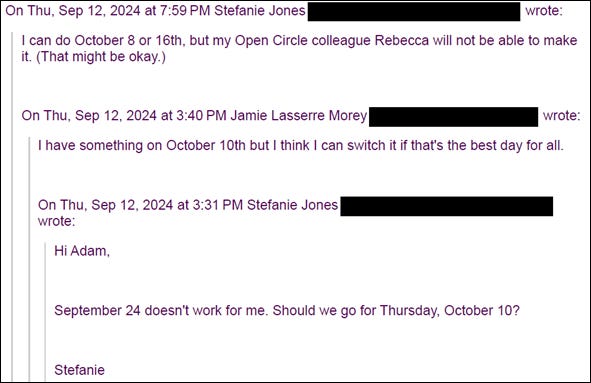
And on October 11, 2024, in response to an invitation for Open Circle Alliance to co-host another film screening of Music for Mushrooms, Slater’s reaction was to write in an email to Morey, “I don’ t have huge bandwidth, but have a bit and can help,” even though the last public event Open Circle Alliance had plausibly done substantial organizing for—the August 22 “Late Summer Social”—had been held nearly two months prior, and—apart from co-hosting another Music for Mushroom screening with minor involvement—Open Circle Alliance would not hold another public event until November 9.

From our vantage point as campaign officials, Morey and I had little insight into where Jones’s and Slater’s professional energies were actually being directed, although it was clear not much was being invested into grassroots organizing. In the case of Jones—who appeared far less operationally active in Open Circle Alliance than Slater to Morey and me—it was especially unclear what, if any, substantial output she had produced for the new nonprofit.
However, in 2025, when I flippantly remarked that Jones had “appeared to have been paid for nothing” during a candid conversation with journalist Gorsline—who reported on Open Circle Alliance’s ties to the ballot question committee—he appropriately pushed back, telling me: “We don’t know that. We have no idea what Stefanie [Jones] did or didn’t do to get paid because there was no transparency.” Contributing to the uncertainty was the ambiguous nature of Jones’s and Slater’s ties to Heroic Hearts Project. On Jones’s 2025 LinkedIn profile, Jones claimed to have been a “strategic project consultant” for Heroic Hearts Project at some point between November 2021 and the “present” (2025).
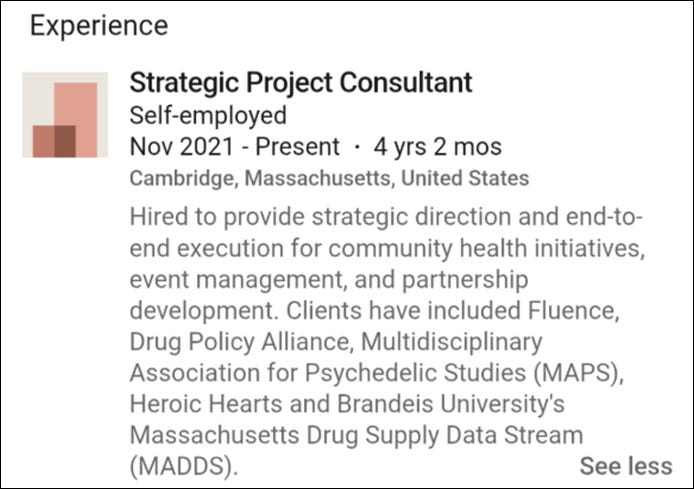
Although Slater did not advertise whether she had also been employed by Heroic Hearts Project apart from her work for Open Circle Alliance, she conspicuously avoided referring to her labor on behalf of Heroic Hearts Project and the veterans affinity group as “volunteer” work. And while this may have simply been a rhetorical strategy to give minor, unpaid roles the appearance of substantial—presumably compensated—advocacy experience, it may also have reflected Slater’s work for Open Circle Alliance being a continuation of a discrete professional relationship with Heroic Hearts Project.
On the March 2025 call with advocates in which Slater disclosed the $7000 per month compensation for Open Circle Alliance, Slater stated she became involved with Open Circle Alliance through a preexisting, but unspecified, relationship with Heroic Hearts Project founder and president Jesse Gould.
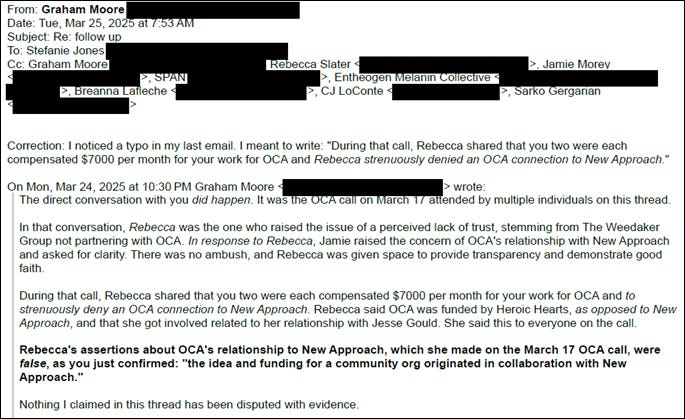
As previously mentioned, Slater’s “ambassador” position with Heroic Hearts Project did not intrinsically signify any specific responsibilities or accomplishments, and Slater’s “veterans support group” was primarily composed of civilians, had only a tiny handful of veteran members—as few as five for much of 2024—and typically met only briefly online, once a month. At face value, neither of these experiences—nor any other parts of Slater’s publicly disclosed professional and volunteer histories—qualified Slater to be a well-paid co-founder of a new, Heroic Hearts Project-backed nonprofit, let alone explained the close relationship with Gould that Slater purported to have. Consequently, if there was any truth to Slater’s claim that—from her perspective, at least—Gould and Heroic Hearts Project, rather than Moffat and New Approach, were the main reason she had joined Open Circle Alliance, it was likely Slater had already demonstrated professional competence specifically to Heroic Hearts Project in some capacity. Consequently, if Slater avoided categorizing her “leadership” of the Veteran Connection & Support Affinity Group as “volunteer” labor because she had been compensated for it, it was plausible she had been paid by Heroic Hearts Project.
Undergirding this speculation, Slater had aggressively maneuvered to be a leader of the affinity group, and—as evidenced by Slater’s remarks in recorded Boston Psychedelic Research Group meetings—had overseen the organization’s development into a funnel of former servicemembers to extant psychedelic therapy and advocacy organizations, particularly Heroic Hearts Project. For two illustrative examples:
· In a recorded presentation to the Boston Psychedelic Research Group in November 2022, Slater claimed the Veteran Connection & Support Affinity Group was “not necessarily building something new; we would like to complement existing efforts” and specifically identified Heroic Hearts Project, The Mission Within, and VETS as “trusted organizations” struggling veterans should be encouraged to contact.
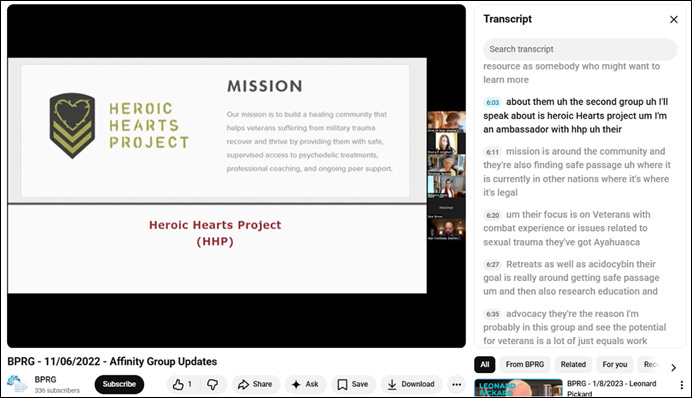
· In a recorded presentation to the Boston Psychedelic Research Group in September 2023, Slater said about the Veteran Connection & Support Affinity Group:
We’re a hub to, to other support channels—as I mentioned, we’re not something new—but we’ve got engagement with Heroic Hearts Project, Hope Project [(closely affiliated with Heroic Hearts Project)], Heroic Path to Light [(a vehicle for fundraising to pay for psychedelic therapy offered by organizations such as Heroic Hearts Project and Hope Project)], a lot of these leading organizations that are trusted, they are trying to build the gold standard for treatment for veterans, and so we are really working to make sure that we’re able to connect them with those that are emerging additionally at a local level.”
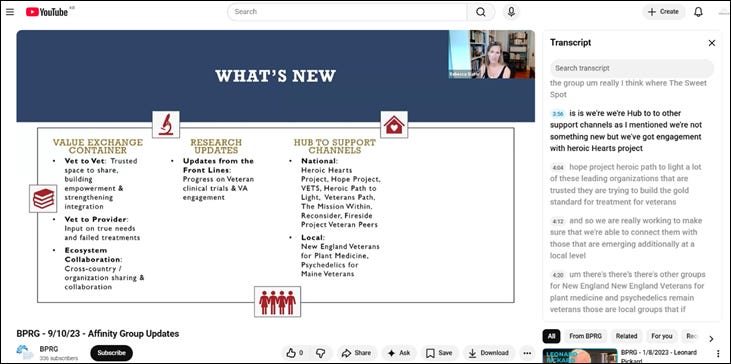
Gould himself notably presented to Slater’s affinity group in May 2023 on “how to tell your story effectively”—considering the tiny audience, the appearance functioned more as a branding opportunity than an educational event, and Slater repeatedly cited Gould’s participation as a demonstration of her organization’s strong ties with Heroic Hearts Project. And while veteran representation among its regular membership continued to languish, the Veteran Connection & Support Affinity Group increasingly functioned as a referral service to Gould’s organization and others like it. This pattern of behavior—especially in light of the Slater-directed “migration” of affinity group members to Open Circle Alliance in 2024—suggested that Open Circle Alliance may not have been an entirely new initiative but, instead, encompassed the scaling of a pre-existing contractor relationship between Slater and Heroic Hearts Project to expand the veterans charity’s commercial and political footprint.
But while the full scope and motivations of Open Circle Alliance’s activities—seemingly related to lobbying regarding the HERO Act and giving initiatives of out-of-state partners a local grassroots veneer—can only be speculated at, its failure as a public outreach vehicle is clear. After nearly two years of operation and effectively raising over $130,000, the 501(c)(3) Open Circle Alliance ceased operations having:
Not achieved federal tax-exempt status.
Not added any board members—the nonprofit shuttered one officer short after Oneschuk’s July 2025 resignation.
Received practically no media coverage unrelated to scandal.
Solely hosted just four small public events.
Published three factsheets.
Made two social media posts.
Netted around 50 social media followers.
Furthermore, all the co-founders of Open Circle Alliance have appeared to publicly distance themselves from the nonprofit, demonstrating the undesirability of its brand. As of writing (April 24, 2026), neither Jones’ LinkedIn profile nor Slater’s LinkedIn profile contain any reference to Open Circle Alliance. A local nonprofit’s November 2025 “alum” profile of Oneschuk—who does not have a LinkedIn profile or a major social media presence—made no mention of Open Circle Alliance in detailing Oneschuk’s life in the last few years.
While an exact figure is impossible to calculate, the monetary value of the resources Yes on 4 diverted to Open Circle Alliance directly and indirectly—including the labor of Dewey Square Group principals and multiple campaign “directors”—undoubtedly exceeded the nominally independent organization’s over $130,000 in functional contributions and—by any objective metric—negligibly contributed to public support for Question 4, at best.