
The list of problems with the Question 4 campaign is long, and this postmortem examines the major issues in depth one by one.
Part 1 (released on October 17, 2025) analyzes the decision to run a policy out of touch with public opinion as indicated by polling, against the recommendations of the Dewey Square Group strategists hired by the campaign and the Massachusetts ACLU.
Part 2, initially released in installments as Part 2.1, Part 2.2, and Part 2.3 (on October 21, October 31, and November 6, 2025), analyzes the campaign’s costly handling of a polarizing psychedelics activist and underground practitioner.
Part 3 (released on November 8, 2025), analyzes the campaign’s decision to divert resources to a new nonprofit, co-founded by a close associate of Yes on 4’s campaign director, while polling behind.
Part 4 (released on November 17, 2025), analyzes the campaign’s decision to portray itself as led by a local female veteran who had suffered PTSD while the official campaign director was a non-veteran, white male, with no history of serious mental illness, operating from 3000 miles away in California and patient advocates were excluded from the strategy team.
Part 5 (released on December 7, 2025), analyzes how the campaign’s messaging exaggerated the risks of its proposal and capitulated to misleading ballot language—in contradiction to the campaign’s own polling and research.
Part 6 (released on December 26, 2025), analyzes a variety of the campaign’s shortcomings in the context of an organizational structure that discouraged accountability.
Part 7 (released on December 28, 2025), analyzes how the campaign possibly put its grassroots staff and nonprofit affiliates in legal jeopardy in the absence of conservative adherence to campaign finance law.
Part 8 (released on December 30, 2025), concludes the postmortem with an acknowledgement of unanswered questions, a description of what happened to ballot committee organizers after election day, and where the psychedelic healing movement should go from here.
WHY THE CAMPAIGN FELL SHORT
2. The Campaign Elevated a Divisive and Hostile Activist to Statewide Prominence Despite Forewarning
2.2 An Opportunistic Opponent, an Expensive Endorsement, a Special Relationship, and a New Bay Staters for Natural Medicine
An Opportunistic Opponent
James Davis and his organization exhibited a willingness to corroborate conservative talking points—even those politically undercutting the psychedelics decriminalization they purported to support—to damage the Question 4 campaign.
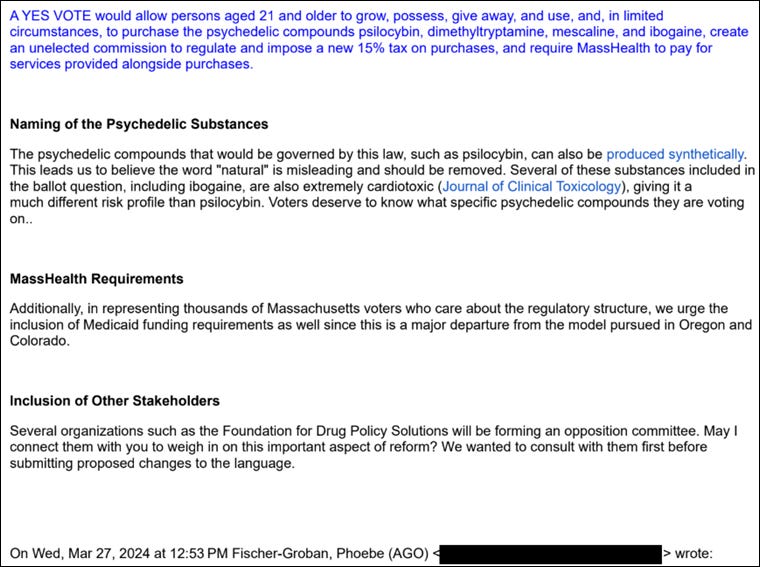
In his email to Massachusetts assistant attorney general Phoebe Fischer-Groban on April 4, 2024, Davis proposed alterations to how Question 4 would be described on the ballot—the characterization of the initiative that all Massachusetts voters would be exposed to—to reduce the ballot measure’s electoral viability. Davis suggested the following final language:
A YES VOTE would allow persons aged 21 and older to grow, possess, give away, and use, and, in limited circumstances, to purchase the psychedelic compounds psilocybin, dimethyltryptamine, mescaline, and ibogaine, create an unelected commission to regulate and impose a new 15% tax on purchases, and require MassHealth to pay for services provided alongside purchases.
In justifying changes to the short description, Davis argued:
“The word ‘natural’ [in ‘natural psychedelic substances’] is misleading and should be removed [from the description of the ballot question]” because psychedelics “can also be produced synthetically.”
That the description of the ballot question should identify all five of the initiative’s psychedelics by name—rather than refer to them with a catch-all phrase like “natural psychedelics”—“because several of these substances included in the ballot question, including ibogaine, are also extremely cardiotoxic (Journal of Clinical Toxicology), giving it [sic] a much different risk profile than psilocybin.”
That voters should be informed the ballot question contained “Medicaid funding requirements” (implying the government-funded health insurer Medicaid—and therefore taxpayers—would be forced to pay for psychedelic therapy) because this provision would be “a major departure” from previous psychedelic legalization frameworks in Colorado and Oregon.
That “other stakeholders”—specifically “several organizations such as the Foundation for Drug Policy Solutions [that] will be forming an opposition committee” and who “[Bay Staters for Natural Medicine] wanted to consult with […] first before submitting proposed changes to the language”—should be “[included]” to weigh in on the description on the ballot as well.
His points were hypocritical and misleading:
Contrary to what Davis’s comment implied, the ballot measure as written explicitly did not legalize or decriminalize any “synthetic or synthetic analog of any of these substances [(psilocybin, psilocin, mescaline, DMT, and ibogaine)],” making the mere fact the psychedelics could “be produced synthetically” practically irrelevant.
Furthermore—both before and after Davis criticized the inclusion of the phrase “natural psychedelic substances” in the proposed ballot language—the official website of his nonprofit Bay Staters for Natural Medicine declared, “Find Healing With Plant Medicine,” on its homepage banner, and the website explicitly characterized the psychedelics in the initiative—“psilocybin mushrooms” (which contain psilocin), “cacti with mescaline,” “ayahuasca” with “DMT [as] the active ingredient,” and “ibogaine”— as “plant medicine” and “naturally-occurring psychedelics,” mirroring the linguistic framing that Davis opposed for Question 4.Of the substances included in the ballot question, only one (ibogaine) was cardiotoxic—not “several.” And, at the time, nowhere on the Bay Staters for Natural Medicine website was ibogaine described as “cardiotoxic,” let alone “extremely cardiotoxic.” Rather, the website euphemistically characterized ibogaine as “having strong effects on the heart,” meriting “be[ing] used with guidance of a nurse after medical screening.”
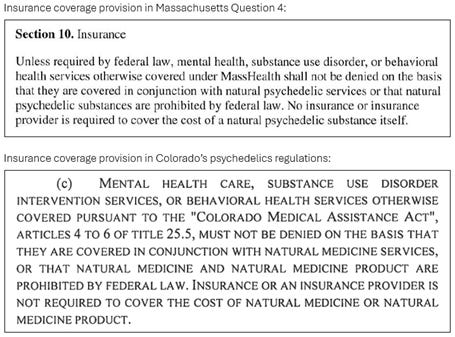
Although the ballot measure did include a provision that might have forced Medicaid to cover at least some psychedelic therapy (the legal language was such that, if left unchanged, it would have required litigation to direct implementation)—this provision was not “a major departure” from what had come before. Rather, the provision had been lifted—nearly verbatim—from the psychedelic therapy bill signed into law in Colorado in 2023 (because Colorado’s legal psychedelic therapy industry did not launch until 2025, the bill’s insurance coverage provision had not yet come into practical effect as of 2024).
In addition, Davis’s spotlighting possible coverage of psychedelic therapy by Medicaid—a government-sponsored health insurance program for low-income residents—in a negative light ran counter to his longstanding contention that the ballot question should be opposed because it would make psychedelic therapy unaffordable for the poor.
In referencing the “other stakeholders” who he thought should weigh in on the ballot language, the only specific stakeholder Davis highlighted was the 501(c)(3) nonprofit “Foundation for Drug Policy Solutions” (FDPS), closely affiliated with the 501(c)(3) nonprofit Smart Approaches to Marijuana (promoted as, and widely known by, its acronym, SAM)—former White House Office of National Drug Control Policy advisor Kevin Sabet is co-founder, president, and CEO of both organizations. Of all the coalition partners openly opposed to the ballot question, the Foundation for Drug Policy Solutions was the most antithetical to Davis’s purported values.

For years, Davis had been publicly opposed to the harsh criminalization of the non-pharmaceutical drug trade—as early as 2021, he had cited the explosion of “a meth lab” in his poor neighborhood as “[teaching] me a lesson that prohibition contributes to the crime and public safety hazards that drug warriors think they’re solving.” By contrast—despite euphemistic “drug policy solutions” and “smart approaches” phrasing and nominal support for not criminalizing individuals for limited personal drug use—in practice, Sabet and his allies had spent more than a decade defending draconian punishments for even minor drug-related offenses, as they have continued to do so. In an action representative of his organizations’ priorities, and promoted by SAM in November 2025, Sabet complimented Hungary’s zero-tolerance drug policy—which punishes merely persuading someone to use cannabis or psilocybin with up to two years in prison—as “an example [to follow].” By explicitly promoting Sabet’s Foundation for Drug Policy Solutions as a stakeholder, Davis was legitimizing an organization dedicated to—in the long run at least—destroying groups like Bay Staters for Natural Medicine and criminalizing individuals like Davis.
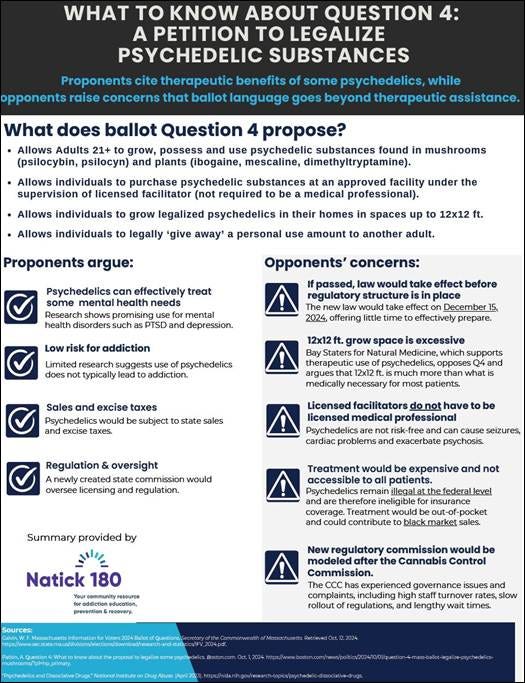
And while Davis’s suggested ballot language was not adopted, he continued to selectively bolster conservative talking points—in contradiction to the liberatory, pro-decriminalization ethos advertised on Bay Staters for Natural Medicine’s website and social media pages—as politically expedient. For example, as one of two opposition representatives—along with Dr. Nassir Ghaemi, then president of the Massachusetts Psychiatric Society—interviewed by Boston 25 News for an October 4, 2024, segment on the ballot question, Davis warned that “if someone uses mushrooms and they don’t know what they’re doing at a festival or at a party where there’s a lot going on[,] they can have a pretty miserable experience that can be traumatic,” echoing concerns raised by Dr. Ghaemi about the dangers of unregulated psychedelics use. For another example—in a stark departure from Davis’s frequently-voiced contention that the ballot question did not decriminalize enough—Bay Staters for Natural Medicine told a prominent local addiction prevention organization, Natick 180, that the initiative’s decriminalization provisions would allow individuals to grow psychedelics too much. According to the Question 4 voter guide that Natick 180 released on October 27, 2024, among “opponents’ concerns” was that “12x12 ft. grow space is excessive,” citing that “Bay Staters for Natural Medicine, which supports therapeutic use of psychedelics, opposes Q4 and argues 12x12 ft. is much more than what is medically necessary for most patients.”
On Bay Staters for Natural Medicine’s official X account that same month, however, Davis’s nonprofit stated the opposite was true—its posts repeatedly disparaged Question 4’s home cultivation provisions as “weenie,” with restrictions so extensive that they hardly qualified as a meaningful protections for those wishing to grow their own psychedelics.
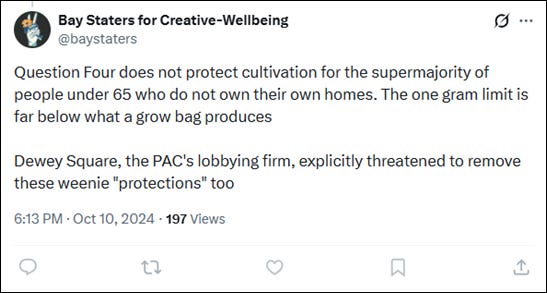
In one X post, Bay Staters for Natural Medicine went so far as to characterize Question 4’s home cultivation provisions as merely an “homage to growing,” included as “a necessary nod” to the nonprofit’s “movement” by New Approach.
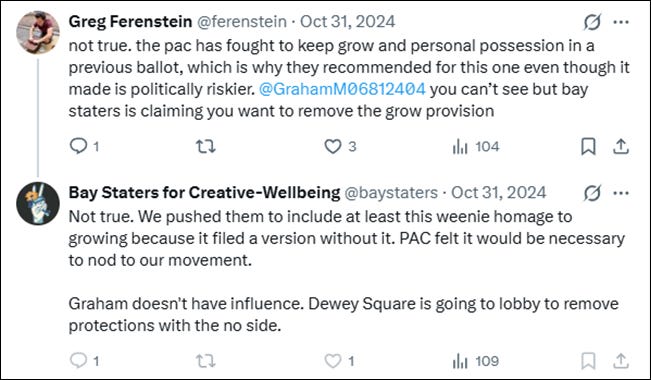
Clearly, Davis recognized the ballot question was vulnerable to criticisms from both sides of the drug policy debate, and he freely fabricated or amplified salient arguments against the initiative for any given audience: falsely construing the ballot measure as oppressively conservative for some; playing up the ballot measure’s most polarizing liberal elements for others. Moreover, the fact the campaign had chosen to run a policy that polling showed was unpopular at baseline—as described in the previous chapter—gave him a stronger hand. Publicly correcting the assertion that Question 4 would not meaningfully decriminalize personal use and home cultivation of psychedelics risked detrimentally drawing attention to the proposal’s most controversial provisions.
An Expensive Endorsement
Despite James Davis’s persistent opposition to, and dishonesty about, the ballot question, the campaign continued to court Davis as a partner with repeated overtures through at least the end of February 2024. These included reaching out “several times by email and text during the fall [in 2023],” publicly claiming to be “eager to work collaboratively with [Davis’s organization]” as late as December 1, 2023, a meeting between grassroots campaign director Emily Oneschuk and Davis at the end of 2023, in which Davis spooked Oneschuk enough to contribute to her brief resignation from the campaign, an outreach email on January 5, 2024, in which strategic leadership characterized Davis as an “important [leader]” whose involvement with the campaign was “critical,” a second meeting with Oneschuk after January 12, 2024, and a meeting with strategic leadership—specifically Dewey Square Group principals Lynda Tocci and Jennifer Manley—on February 26, 2024.
Simultaneously, beginning as early as January 1, 2024, the campaign employed Dewey Square Group for lobbying, ostensibly to counter Bay Staters for Natural Medicine’s influence in the legislature. The official ballot question committee ultimately spent $150,000 on lobbying, a relatively large amount. For comparison, Fortune 500 company Molina Healthcare, Inc. paid Dewey Square Group $96,000 for lobbying related to the state government program it operates.
Despite Yes on 4’s less than $10 million budget being dwarfed by annual revenues, ranging into the billions, of Dewey Square Group’s other clients, the official ballot question committee Massachusetts for Mental Health Options (MMHO) became Dewey Square Group’s second largest Massachusetts state-level lobbying client in 2024:
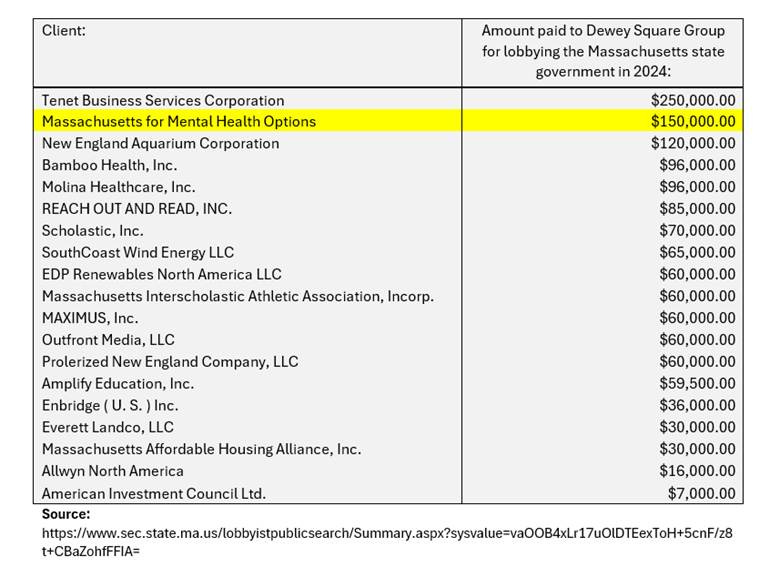
According to Dewey Square Group, the lobbying was related to Bay Staters for Natural Medicine’s push to get a competing proposal on the ballot. In an October 2025 email, Dewey Square Group principal Jon Carvalho claimed: “$150,000 was paid to [Dewey Square Group] and was a lobbying expense — [Dewey Square Group] spoke to more than 60 legislators/offices about the [ballot] measure because Bay Staters for Natural Medicine were asking the legislature to put forward a substitute petition.” This was even though—in totality and not just possibly related to lobbying—Bay Staters for Natural Medicine spent just $696 in 2023 and $2,318 in 2024, according to public filings.
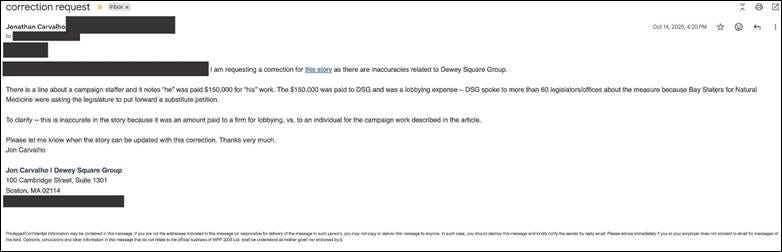
Carvalho’s characterization is supported by public disclosures showing Dewey Square Group was paid by the ballot question committee to lobby exclusively regarding H.4255 (the ballot question legislation before it was sent to the ballot) with a “neutral” position.
As a reminder, ballot question committees in Massachusetts are legally obligated “to expend money or other things of value solely for the purpose of favoring or opposing the adoption or rejection of a specific question or questions submitted to the voters.” Furthermore, under Massachusetts law, paid work encouraging lawmakers to endorse a ballot measure before voters is not regulated as lobbying, but paid work encouraging lawmakers to adopt or reject a proposal to place an alternative ballot measure on the ballot is.
Consequently, Davis’s effort to give voters two competing psychedelics initiatives to choose from created a unique circumstance in which a ballot question committee could, relatively easily, justify paying for regulated lobbying. The novelty of this situation was demonstrated by the fact that the public disclosures for every other Massachusetts ballot question committee active in 2024 did include any lobbying spending.
The alternative psychedelics ballot measure was notable for other reasons, too:
As stated by the legislative committee tasked with evaluating the ballot question, the substance of the Bay Staters for Natural Medicine legislation meant it was likely constitutionally prohibited from being placed on the ballot.
No alternative measure had ever been placed on a Massachusetts ballot before.
To my knowledge, after speaking with multiple individuals working in the state house, Davis had very little credibility in the legislature by the end of 2023, and his reputation had been tarnished by his past actions as a legislative staffer, making his attempt to pull off an unprecedented legislative accomplishment an even harder lift.
To summarize: the ballot question committee purportedly determined it was appropriate to pay Dewey Square Group up to $150,000 for lobbying—more than Dewey Square Group was paid for lobbying by any other state-level lobbying client in Massachusetts that year save one—in response to a longshot, likely unconstitutional, legislative proposal advanced, by a small nonprofit—which spent nothing or virtually nothing on lobbying, did not employ a registered lobbyist, and received most of its 2023 revenues from the Dewey Square Group-advised ballot question committee itself—championed by a former legislative staffer with a poor reputation and little influence among state lawmakers.
And this lobbying spending contributed to the campaign seemingly devoting far more resources on responding to Davis and Bay Staters for Natural Medicine—a relatively fringe, psychedelics decriminalization/underground therapy organization—than the campaign did on influencing the public position of any other entity. In addition to the $35,000 donation and the $150,000 in lobbying expenditures, considerable staff and volunteer time was invested in courting Davis for eight months (July 2023 through February 2024) and then in efforts to contain him for another nine months (March 2024 through November 2024) until election day.
For example, encouraged by, and in collaboration with, the campaign, five months (October 2023 through February 2024) of my volunteer advocacy were focused, in significant part, on trying to bring Davis and the ballot question committee together. My efforts included floating unity proposals, helping prepare strategic leadership for the February 2024 meeting with Davis, and acting as a go-between for the ballot question committee and Davis. Oneschuk even gave me “props” for having donated thousands of dollars to Bay Staters for Natural Medicine and told me there was “100% no reason you shouldn’t be supportive of [Bay Staters for Natural Medicine]” unless it went “nuclear […] in a really toxic way” as late as February 4, 2024.
By the time of the ballot question’s key legislative hearing on March 26, 2024, the ballot question committee had spent over $700,000 excluding signature gathering costs, and, to my knowledge, had earned only a single public endorsement from a Massachusetts organization: the nominal endorsement of Davis-led Bay Staters for Natural Medicine.
In contrast, the opposition to the ballot question, having spent practically no money comparatively, had already gained support from two influential healthcare professional organizations: the Massachusetts Psychiatric Society and the Massachusetts Medical Society.
Despite the extensive effort to win him over, Davis criticized the initiative he had nominally endorsed at the March 26 hearing, and, subsequently, Bay Staters for Natural Medicine officially rescinded its endorsement just a few weeks later. To my knowledge, this left the ballot question with no endorsements from local organizations out the gate.
Subsequently, vowing to “oppose [the ballot question] full force” in an X post on April 18, 2024, Davis’s nonprofit followed through with a combination of on-the-ground canvassing (including advocating against Question 4 at public events and distributing and posting opposition fliers), social media messaging, media interviews, and direct outreach to influential individuals and organizations. The latter category of activity notably included lobbying numerous city councilors in municipalities where the campaign hoped to pass pro-ballot measure resolutions, which may have been partially responsible for Yes on 4’s failed efforts to convince the city councils of Boston, Revere, and Salem to endorse Question 4. On a phone call with me, a minor consultant to the campaign tasked with outreach to the Boston City Council speculated that Davis—who was a staffer for a Boston city councilor at the time—was likely the reason the council did not embrace a supportive resolution. Considerable resources spent trying to counter Bay Staters for Natural Medicine’s opposition—literally bankrolled, in significant part, by the ballot question committee’s $35,000 donation—could have been better spent had the campaign not ceded a platform and credibility to Davis in the first place.
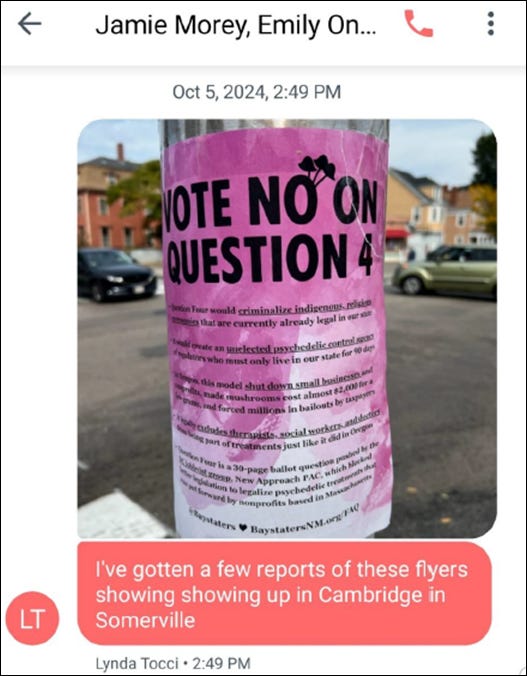
In light of both the substantial opportunity costs (such as the superior early endorsements the campaign might have secured in lieu of Bay Staters for Natural Medicine) and the political damage directly inflicted by Davis and his nonprofit using their heightened visibility (such as the passage of two city council resolutions in Provincetown and Medford criticizing the ballot measure), the campaign’s decision to chase a partnership with Davis significantly reduced its likelihood of success.
Personally, had I known of Davis’s deception at the same time as the ballot question committee, I would not have spent the many hours of free time, and the over $3,000 in personal donations, that I did supporting Bay Staters for Natural Medicine as a volunteer from September 2023 through February 2024. I would not have been comfortable trying to win over someone who had appeared to operate in such bad faith toward the ballot question committee as well as toward fellow grassroots advocates. As it happened, I only learned the truth in late March 2024, when the campaign finally informed select grassroots advocates of Davis’s involvement in the drafting process.
Shortly afterward, the campaign made this information public by directly leaking internal communications (not using advocates like Jamie Morey and me as intermediaries) exclusively to local journalist Jack Gorsline for a Talking Joints Memo article published April 3, 2024. For the same article, the campaign provided Gorsline an exclusive reaction quote from Oneschuk, who did not disclose the campaign’s responsibility for the leak and who implicitly kept the door open to “collaborating” with Davis.
Reacting to the leak, Tim Morris—one of Massachusetts’ most active grassroots advocates—expressed the opinion that Davis would have been “laughed out of the room” if the facts had been revealed earlier. As it was, Davis had spent more than half a year mobilizing opposition, and becoming the face of the psychedelics grassroots, on the basis of a largely unconfronted lie, undermining support for Question 4 in a way that was difficult to undo.
A Special Relationship
Rather than immediately using Jack Gorsline’s reporting as a springboard to broadly correct the record about James Davis with diverse media outlets, the campaign chose to largely limit its pushback to giving exclusives to Gorsline, who had only a relatively small readership—even after Bay Staters for Natural Medicine began formally opposing the ballot question. As a consequence, Davis was consistently referenced as a credible opponent of the initiative by major media outlets, including USA Today, The Boston Globe, WBUR, GBH News, and Boston.com, up to a week before election day.
The campaign’s shots at Davis via Gorsline included:
In December 2023, an exclusive interview (for the article published February 8, 2024) that disclosed the $35,000 donation to Gorsline before it became public through a mandatory filing.
In March 2024, the exclusive leak of internal communications confirming Davis’s 2023 involvement in the drafting process, along with an exclusive reaction quote (for the article published April 3, 2024).
In April 2024, an exclusive leak of Davis’s email to the attorney general’s office regarding the ballot language (for an article published May 8, 2024).
In May 2024, an exclusive leak of private and internal communications related to a veteran Davis allegedly impersonated (for an article published June 20, 2024).
Other exclusives the campaign provided to Gorsline included:
An exclusive quote from Dewey Square Group principal Lynda Tocci for an article published October 29, 2024 (to my knowledge, Tocci provided on-the-record commentary on Question 4 exclusively to Gorsline and a single podcast during the campaign).
Exclusive, authorized, off-the-record access to campaign staff, particularly grassroots campaign director Emily Oneschuk, community outreach director Jamie Morey, and educational outreach director Graham Moore (me).
As reflected in an email in which Yes on 4 campaign manager/ballot question committee chair Danielle McCourt characterized a summary of an off-the-record conversation between Gorsline and me as “super helpful,” a uniquely open line of communication to Gorsline was perceived as an asset. During the campaign, strategic leadership assisted, expressed appreciation for, and disseminated Gorsline’s journalism. Illustrating the point, on October 9, 2024, McCourt insisted on citing Gorsline’s reporting in an official campaign communication against my recommendation.
The resultingly high familiarity Gorsline had with the campaign meant he was uniquely aware of its shortcomings, which he commented on in a December 2024 op-ed and co-reported on in a 2025 multi-part series for Lucid News, comprised of three articles: “Whistleblowers Claim 2024 MA Psychedelics Ballot Initiative Violated Campaign Finance Laws,” “Details of Alleged MA Initiative Campaign Finance Violations In New OCPF Complaints,” and “How (Not) To Win A Campaign: Lessons From Question 4.”
A New Bay Staters for Natural Medicine
As described by longtime Drug Policy Alliance staff member and Open Circle Alliance (OCA) co-founder Stefanie Jones during a recorded panel in December 2024, the genesis of the nonprofit Open Circle Alliance was a conversation with Jared Moffat in “early 2024” about “how [the campaign] was going” and the “need” to bring the Massachusetts psychedelics community together.
This aligns with my understanding of Open Circle Alliance—informed by my contemporaneous communications with Moffat and grassroots campaign director Emily Oneschuk—as intended to be a replacement for Bay Staters for Natural Medicine as a response to James Davis’s divisive leadership.
I first got wind of the plan for a new nonprofit on February 20, 2024, during a text message conversation with Moffat. Still a volunteer at the time, I informed Moffat that “I was looking to get a better sense of the prospects of me formally joining the campaign.” He replied, “I’m pretty hopeful but what we’re cooking up is a little separate from the actual campaign. Let’s talk tomorrow. Want to describe the idea, get your input, and hear your pitch on why you’re an asset!” As planned, we spoke on the phone the next day.
During our call, Moffat told me he had come up with the idea of launching a nonprofit alongside the campaign. As he described it to me, the intention was for the nonprofit to assume the position of grassroots leadership previously held by Bay Staters for Natural Medicine, providing public education complementary to the ballot question and being a standard bearer for grassroots advocacy that would outlive the campaign. He said his hope was that the organization would steward the Massachusetts psychedelics community in a helpful manner so that, post-election victory, there would be a strong voice to guide policy after the ballot question committee dissolved. Moffat said if the model was effective in Massachusetts, it could be adopted in other states. He pitched me on joining this new nonprofit as staff, emphasizing the benefit of joining an organization that could continue indefinitely.
I responded positively to Moffat, although I still preferred to work for the ballot question committee, where I thought I could make the greatest positive impact. Immediately after our call, I texted Moffat: “Thank you so much for your amazing work and coming up with this innovative model” (referring to the campaign plus supportive nonprofit co-launch model). Moffat responded that he was “excited to put all this into motion.” As later corroborated by Jones in an email, “the idea and funding for a community org [sic] originated in collaboration with New Approach.” Open Circle Alliance was formally incorporated on April 19, 2024.
While Open Circle Alliance is the main subject of the next chapter of this postmortem, I mention it succinctly here because, in my understanding, the polarizing behavior of Davis’s Bay Staters for Natural Medicine—exacerbated by the campaign’s long courtship and soft gloves treatment of Davis—was a prime justification for the over $130,000 of spending in relation to Open Circle Alliance. Of that sum, at least $120,123.69 was paid by veterans advocacy nonprofit Heroic Hearts Project (HHP). For context, Heroic Hearts Project describes its primary activities on its website as “direct care of veterans” (characterized as its “number one priority”), “support[ing] research and advocacy efforts to improve access to psychedelics, offer[ing] programs for veteran spouses to better nurture the entire veteran family, and foster[ing] a community in which veterans can grow and give back to others who are suffering.” According to Heroic Hearts Project, the cost of sponsoring a veteran to access “direct care” through its psychedelic therapy program is $6000.
As visible in public financial disclosures, $112,000 of the Open Circle Alliance-related spending went to salaries for two non-veteran board members ($56,000 each), including Jones—a close associate of Moffat. An additional $8,123.69 was paid to a non-veteran board member for “expense reimbursement.” As of March 31, 2025—the end date of the last fiscal period for which Open Circle Alliance submitted a filing to Massachusetts’ nonprofit regulators—Open Circle Alliance had spent just $4,581 on “Program services and similar amounts” since its formal incorporation and had not applied for IRS tax exempt status. As of writing on January 19, 2026, over its entire history, Open Circle Alliance has made only two social media posts, netted only 49 social media followers, solely organized just four small public events, and has not held an event since February 2025.
As confirmed by The Boston Globe, Heroic Hearts Project spent over $300,000 on television advertising educating Massachusetts residents about natural psychedelics ahead of the 2024 election. It seems likely that Yes on 4 would have been better served by Heroic Hearts Project spending an additional $120,000 of Massachusetts advocacy spending on advertising rather than on supporting Open Circle Alliance, given the nonprofit’s paucity of activity.