The Campaign Elevated a Divisive and Hostile Activist to Statewide Prominence Despite Forewarning - A Substantial Risk, a Misinformation Blitz, and a Rising (and Fabricated) Hero
Part 2.1 of a postmortem of the 2024 Massachusetts psychedelics campaign

The list of problems with the Question 4 campaign is long, and this postmortem examines the major issues in depth one by one.
Part 1 (released on October 17, 2025) analyzes the decision to run a policy out of touch with public opinion as indicated by polling, against the recommendations of the Dewey Square Group strategists hired by the campaign and the Massachusetts ACLU.
Part 2, initially released in installments as Part 2.1, Part 2.2, and Part 2.3 (on October 21, October 31, and November 6, 2025), analyzes the campaign’s costly handling of a polarizing psychedelics activist and underground practitioner.
Part 3 (released on November 8, 2025), analyzes the campaign’s decision to divert resources to a new nonprofit, co-founded by a close associate of Yes on 4’s campaign director, while polling behind.
Part 4 (released on November 17, 2025), analyzes the campaign’s decision to portray itself as led by a local female veteran who had suffered PTSD while the official campaign director was a non-veteran, white male, with no history of serious mental illness, operating from 3000 miles away in California and patient advocates were excluded from the strategy team.
Part 5 (released on December 7, 2025), analyzes how the campaign’s messaging exaggerated the risks of its proposal and capitulated to misleading ballot language—in contradiction to the campaign’s own polling and research.
Part 6 (released on December 26, 2025), analyzes a variety of the campaign’s shortcomings in the context of an organizational structure that discouraged accountability.
Part 7 (released on December 28, 2025), analyzes how the campaign possibly put its grassroots staff and nonprofit affiliates in legal jeopardy in the absence of conservative adherence to campaign finance law.
Part 8 (released on December 30, 2025), concludes the postmortem with an acknowledgement of unanswered questions, a description of what happened to ballot committee organizers after election day, and where the psychedelic healing movement should go from here.
WHY THE CAMPAIGN FELL SHORT
2. The Campaign Elevated a Divisive and Hostile Activist to Statewide Prominence Despite Forewarning
2.1 A Substantial Risk, a Misinformation Blitz, and a Rising (and Fabricated) Hero
A Substantial Risk
In her aforementioned September 2024 podcast appearance, Lynda Tocci—a chief strategist of Yes on 4, privately referred to as “the head honcho of the overall campaign” and “the strategy brain” by grassroots campaign director Emily Oneschuk in a January 2024 email and an April 2024 text message, respectively—emphasized the importance of “group” harmony to the electoral success of a ballot measure:
Yes on 4 consultant Lynda Tocci, Dewey Square Group (DSG) principal: I think one of the things that is really important [...] is who is the group behind the Yes or No side that you’re with. Is it a cohesive group? Have you learned how to work together, how to disagree and agree, how to move forward, make decisions? [...] I think that’s a really primary, important part.
Yet, only a year earlier, the Question 4 campaign had actively solicited the involvement of an inflammatory local activist—James Davis, co-founder and leader of the 501(c)(3) nonprofit Bay Staters for Natural Medicine (BSNM) (now rebranded as Bay Staters for Creative Well-Being)—disregarding multiple red flags.
At the time, Davis was one of the most prominent faces of psychedelics reform in Massachusetts. He and Bay Staters for Natural Medicine were credited with significant accomplishments, particularly driving the effective decriminalization of psychedelics in multiple cities and towns. But Davis was also a divisive figure, which New Approach had at least a hint of before launching the campaign, since—as told to me by then New Approach deputy policy director and Yes on 4 campaign director Jared Moffat—Moffat had allegedly witnessed Davis insult a non-white advocate with a racially prejudiced remark prior to Moffat’s work on the psychedelics initiative. And, on July 10, 2023, New Approach was warned by a high-profile drug policy expert in an email that the ballot measure was unlikely to succeed in part because of “the groups on the ground” in Massachusetts (the expert confirmed to me that the statement was alluding to Davis’s leadership):
I have to decline to get involved. I’ve heard complaints by local groups on the ground in OR and CO who felt left out, and at the same time I have major concerns about the groups on the ground in MA, so I don’t see any scenario where this goes well. [...] My honest opinion is that Massachusetts is just not ready.
But Davis was far from the only public-facing psychedelics advocate in the state, as evidenced by the joint press release he issued with local veteran Mike Botelho and Jamie Morey on July 17, 2023—there were credible, alternative grassroots voices “on the ground” to collaborate with.
Nevertheless, when New Approach ramped up its advocacy in Massachusetts, practically the only notable grassroots advocate it involved in drafting the ballot question, and pitched a major partnership to, was Davis. This was later reflected in an official response to criticism that Yes on 4 began “without consulting local advocates.” The campaign’s rejoinder claimed: “Our intent at the onset of this campaign was to work with Bay Staters [for Natural Medicine]. In fact, James Davis, the head of the organization, was one of the first people to review (link) [sic] AND endorse the question”—the official statement did not note the participation of any other “local advocates.”
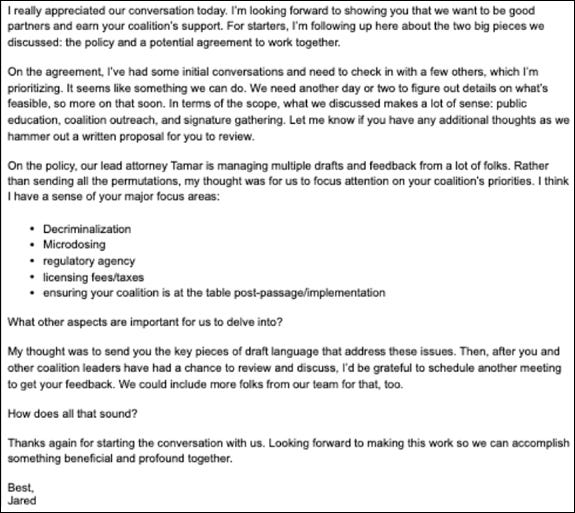
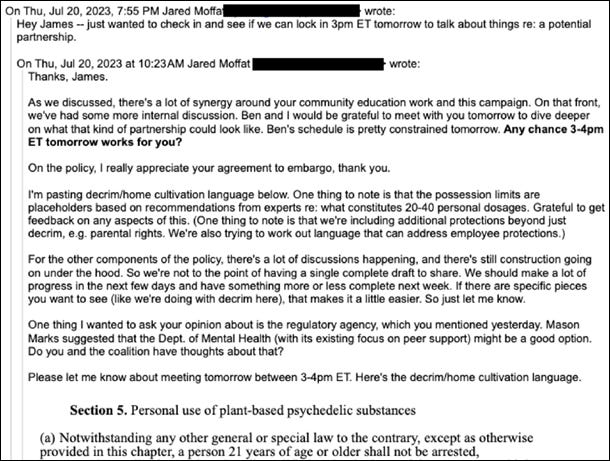
As confirmed by a July 2023 email exchange between Davis and Moffat, the campaign provided Davis with specific draft language, invited him to broadly weigh in on the ballot question proposal, and encouraged him to partner with the campaign for “public education, coalition building, and signature gathering.”
At Moffat’s recommendation, the campaign donated $35,000 to Bay Staters for Natural Medicine on August 1, 2023—the official ballot question committee’s only donation to a nonprofit. The contribution comprised over 70% of Bay Staters for Natural Medicine’s $49,547 in revenues for the entirety of 2023, and the contribution would end up considerably greater than Bay Staters for Natural Medicine’s $20,655 in revenues for the entirety of 2024. Bay Staters for Natural Medicine endorsed the home cultivation version of the ballot question the next day after receiving the large donation. Legally, the ballot question committee could “pay and expend money or other things of value solely” to promote the ballot measure, so the contribution signaled campaign leadership thought Davis and his organization would be an asset. In fact, Davis was—and remained—intractably opposed to the campaign, despite the nominal endorsement.
The decision to donate to Bay Staters for Natural Medicine was not in accordance with the campaign’s most persuasive arguments according to the June 2023 feasibility survey:
“Hospice providers and end-of-life medical practitioners support this question to allow natural psychedelic medicine therapy for terminally ill people” (78% found convincing).
“Pioneering research from leading medical research institutions [...] finds that natural psychedelic medicines can be effective in treating depression and anxiety” (77% found convincing).
“Veterans are facing a PTSD crisis. [...] This question allows people with PTSD who have already tried therapy and pills without success a chance to recover and truly heal” (76% found convincing).
Davis was not a veteran, medical researcher, or licensed healthcare provider, and his nonprofit’s primary focus was education about, and access to, psychedelics for the public at large—not assisting veterans, producing research, or supporting individuals in hospice. Polling indicates that a donation to a nonprofit dedicated to end-of-life patients, scientific research, or veterans would have generated more enthusiasm from voters, and come with much less risk, than the contribution to Davis’s organization.
The ballot question committee’s elevation of Davis was politically perilous. His nonprofit provided access to underground psychedelic therapy, championed politically unpopular unregulated home cultivation and distribution of psychedelics, and publicly declared it “[stood] in opposition to the corporations trying to charge people thousands of dollars for [natural psychedelics],” a category that could arguably include all the legal psilocybin therapy businesses in Oregon, where—under the regulatory framework backed by New Approach—the typical cost of a treatment session was $1,000 or more.
Campaign finance law guaranteed the donation to Bay Staters for Natural Medicine would become public within six months, disclosing the ballot question committee’s de facto endorsement of the nonprofit’s activities relatively early in the election cycle. At best, the endorsement would undercut the campaign’s ostensible focus on “licensed, supervised psychedelic therapy.” At worst, it would directly, financially tie the ballot question committee to Davis and his organization in the event of a scandal—such as a tragic outcome of unregulated psychedelics use or an allegation of serious misconduct—potentially tanking the campaign.
Although Davis purported in the summer 2023 negotiations to be representing a coalition co-led by Botelho and Morey, this was not verified by the campaign prior to contributing to Bay Staters for Natural Medicine. Only eight months later did the campaign discover that Davis had, in fact, concealed the offer to weigh in on policy, and his involvement in the drafting process, from Botelho and Morey—moreover, Davis had not been authorized to negotiate unilaterally on their behalf.
Similarly, to my knowledge, the campaign did not communicate with Davis’s fellow nonprofit officers—the official clerk and treasurer—prior to making the $35,000 donation. The publicly listed clerk for the Massachusetts-based nonprofit was living in Taiwan, as he had been for over six years. The publicly listed treasurer—a Massachusetts resident—was, according to her own account the following year, on the verge of leaving the organization at the time. In 2024, she described Davis as “verbally abusive,” expressed fear he had “forged documents,” and claimed she “[had] no clue about any donations or earnings Baystaters [sic] has.” Had the campaign spoken to these officers, the ballot question committee might have been more wary of Bay Staters for Natural Medicine, which had not yet received 501(c)(3) tax exempt status or made public any detailed financial filings (the organization retroactively filed state-mandated financial disclosures for 2022-2023 in July 2025, which I confirmed over the phone with the state attorney general’s office).
Another reason for caution with regards to engaging with Bay Staters for Natural Medicine was its combination of legislative advocacy and providing services. Under Massachusetts’s strict lobbying laws, a nonprofit must register with the state secretary and make certain disclosures if it spends more than $250 per year “to promote, oppose, or influence legislation” and “pay[s] a salary or fee to any member for any activities performed for the benefit of the group or organization.” In describing its network of psychedelic guides, Davis’s nonprofit claimed it needed “financial support with donations to sustain its progress, hold events and do marketing that lift all ships, and ensure that giant corporations do not destroy this network with corrupt state legislation” and recommended guides “give 30% of any [compensation] they receive [for facilitation] as a donation.” While Davis later claimed in March 2024 that his “facilitator network” had not spent “any” of the “about $100,000” it had raised since its June 2022 launch, the launch included Bay Staters for Natural Medicine claiming to be “hiring skilled and compassionate people as psychedelic facilitators.” That Davis’s nonprofit was not registered with the state secretary was publicly available information, and, while Bay Staters for Natural Medicine may have complied with lobbying laws, its public statements and unregulated lobbying risked attracting embarrassing legal scrutiny.
Furthermore, if the campaign had asked one of Massachusetts’s most prominent drug policy advocates, Shaleen Title, about Davis, she would have shared that Davis had a history of alleged unethical behavior. In 2024, Title publicly claimed that “People in MA, women and POC especially, have been privately warning each other for years about James Davis/Bay Staters.”
As Title might have predicted, Davis soon turned on his would-be ballot question committee collaborators. Reflecting on the about-face in a media interview, Moffat disclosed: “It was almost like... once that money was donated, then [Davis’s] attitude totally changed.” Moffat went on to observe Davis appeared to have kept the donation from the campaign largely secret, which was, indeed, the case. As previously referenced, Davis also hid his involvement with drafting the ballot measure from supporters, falsely claiming the ballot question committee “did not consult with any organization in [the grassroots advocacy] coalition.” Yet in publicly commenting on Davis’s betrayal, Moffat did not acknowledge his personal responsibility for the failed partnership or address whether better vetting could have prevented the situation.
In fact, more than a year later, Moffat continued to privately defend having recommended the $35,000 contribution to Bay Staters for Natural Medicine. Responding to criticism from journalist Jack Gorsline in a March 2025 text message exchange—which Moffat unilaterally added Jamie Morey and I to, without notice, because Moffat “wanted [us] to be aware of what [he] consider[ed] to be destructive behavior on [Gorsline’s] part”—Moffat disingenuously asked Gorsline: “Is the implication that I was a fool for recommending the campaign make a donation to the only grassroots organization operating around psychedelics in MA at the time?” Not only was the assertion that Bay Staters for Natural Medicine was “the only grassroots organization operating around psychedelics in MA at the time” not true—there were multiple such organizations active in 2023, including the Boston Entheogen Network (BEN) and Morey’s Parents for Plant Medicine—but the claim was not, by itself, a compelling argument for disregarding the red flags and polling signals previously detailed.
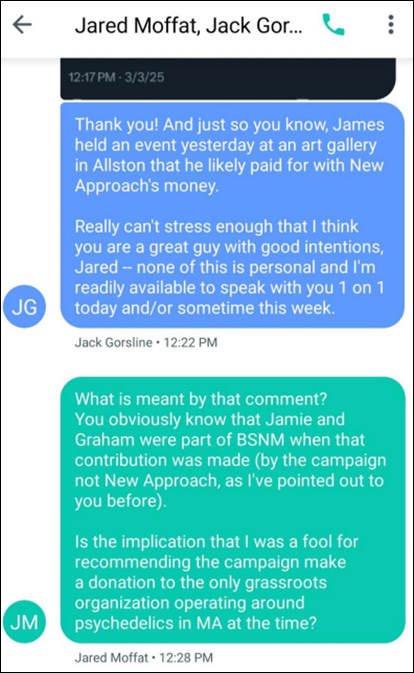
In the same group chat, Moffat also invoked Morey’s and my involvement with Bay Staters for Natural Medicine as volunteers in 2023 as validation of his decision. This brushed over the fact that Morey and I—in addition to having only known Davis for less than a year and having been similarly unaware as Moffat about Davis’s true inclinations at the time—had not been involved with soliciting the donation and, unlike Moffat, had not been professionally responsible for assessing Bay Staters for Natural Medicine as a partner. Alluding to this discrepancy, Gorsline swiftly retorted:
James’ misconduct was the worst kept secret in psychedelic advocacy for the last half decade. I have new people contact me every week with a new story about his insanity – most recently an absolutely unhinged voicemail recording that James left a former board member in 2020! How New Approach and Dewey Square weren’t able to or flat out chose not to fully vet James as an individual prior to handing him the cash equivalent of a mid size [sic] SUV is frankly unconscionable given the resources you guys had to work with.
Moffat provided no further reply to Gorsline in the conversation.
A Misinformation Blitz
A little over a month after his nonprofit received $35,000 from the campaign in August 2023, and just a few days after being privately invited by New Approach to a coalition meeting, James Davis lambasted the ballot question in a public presentation to “more than 60 lawmakers and staff,” and Bay Staters for Natural Medicine published an op-ed attacking the ballot measure the next day. Davis’s criticism focused on “the regulatory structure of the program” and what he deemed to be inadequate decriminalization provisions, which he portrayed as consequences of his purported exclusion from the drafting process.
In reality, as referenced earlier, Davis himself was significantly responsible for the ballot measure as written, particularly the parts he ostensibly took most issue with. In his July 2023 correspondence with the campaign, he had been specifically encouraged to provide “feedback on any aspects” of the “decrim/home [sic] cultivation language,” and he was asked explicitly if “[he] and the [grassroots] coalition have thoughts about” what regulatory agency would be most appropriate.
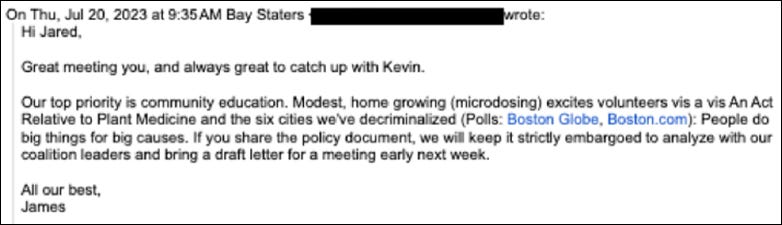
Rather than replying with substantive policy feedback, Davis had answered “our top priority is community education. Modest, home growing (microdosing) excites volunteers vis a vis An Act Relative to Plant Medicine and the six cities we’ve decriminalized.”
As previously mentioned, Question 4’s decriminalization provisions were more far reaching than those in An Act Relative to Plant Medicine, and Bay Staters for Natural Medicine had endorsed the final version of the ballot question on August 2, 2023.
But rather than promptly correct the record in response to Davis’s about-face, the campaign let Davis define the public narrative practically unopposed. Illustrating the point, a campaign spokesperson “would not comment on [a] Bay Staters’ press release or the group’s allegations” as late as January 2024. As a consequence, Davis hammered the ballot question in major media outlets like The Boston Globe and WBUR month after month after month as, essentially, a poorly-written, out-of-touch cash grab pitting locals against an out-of-state political action committee (PAC). Simultaneously, he organized on-the-ground opposition to the campaign, using his nonprofit volunteers to disrupt signature gathering, to canvass against the ballot measure, and to encourage lawmakers and state organizations, including the Massachusetts Psychiatric Society (MPS), the Massachusetts Medical Society (MMS), the Massachusetts Fraternal Order of Police (MAFOP or MASSFOP), the Massachusetts Municipal Association (MMA), and multiple other organizations, to oppose the ballot question.
Bay Staters for Natural Medicine’s talking points were subsequently incorporated into oppositional statements from:
The Massachusetts Psychiatric Society: “Decriminalization can occur through legislation”; “Venture capital millionaires have spent over $5 million to get this question on the ballot and to advertise it… If there was no money to be made, there wouldn’t be a vote.”
The Massachusetts Medical Society: “We support the decriminalization of psychedelic substances”; “Contrary to claims that [the legislation proposed by the ballot question] will increase access to mental health care, these services will be expensive.”
The Massachusetts College of Emergency Physicians (MACEP): “MACEP would support decriminalization over legalization.”
The Massachusetts Municipal Association: “We feel it would be unwise to create yet another unelected commission similarly prone to regulatory capture. The Commission and its Advisory Board will be highly susceptible to commercial psychedelic interests”; “We believe the public would be better served through decriminalization, study, and education.”
The Coalition for Safe Communities (the dedicated opposition committee): “This was written to enable for-profit facilities to open up. And in places like Oregon, they’re charging between $750 and $3,500 per trip to the offices”; “The yes side of this ballot question is touting veterans and other people that have various sicknesses. I’d like to know how many people in the state of Massachusetts are going through the painful issues that they talk about can afford $750 to $3,500 per visit. They are providing false hope to the people that need it the most.”
And, by early February 2024, Davis had utilized his narrative to convince the municipal governments of tourist-haven Provincetown (on December 11, 2023) and Boston-adjacent, Tufts University-home Medford (on February 6, 2024) to pass resolutions criticizing Question 4 as “a ballot question written by a DC-based PAC.”
Public reporting later appeared to corroborate that Davis’s activity was coordinated, at least in part, with other parties opposed to the initiative. It was revealed that, on April 4, 2024, Davis had emailed the Massachusetts assistant attorney general to propose modified ballot language in coordination with, he claimed, “several organizations” intending to form “an opposition committee,” including the ardently drug prohibitionist Foundation for Drug Policy Solutions. On May 2, 2024, the day after the Coalition for Safe Communities—the dedicated opposition committee—officially launched, The Boston Herald reported that the opposition committee “[had] been in conversations with another group Bay Staters for Natural Medicine, which opposes the creation of an ‘unelected control commission prone to regulatory capture by interests outside our communities.’”
A Rising (and Fabricated) Hero
After declining an interview request from The Boston Globe, New Approach provided the campaign’s first public response to James Davis’s misinformation in an exclusive interview with Talking Joints Memo journalist Jack Gorsline for an article published on February 8, 2024, two days after the Medford resolution criticizing the ballot question was passed. This interview, given months before Jamie Morey and I were hired by the ballot question committee, was the start of a series of exclusives the campaign’s strategic leadership provided Gorsline.
While Jared Moffat, identified as “New Approach campaign spokesperson,” told Gorsline that Davis was “making false claims” about the content of the ballot question and “suggested [Davis] may have acted in bad faith” to solicit money, he did not debunk Davis’s central falsehood that Davis had been wrongfully excluded from the drafting process.
Davis’s public profile appeared to be elevated substantially by his feigned victimization. Prior to October 2023, he had never been featured in The Boston Globe. Prior to January 2024, he had never been covered in Boston Magazine. Prior to October 2024, he had never been referenced in USA Today. And these are just a few illustrative examples.
There were other compelling grassroots advocates besides Davis, such as local police officer Sarko Gergerian—who would be featured on The Joe Rogan Experience in 2025—but what set Davis apart was his unmatched ferocity against the ballot question. Davis had fabricated a story that made him the central protagonist and was appealing to journalists: a principled, scrappy local activist leading the charge against the corrupt, out-of-state PAC that spurned the grassroots. Had the campaign exposed him early, he likely would have quickly become politically irrelevant, as he is now (to my knowledge, Davis has not been quoted by any Massachusetts or national news outlet since 2024, even with ongoing coverage of psychedelics legislation in Massachusetts). And if the campaign had stopped Davis’s bad faith crusade from being a media focus, more conventionally appealing movement representatives, like police officers, doctors, veterans and mothers, could have been elevated as faces of the psychedelics grassroots instead.
Making the situation worse, the campaign was late and inconsistent in utilizing a sympathetic official spokesperson. Over and over again, the only individuals offering comment on behalf of the ballot question committee were clearly hired guns: New Approach employees and Dewey Square Group principal Jennifer Manley. This set up an unflattering contrast with Davis’s opposition, which repeatedly wove in the voices of local veterans and other compelling figures. Local veteran Emily Oneschuk started functioning as an official campaign spokesperson in December 2023 but did not offer comment consistently. For example, less than two weeks before election day, on October 21, 2024, Manley was the only campaign official quoted in a WBUR rundown, which characterized the ballot question committee as “funded by the Washington, D.C.-based New Approach PAC,” echoing Davis’s opposition talking points (the only direct financial support from New Approach PAC was a $60,000 loan).